You brought the EV home, plugged it into a regular outlet, and the excitement wore off fast. The car is new. The charger cord is in the garage. But the battery is climbing so slowly that your daily routine now depends on planning around charging time.
That's the moment most West Palm Beach drivers realize public charging and home charging solve two different problems. Public stations help when you're out, but day-to-day convenience comes from a dedicated charger at your own property. West Palm Beach already has a strong charging footprint, and that's good news for EV owners. It also means expectations have changed. People want charging that's reliable, fast enough for real life, and installed correctly the first time.
Table of Contents
- Your EV Is Here So Now What
- Level 2 vs DC Fast Charging For Your Property
- Assessing Your Home's Electrical Capacity
- Navigating Palm Beach County Permits and Timelines
- Choosing Your West Palm Beach EV Charger Electrician
- FAQs About Fast EV Charger Installation
- Can I install an EV charger myself in Florida
- Do I need a permit in West Palm Beach
- What if I live in a condo or townhouse
- Will my HOA approve it
- How long will I be without power during installation
- What's the biggest cost surprise for homeowners
- Should I buy the charger before calling an electrician
- What about charging at the right time of day
- Is a hardwired charger better than a plug-in unit
- What should happen before I get a final handoff
Your EV Is Here So Now What
Most new EV owners start the same way. They use the charging cord that came with the car, plug into a standard garage outlet, and assume that will be fine for a while. Technically, it works. Practically, it often doesn't.
If you drive short distances and have plenty of downtime, a standard outlet may hold you over. But for most homeowners in Palm Beach County, that setup becomes frustrating quickly. A missed charge, a longer commute, or a weekend of errands is all it takes to make slow charging feel like a problem instead of a convenience.
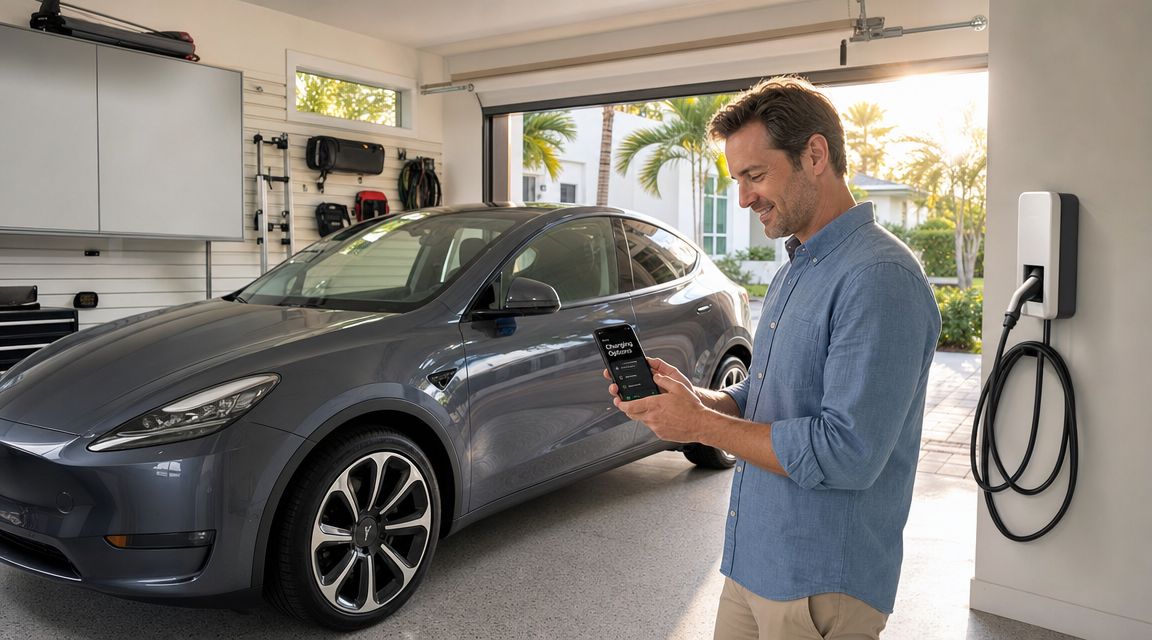
West Palm Beach is already EV-friendly. ChargeHub's West Palm Beach charging map lists 451 total charging stations, including 325 Level 2 stations and 126 DC fast charging stations. That's a solid public network for topping up around town. But home charging is still what changes the ownership experience, because it lets you wake up with a full battery instead of hunting for time to charge.
Why home charging changes everything
The primary win isn't only speed. It's control.
You charge on your schedule. You park where you want. You don't have to plan errands around a station stop or wait behind another driver. For many households, that's the point where the EV starts feeling easier than a gas vehicle.
A charger that fits your daily routine is usually more valuable than the fastest charger you can buy.
There's also the operating-cost side. Rates vary by utility and charging habits, so it helps to understand how home charging math works in plain language. If you want a simple cost breakdown example, this guide on cost to charge electric cars Australia is useful for understanding the basic inputs, even though local utility pricing is different.
What works in real homes
For most homes in West Palm Beach, the practical answer is a professionally installed Level 2 charger. That gives you a major upgrade over a standard outlet without stepping into commercial-grade infrastructure.
What doesn't work is guessing.
- Assuming any panel can handle it: Some can. Some can't. The panel has to be evaluated before hardware is chosen.
- Buying the charger first: People often purchase a unit online, then discover the panel, breaker space, or wiring route makes that model a poor fit.
- Treating the install like an appliance hookup: It's an electrical project, not a plug-and-play gadget purchase.
Fast EV charger installation in West Palm Beach FL starts with matching the charger to the property, not the other way around.
Level 2 vs DC Fast Charging For Your Property
When people say they want a fast EV charger, they usually mean one of two very different things. At home, they almost always mean Level 2. In highway or commercial settings, they may be thinking of DC fast charging.
Those are not interchangeable systems. They differ in power requirements, project scope, and where they make sense.
The practical difference
A Level 2 charger is the standard answer for residential charging and many small commercial properties. It uses a 240V circuit and fits the pattern most owners need, charging while the car is parked for hours.
DC fast charging is a different class of installation. It's designed for rapid turnaround in public and corridor settings, not for a typical garage wall.
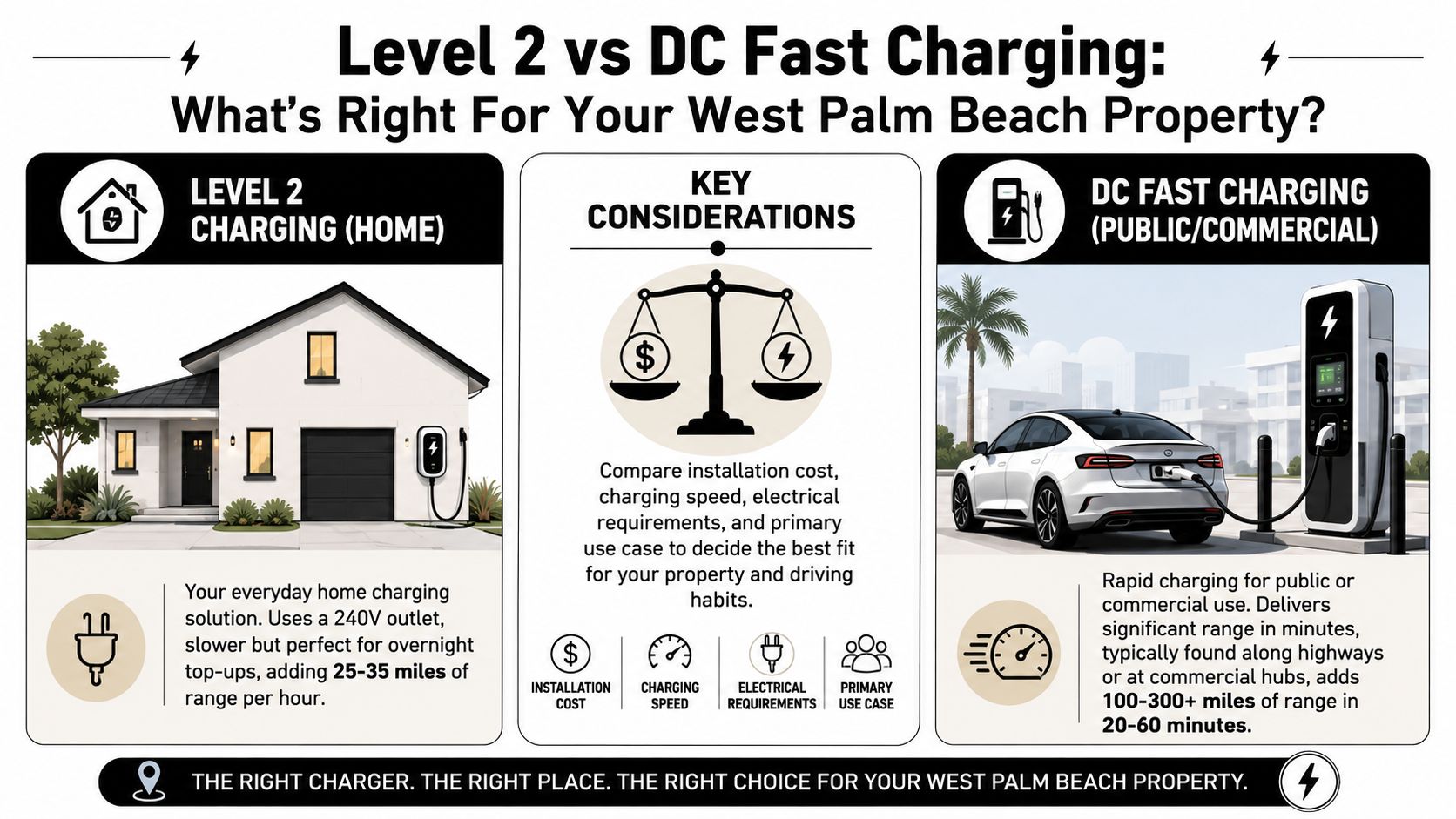
A good local reminder of that difference is Florida's Turnpike rollout. Florida's Turnpike noted the 2020 installation of Level 3 charging stations at the West Palm Beach Service Plaza, part of a broader highway-corridor expansion. That's where DC fast charging belongs. Along major travel routes, where drivers need quicker charging between destinations.
Side-by-side comparison
| Charger type | Best fit | Electrical reality | Typical property use |
|---|---|---|---|
| Level 2 | Homes, condos with dedicated infrastructure, offices, small fleets | Usually workable with existing residential service if capacity is available | Overnight charging, employee parking, routine daily use |
| DC fast charging | Highway sites, retail turnover sites, fleet yards, major commercial properties | Much heavier infrastructure demand and utility coordination | Rapid charging for short stays and higher vehicle turnover |
What homeowners usually get wrong
The most common mistake is aiming too high on charger type and too low on infrastructure planning.
Homeowners hear “fast charger” and picture the units they see near highways. But those systems are tied to a site design that usually includes much heavier electrical service, more complex equipment, and a very different budget profile. For a house in West Palm Beach, that's almost never the right path.
Practical rule: For a single-family home, the right question usually isn't “Can I install DC fast charging?” It's “What Level 2 setup fits my panel, driving habits, and parking layout?”
Connector choices matter too
Before installation, the property should also confirm the connector standard. Local installer guidance for EVSE work points to selecting the connector type as part of the core workflow, commonly J1772 or NACS, before the job moves into final hardware and layout decisions. That matters because the right connector decision affects cable handling, user convenience, and long-term compatibility.
For businesses, the answer can be different than it is for homeowners. A property manager may need to think about mixed-driver access, parking turnover, and whether future tenants will expect a different plug standard. A homeowner usually needs one thing. Dependable overnight charging with equipment that matches the vehicle and the electrical system.
Assessing Your Home's Electrical Capacity
The charger gets most of the attention. The panel decides whether the project goes smoothly.
A fast EV charger installation in West Palm Beach FL starts with one question. Can the existing electrical service support the new load safely and legally? If the answer is yes, the job is straightforward. If the answer is no, the charger may still be possible, but the path changes.
What to look for before anyone installs anything
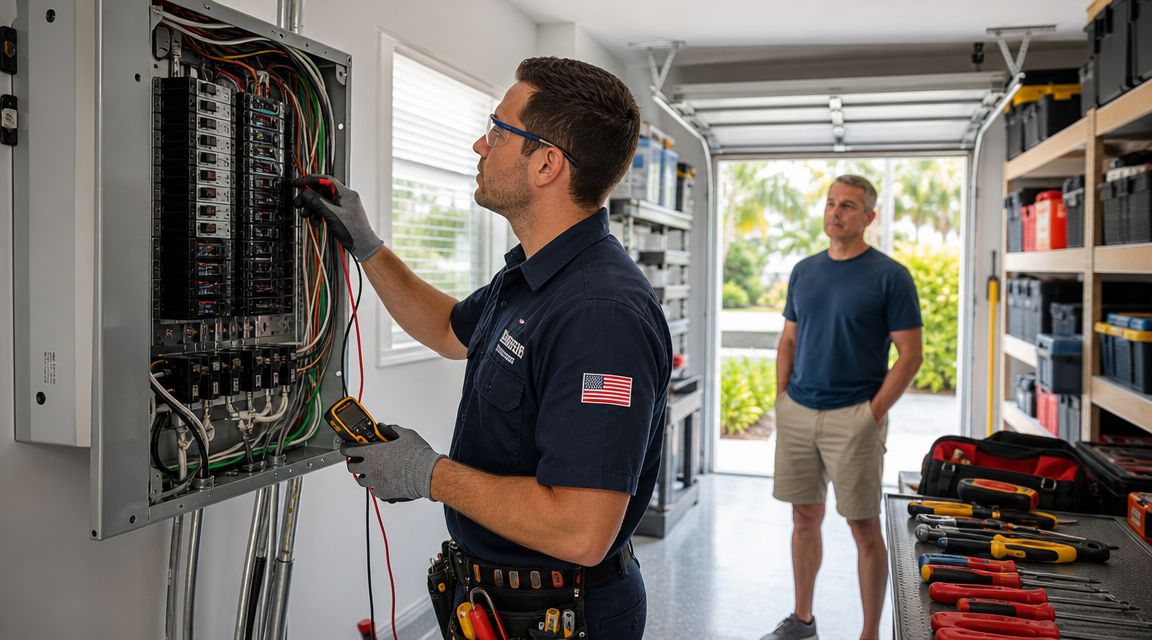
You can do a basic visual check yourself before scheduling the work.
- Main breaker rating: Open the panel door and look for the main breaker size. That gives a rough starting point for understanding service capacity.
- Breaker space: A charger needs room for a dedicated circuit. If the panel is packed, that's an immediate flag.
- Panel condition: Corrosion, heat marks, double-tapped breakers, or unlabeled circuits usually mean the panel needs closer review.
- Distance from panel to parking area: The farther the wiring run, the more planning the install needs.
That quick look is useful, but it isn't a load calculation. It only tells you whether the site looks easy or likely complicated.
What a load calculation actually does
A proper assessment looks at how much electrical demand the home already carries and how much spare capacity is left. Local installer guidance for EVSE work describes the workflow clearly. The process starts with a load and service-capacity assessment, then moves into compliance review, hardware selection, physical installation, and testing. For higher-power installs, the same guidance stresses confirming available spare capacity first so the charger sizing is based on what the site can support. You can review that workflow in this EVSE installation overview.
In plain terms, the electrician is asking:
- What loads are already on this service?
- What runs at the same time?
- Is there enough room for the charger without overloading the system?
If the answer is no, the right fix may be a service or panel upgrade instead of trying to squeeze one more circuit into an already stressed system.
Common West Palm Beach housing issues
Older housing stock often creates the same few problems.
Some homes have limited breaker space. Some have service equipment that was fine for lighting, appliances, and air conditioning when the house was built, but not for adding EV charging. Detached garages can also complicate the wiring route, especially when trenching or long feeder runs enter the picture.
A lot of homeowners already suspect this. If your lights dim under load, your panel is crowded, or you've delayed other electrical upgrades, the charger project tends to expose those issues.
If the panel is already near its limit, installing the charger first and asking questions later usually costs more in the end.
For homes that are close to the edge, a service upgrade may be the cleanest answer. If that's where your property is headed, this page on upgrading from 150 amp to 200 amp service gives a useful picture of what that kind of improvement involves.
Navigating Palm Beach County Permits and Timelines
Many EV charger projects often slow down. Not at the wall mount. Not at the breaker. At paperwork, approvals, and scheduling.
The physical install is often the shortest part of the job. Gator Electric's EV charger installation guidance notes that the charger installation itself often takes about 2 to 4 hours, while the full project can run several weeks to a few months when permitting, utility approval, and inspections are involved. The same guidance says panel upgrades can add about $1,800 to $2,500, with wiring runs and trenching increasing scope further.
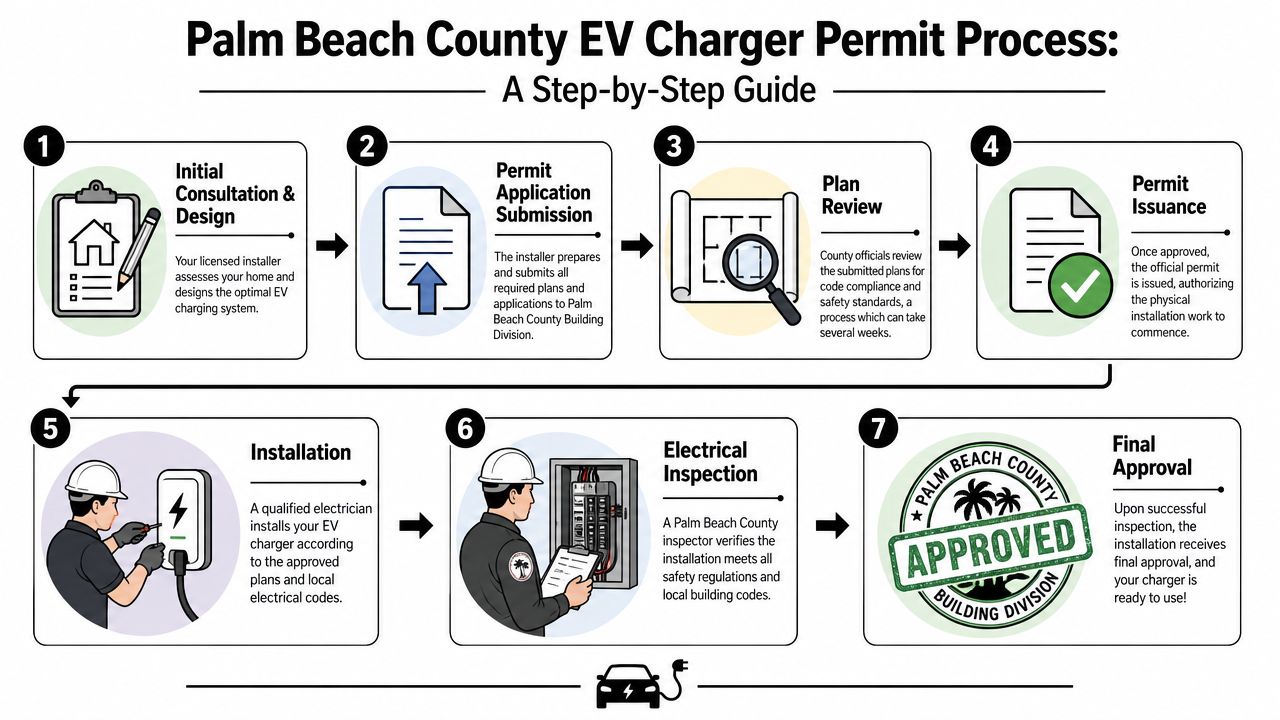
What the local process usually looks like
For a permitted installation in Palm Beach County, the sequence usually follows a familiar pattern:
Site visit and electrical review
The electrician checks the panel, service size, charger location, and wiring path.Permit preparation
Project details are assembled for submission. If the job includes service changes, the documentation gets more involved.Plan review and approval
Here, time can stretch. The project may sit in queue before work is authorized.Installation day
Once approval is in place, the on-site work itself is usually efficient.Inspection and final signoff
The charger shouldn't be considered fully done until it passes inspection and is ready for use as intended.
What causes delays
The charger unit itself usually isn't the problem. Delays tend to come from upstream electrical realities.
- Panel limitations: If the existing panel can't support the load, the project changes from a simple branch circuit install into a larger electrical job.
- Long wiring routes: Finished walls, detached structures, and difficult access add labor and planning.
- Inspection scheduling: Even after the install is complete, final approval depends on inspector availability.
- Utility involvement: If service capacity or metering has to change, outside coordination can extend the schedule.
What clients should ask early
A short conversation at the beginning saves a lot of frustration later.
Ask whether the site appears permit-ready. Ask whether the panel has room and capacity. Ask whether trenching, drywall access, or service upgrades are likely. Those answers usually tell you whether you're looking at a smooth install or a broader electrical improvement.
The cheapest-looking quote often assumes the existing electrical system is perfect. Real projects should account for what the panel and service can actually support.
If you want a contractor already accustomed to code-driven work, permitting, and inspection coordination, it helps to start with government-approved electrical contractors rather than treating the charger as a casual add-on.
Choosing Your West Palm Beach EV Charger Electrician
By the time a client gets serious about an EV charger, the main risk usually isn't the equipment. It's hiring someone who treats the job like a simple outlet install.
A proper EV charger project follows a methodical workflow. As noted earlier in local installer guidance, that means load assessment, compliance check, hardware selection, physical installation, and operational testing. Skipping steps might save time on day one, but it creates problems later. Wrong breaker sizing, poor cable routing, nuisance trips, failed inspections, and chargers that don't perform the way the owner expected.
What to look for in an electrician
A qualified EV charger electrician in West Palm Beach should be able to handle more than the final connection.
- Licensing and insurance: This is basic, but it matters. You need someone who can legally pull permits and stand behind the work.
- EV-specific experience: A charger install has its own design questions. Connector type, charging behavior, mounting height, wire path, and service load all matter.
- Local code familiarity: Palm Beach County compliance issues are easier to manage when the contractor deals with them regularly.
- Troubleshooting ability: If the panel, service, or feeder creates a problem, the installer needs to solve it, not just point at it.
Availability matters more than people think
Electrical questions don't always come up at a convenient time. A panel issue can show up after business hours. A charging circuit may trip the first time the vehicle pulls full load. A property manager may need an answer before tenants start using new equipment.
That's one reason response structure matters. Some companies route calls through an answering service and call back later. Others have licensed electrical professionals involved earlier in the process. If you want context on why communication setup matters for service trades, Rosie's solutions for contractors gives a helpful operational perspective.
One practical local option
For property owners who want one contractor to handle residential and commercial electrical work in the area, Lighthouse Energy Services in West Palm Beach offers electric car charger installation along with broader repair, upgrade, and troubleshooting work. That matters because EV charging projects sometimes uncover larger service issues that need to be fixed at the same time.
The strongest electricians for this kind of work tend to approach the job the same way every time. They verify capacity before promising speed. They account for permitting. They test the charger under operation before handing it off. And they can still respond if something unexpected shows up after installation.
A charger installer should be able to explain the electrical system behind the charger, not just the charger on the wall.
FAQs About Fast EV Charger Installation
Can I install an EV charger myself in Florida
For a hardwired fast charger, DIY is a bad bet. The work usually involves a dedicated circuit, breaker sizing, conductor sizing, equipment mounting, and code compliance. If permitting applies, the installation also has to pass inspection. Even if someone is comfortable replacing fixtures or outlets, EV charging is a different category of load and shouldn't be treated casually.
A plug-in charger can also create problems if the receptacle, breaker, wire size, or circuit condition isn't correct. Safe charging depends on the upstream electrical work being right.
Do I need a permit in West Palm Beach
In many cases, yes. The exact requirements depend on the type of charger and the scope of electrical work, but homeowners should assume that a permitted installation is the correct route for a dedicated EV charger. If the job touches the panel, adds a new circuit, or changes service equipment, permit and inspection questions become even more important.
The cleaner approach is to have the electrician confirm the permitting path before work starts, not after the charger has already been purchased and mounted.
What if I live in a condo or townhouse
That's still possible, but the process is less about the charger and more about control of the electrical infrastructure. In attached housing, there may be HOA rules, shared walls, assigned parking complications, or common-area electrical systems that limit what can be done. Some properties allow owner-paid installation with approval. Others require board review, common-element coordination, or a house meter strategy.
The key is to verify who owns the parking area and who controls the electrical service feeding it. Until those two points are clear, charger selection is premature.
Will my HOA approve it
Maybe, but approval usually depends on documentation. HOAs tend to want a defined installation plan, a licensed contractor, proof of code-compliant work, and clarity on responsibility for maintenance or removal. They also want reassurance that the charger won't create safety problems or visible damage to common property.
If you're in an HOA community, bring them a complete proposal instead of a rough idea. Projects move faster when the board can review a real electrical scope rather than a general request.
How long will I be without power during installation
For a straightforward charger circuit added to an adequate panel, power interruption is often limited and managed during the connection work. If the project includes panel replacement or service changes, outages can be longer and may require utility coordination.
This is worth discussing up front if you work from home, have medical equipment, or need refrigeration and climate control uninterrupted.
What's the biggest cost surprise for homeowners
Usually not the charger itself. It's the electrical work behind it.
If the panel is full, the service is undersized, or the charger location requires a difficult wire run, the project changes. That's why serious estimates start with the panel and path, not with a generic charger price.
Should I buy the charger before calling an electrician
Usually no. Pick the installation approach first, then choose hardware that matches the site. A charger that looks perfect online may not be the best fit for your panel capacity, mounting location, connector preference, or required circuit size.
Waiting until after the site assessment avoids returns, redesigns, and awkward compromises.
What about charging at the right time of day
That's one of the easiest ways to make ownership smoother. Many EV owners choose to charge overnight because the vehicle is already parked and the routine is predictable. Depending on your utility plan, off-peak charging may also be more favorable than charging during high-demand hours. Check your utility's current rate structure and program options before setting your charging schedule.
Is a hardwired charger better than a plug-in unit
Sometimes yes, especially where reliability, dedicated use, and a cleaner installation are priorities. Hardwired units can reduce one more point of failure and often make more sense for permanent installations. Plug-in units can work well too, but only when the receptacle and branch circuit are installed correctly for the intended load.
The answer depends on the property and how the charger will be used.
What should happen before I get a final handoff
You should expect more than a mounted charger and a green light.
A proper handoff should include verification that the circuit is installed as designed, the charger powers up correctly, charging is tested with the vehicle or appropriate procedure, and the user understands normal operation. If the charger has app-based settings, scheduling, or current-limit options, those should be reviewed as part of turnover.
If you're planning fast EV charger installation in West Palm Beach FL and want the electrical side handled correctly from the start, Lighthouse Energy Services is available for residential, commercial, and emergency electrical work across Palm Beach County. A proper site review now can save you from permit delays, panel surprises, and charger problems later.