
You bring the EV home, plug it into a standard garage outlet, and then realize the simple part was buying the car. The harder part is getting charging to fit your real life in West Palm Beach. If you commute, run errands across Palm Beach County, or share parking with other residents, slow charging gets old fast.
That's where a proper plan matters. EV outlet installation in West Palm Beach FL isn't just about adding a receptacle to the wall. It starts with choosing the right charging level, checking whether your panel can support it, pulling permits, and making sure the installation will pass inspection and hold up for daily use. For condo boards, property managers, and HOAs, the job gets more complicated because metering, shared parking, and electrical capacity affect everyone, not just one driver.
Table of Contents
- The First Step From the Dealership to Your Driveway
- Level 1 vs Level 2 Charging The Right Choice for Your WPB Lifestyle
- The Professional Site Assessment and Load Calculation
- Budgeting Your Installation Costs Timelines and Florida Incentives
- Hiring a Licensed Electrician and Special Cases for HOAs
- Your Next Steps to Effortless Home Charging
The First Step From the Dealership to Your Driveway
Most new EV owners start in the same place. They use the outlet they already have, then find out that basic charging may work in theory but doesn't always work well in practice. If the car is driven daily, that slow refill can turn into a routine headache.
The first decision is simple. Do you need a basic 120V setup, or do you need a dedicated 240V charging circuit? That answer depends less on the car and more on how you live. A driver who parks all weekend and barely commutes may tolerate slower charging. A driver who needs the vehicle ready every morning usually wants a more permanent setup.
In West Palm Beach, that decision also ties into the kind of property you have. A single-family home with a garage is one thing. A townhouse with limited panel access is another. A condo with assigned parking and HOA approval requirements is a different job entirely. The charging equipment might look similar, but the electrical path to get there often isn't.
A proper installation usually follows a straightforward sequence:
- Start with the car and charger requirements: Check whether the vehicle can use Level 1 or Level 2 charging and whether the charger is plug-in or hardwired.
- Look at your parking situation: Garage, carport, driveway, and shared parking all create different routing and protection needs.
- Check the electrical system: Panel space, service capacity, and distance to the parking area often decide whether the project stays simple.
- Handle permitting and inspection: That keeps the work code-compliant and helps avoid problems later during resale, insurance questions, or future electrical upgrades.
A charger that looks easy to install can still become an expensive mistake if the panel, wiring path, or parking layout was never evaluated first.
That's why the process should feel organized from the beginning. Done right, you end up with charging that's predictable, safe, and matched to the way you use your EV.
Level 1 vs Level 2 Charging The Right Choice for Your WPB Lifestyle
You get home at 6:30, plug in, and expect the car to be ready by morning. Whether that works depends less on the charger label and more on how you use the vehicle, where you park, and what the electrical system can support.
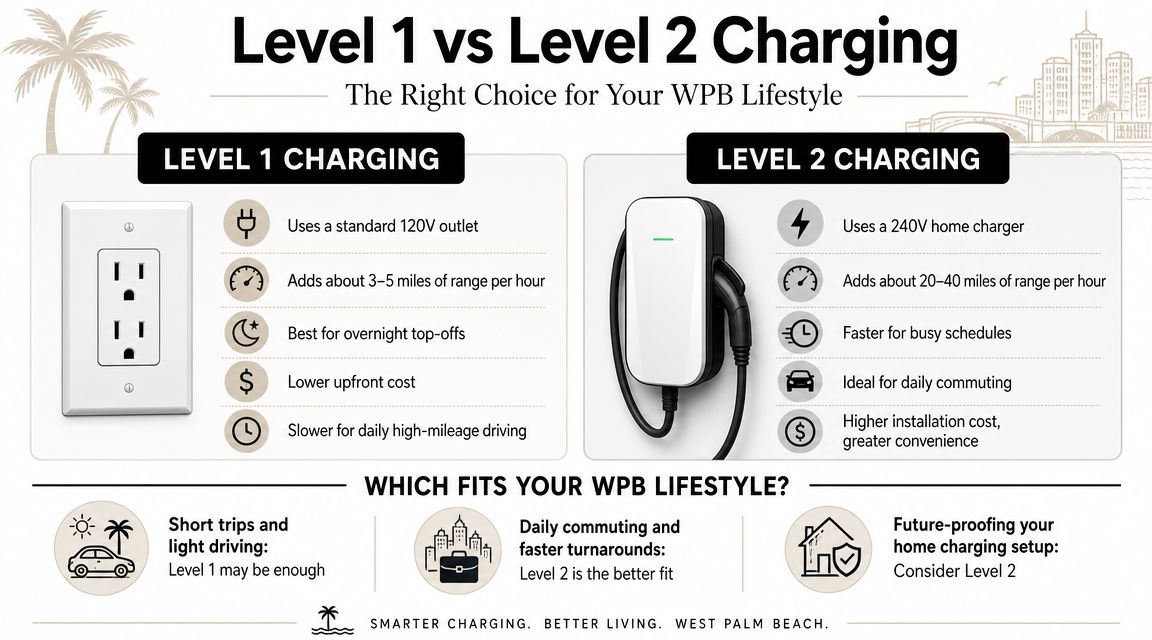
For many West Palm Beach households, Level 1 sounds fine at first because it uses a standard 120-volt outlet. Then real life takes over. A longer commute, two drivers sharing one EV, weekend errands that drain more range than expected, or a storm prep run can turn slow charging into a daily annoyance. Level 2 usually solves that by putting charging back on your schedule instead of the other way around.
What changes in daily use
A Level 1 charger runs on 120V. It can be a reasonable short-term fit for a driver with light mileage, long parking windows, and no urgency about replenishing range overnight. It also makes sense in a temporary setup, such as a new EV owner waiting on panel work or HOA approval.
A Level 2 charger runs on 240V and is the setup that fits everyday ownership better. It is usually the right call for regular commuting, larger vehicles with bigger batteries, and households that do not want to watch charging levels too closely. If the goal is to plug in at night and start each morning ready to go, this is usually the practical answer.
The trade-off is straightforward. Level 1 keeps upfront work lower if a suitable outlet is already in the right location. Level 2 costs more because it usually needs a dedicated circuit and sometimes service or panel improvements. In return, you get charging that matches normal routines instead of asking the household to plan around a slow charger.
Here is the plain-language version I give homeowners and property managers:
- Level 1 fits limited daily driving: Best for short trips, backup charging, or a temporary solution.
- Level 2 fits full-time EV use: Better for overnight recovery, consistent readiness, and fewer workarounds.
- Level 2 usually ages better with the property: If another EV gets added later, the smaller setup often feels undersized fast.
If you are already worried about charging speed before installation starts, Level 1 usually will not fix the problem.
Level 1 vs. Level 2 Home Charging at a Glance
| Feature | Level 1 Charger | Level 2 Charger |
|---|---|---|
| Voltage | 120V | 240V |
| Typical use case | Light daily driving, temporary setup, backup charging | Daily home charging, overnight readiness, long-term solution |
| Installation complexity | Lower if a suitable outlet already exists | Higher, usually requires a dedicated circuit |
| Electrical requirement | Standard 120V outlet | Dedicated 240V circuit |
| Cost outlook | Lower upfront for basic outlet-related work | Higher upfront, but usually better suited to regular EV use |
| Best fit | Single driver with low charging demand | Most EV households in West Palm Beach |
Public charging patterns in West Palm Beach point the same direction. Level 2 is the common everyday format because it balances speed, cost, and practical installation requirements better than slower home charging alone. The City of West Palm Beach has also added EV charging in municipal parking garages, which shows how charging is becoming part of ordinary parking infrastructure across the area.
That matters even more for condos, apartment buildings, townhome communities, and mixed-use properties. In those jobs, the charger is only part of the decision. Property managers and HOAs have to consider shared parking, meter access, house power versus tenant power, load sharing, and whether one resident installation sets a precedent for ten more requests next year. A Level 1 outlet may look easier on paper, but in shared parking it often creates enforcement and usability problems because it serves one owner slowly without offering a good long-term model for the property.
Level 2 gives multifamily properties a better framework to build on, especially if the board wants a repeatable policy instead of one-off exceptions. Some buildings can support that with existing capacity. Others need planning for future expansion or even a 150-amp to 200-amp electrical service upgrade before resident charging becomes reliable.
The right choice comes down to driving habits, parking layout, and how long you expect the setup to serve you. A charger should fit the way the property operates, not just the cheapest version of the project on day one.
The Professional Site Assessment and Load Calculation
A charger install can look simple from the parking space. The key decision happens at the panel.
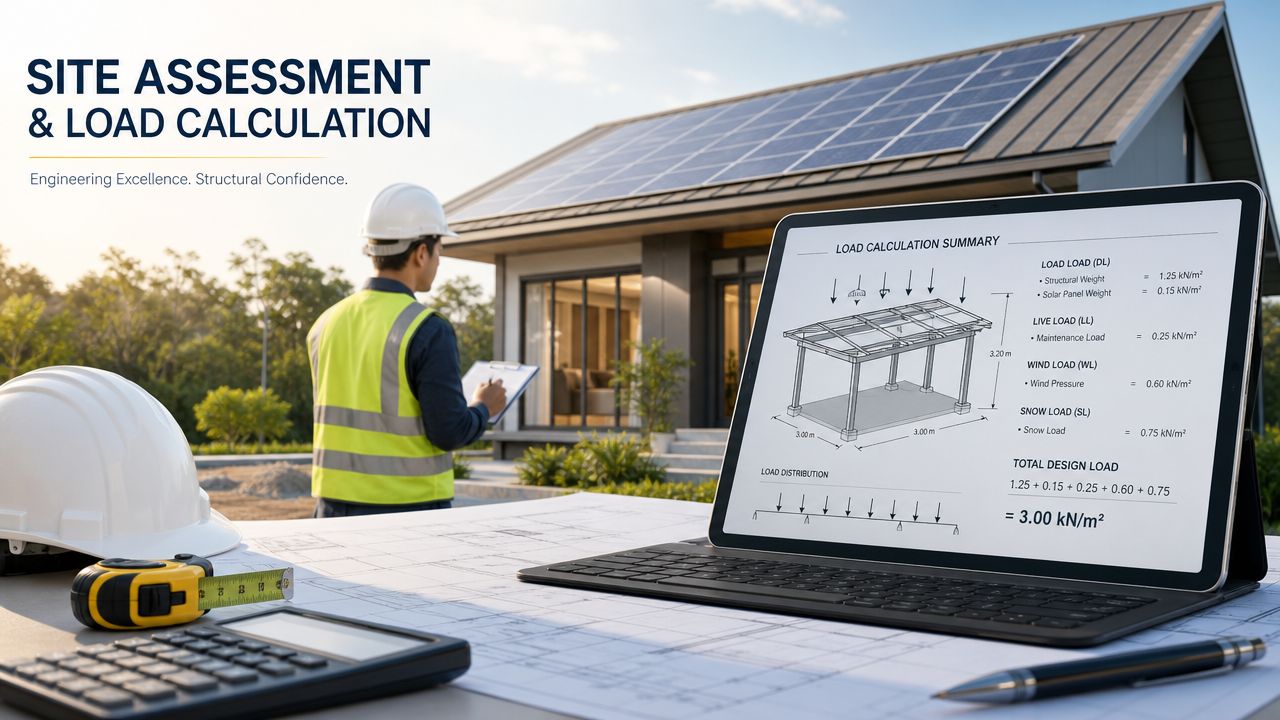
Before any permit gets filed in West Palm Beach, the electrical system needs a proper site assessment and load calculation. That tells you whether the job is a straightforward dedicated circuit, whether load management makes sense, or whether the property needs panel or service work first. Skipping that step is how people end up buying a charger that their electrical system cannot support without nuisance tripping, failed inspection, or costly rework.
For a typical Level 2 installation, I start at the service equipment. I check the panel rating, available breaker spaces, wire terminations, grounding and bonding, panel condition, and the actual connected loads already in the home or building. Air conditioning matters here in South Florida. So do electric water heaters, ranges, dryers, pool pumps, spas, and any subpanels feeding detached garages or common areas.
The load calculation is not paperwork for its own sake. It answers one practical question. Can this system carry a continuous EV charging load safely, day after day, in summer, with everything else running?
The site visit also covers the physical path of the installation. A charger on the same wall as the panel is one type of job. A charger across the house, out to a driveway pedestal, or over to assigned condo parking is another. Conduit routing, wall construction, attic access, distance, weather exposure, flood-prone areas, and where the disconnecting means will be located all affect the final design.
Three conditions usually change the scope fast:
- No usable panel space: The service may have enough capacity on paper but no practical room for the new breaker.
- A long or difficult circuit run: Distance, finished surfaces, and exterior routing add labor and material quickly.
- Older or marginal equipment: Corrosion, overheating, recalled panels, or undersized service often need to be addressed before adding EV charging.
If the calculation shows the house is close to its limit, forcing in one more large load is the wrong move. In some cases, load management can solve the problem. In others, the clean fix is a 150 amp to 200 amp service upgrade so the charger and the rest of the house can operate without strain.
Multifamily properties need a wider review. For HOAs, condos, and apartment-style buildings, the first charger request is rarely just one charger. The site assessment should identify whose meter will serve the load, whether the parking space is deeded or common, whether house power is being used, how future residents would be added, and whether the board wants individual circuits or a managed system that can expand. Those decisions affect conduit layout, panel sizing, equipment location, and the rules the property will have to live with later.
That is where many communities in West Palm Beach get into trouble. A board approves one installation for one owner, then finds out the path cannot be repeated for the next five requests, or that the common-area service was never set up to bill charging fairly. A proper assessment catches that early. It gives homeowners a safe installation plan and gives property managers a repeatable policy instead of a one-off exception.
Judge the job by the full electrical path, the panel capacity, and the property's long-term use of the parking area. The charger on the wall is only the visible part.
Budgeting Your Installation Costs Timelines and Florida Incentives
A West Palm Beach homeowner buys an EV on Saturday and wants charging ready by the next weekend. Sometimes that happens. Sometimes the actual schedule is driven by permits, panel conditions, parking layout, or HOA approval long before anyone mounts equipment on the wall.
Cost follows the same pattern. A straightforward installation near the main panel is one kind of project. A charger that needs a long conduit run, exterior work, a service change, or shared-property approvals is a different job with a different budget. The charger itself is only part of the total.
What the budget usually includes
A solid quote should break the work into parts so you can see what is driving the price:
- Charging equipment: Some owners supply the charger. Others want the electrician to provide a unit that matches the circuit and mounting location.
- Dedicated circuit materials: Wire size, breaker type, conduit, fittings, receptacle or hardwire hardware, and weather protection all matter.
- Labor: Garage installs are usually simpler than detached parking, exterior walls, carports, or runs that cross common areas.
- Permit and inspection: In Palm Beach County, these steps should be accounted for up front, not treated like an afterthought.
- Panel or service work: If the panel needs reworking or the service needs more capacity, that can change the budget quickly.
That last item is the one people miss most often.
A charger quote can look reasonable until the electrician opens the panel and finds there is no practical space for the new breaker, no margin for the added load, or no clean route for the wiring. If you are trying to figure out whether that belongs in your EV budget, this electrical panel upgrades guide explains what usually pushes a home from a simple charger install into broader electrical work.
Florida incentives can help, but treat them as a possible offset, not a reason to rush the job. Eligibility rules, tax treatment, and timing can change. Before counting on any credit or reimbursement, confirm the current program requirements with your tax professional and the official program source.
What affects the timeline
The installation day is only one piece of the calendar. The full schedule usually includes the site visit, written estimate, approval, permit processing, installation, and final inspection. If equipment has to be ordered, add lead time for that too.
For a single-family home with a clear path from panel to charger location, the work often moves along without much drama once the permit is in place. Jobs slow down when the panel needs correction, the wiring route is difficult, or the charger location is far from the electrical service.
Managed properties have more steps, and boards should plan for them early. A condo or HOA request often stalls over questions that have nothing to do with the charger brand. Who pays for common-area power. Who owns the conduit path. Whether the parking space is exclusive or shared. How the next resident will be handled. A one-off approval can create a messy standard for the whole community.
Property managers in West Palm Beach should budget for policy work as well as electrical work. Written rules on approvals, metering, equipment standards, access, and future expansion save a lot of conflict later. For board members reviewing those governance issues, VerticalRent's Florida HOA guide is a useful starting point.
The low quote is not always the low-cost option. If permits, inspection corrections, panel limitations, or HOA requirements are left out at the start, the project usually gets more expensive and takes longer once those problems surface.
Hiring a Licensed Electrician and Special Cases for HOAs
A resident buys an EV on Saturday, submits an HOA request on Monday, and expects charging by the weekend. In West Palm Beach, that timeline usually falls apart for one reason. The electrical work and the property rules have to line up at the same time.
For a single-family home, the hiring process is fairly direct. For a condo, townhome, or managed property, the electrician also has to account for common walls, shared electrical rooms, assigned parking, access rules, and who owns each part of the installation. That is where weak planning turns into delays, change orders, and neighbor disputes.
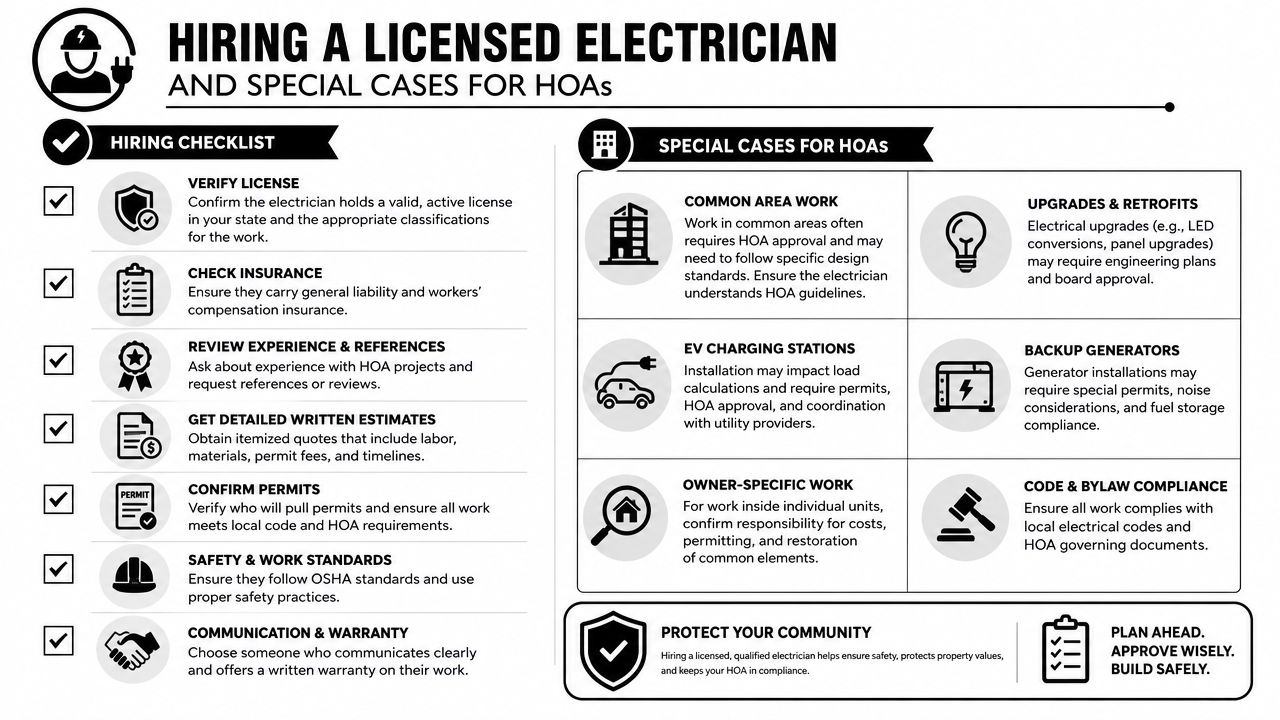
Start with the electrician. In Palm Beach County, the contractor should be properly licensed and insured, but that is only the baseline. EV charging work calls for someone who can read the whole job before quoting it. That means panel condition, load capacity, breaker space, wiring route, mounting location, disconnect requirements if applicable, permit handling, and final inspection.
What to check before you hire
Ask direct questions and listen for direct answers:
- What are you inspecting before you price the job? A real answer should include the service panel, available capacity, the charger location, and the path for conduit or cable.
- Are you quoting a receptacle installation or a hardwired charger circuit? That choice affects cost, equipment, and maintenance responsibility.
- Who is pulling the permit and meeting the inspector? If that is unclear before work starts, it usually stays unclear when problems show up.
- What is excluded from the base price? Panel repairs, drywall patching, trenching, bollards, access-control work, and long conduit runs should not be surprises.
- How will you document changes if hidden conditions show up? In older West Palm Beach properties, hidden conditions show up often.
Homeowners who want a broader screening process can use this guide on hiring a new home electrician before signing a contract. It helps separate a contractor who installs circuits from one who plans the work properly.
Lighthouse Energy Services is often part of these projects because EV charging work can overlap with panel corrections, troubleshooting, service upgrades, and coordination in shared buildings. That matters in older neighborhoods and multi-unit properties, where the charger itself is often the easy part.
Special cases for HOAs and managed properties
HOA projects stall for reasons that have nothing to do with the charger brand.
Key challenges include ownership, power source, access, and future expansion. If the charger is tied to common-area power, the board needs a written method for billing or reimbursement. If the resident parks in a limited common element space, the association needs to decide whether conduit, pedestals, and wall-mounted equipment stay with the unit, stay with the association, or get removed when the owner moves out.
I see another common problem in shared parking areas. A resident may have board approval but no practical path to install a dedicated circuit without crossing common space, cutting pavement, or entering an electrical room with restricted access. That should be addressed before approval, not after the electrician is already scheduled.
The first EV request also sets a precedent. If the board approves one charger without standards, the second and third requests get harder, not easier. Property managers should have a policy that covers:
- Application requirements: site plan, equipment cut sheet, load information, and contractor credentials
- Metering and billing: resident meter, common meter reimbursement, or networked usage tracking
- Installation standards: approved mounting methods, conduit routing, protection from vehicle impact, and restoration of common areas
- Responsibility for upgrades: whether the owner, the association, or both pay for panel work and distribution changes
- Removal and turnover: what happens to the equipment if the unit is sold or the resident leaves
Boards reviewing those administrative issues can use VerticalRent's Florida HOA guide as a starting point for the governance side.
The cleanest HOA installations happen when the board treats EV charging as an ongoing property policy, not a one-time exception. That approach gives residents a fair process, gives managers a repeatable standard, and keeps the electrician from designing around preventable rule conflicts.
Your Next Steps to Effortless Home Charging
A good EV charging setup should feel boring in the best possible way. You park, plug in, and move on with your evening. Getting to that point takes a few decisions up front, but none of them are difficult when the project is approached in the right order.
Start by matching the charging level to your actual routine. Then make sure the property can support it. After that, get a clear written scope that covers circuit design, permitting, installation, and inspection. If you're in a condo or managed community, address the HOA questions early instead of treating them like paperwork that can wait until the end.
The biggest mistakes are usually predictable:
- Choosing based only on upfront price: That often leads to undersized charging or surprise upgrade costs later.
- Skipping the panel review: The charger might be new, but the electrical system serving it may not be.
- Ignoring shared-property rules: In HOA settings, approval and metering questions can delay a project more than the installation itself.
- Treating EV charging like a basic outlet swap: A permanent charging setup deserves a real plan.
West Palm Beach already has an established charging environment, and that makes professional planning even more important. Homeowners want dependable overnight charging. Property managers want a policy they can apply more than once. Boards want a process that won't create resident disputes.
If you want a property-specific plan for EV outlet installation in West Palm Beach FL, the simplest next step is a professional assessment of the panel, parking layout, and installation path.
Lighthouse Energy Services handles residential and commercial electrical work in Palm Beach County, including the kind of panel evaluation, charger circuit planning, and code-compliant installation that EV charging projects require. If you want a clear next step, ask for a consultation and get the scope based on your actual property, not a generic estimate.