
You bought the EV. The dealer walked you through the app, the charging cable, and maybe the tax side. Then you pulled into your driveway in West Palm Beach and hit the first real homeowner question.
Where is this thing going to charge every day?
That's where a lot of people get bad advice. They're told home charging is simple, like hanging a garage gadget on the wall and plugging it in. Sometimes it is. In plenty of West Palm Beach homes, especially older houses and condos, it isn't. The charger is usually the easy part. The electrical system behind it is what decides whether the job is straightforward or turns into a panel upgrade, a permit issue, or an HOA conversation.
Your New EV Is Here What About the Charger
A common local scenario goes like this. You get home with the car, plug into the cord that came with it, and realize pretty quickly that “technically charges” and “works well for daily life” are not the same thing. If you drive regularly, depend on street-to-street reliability, or just don't want to think about battery percentage every night, home charging stops being an accessory and becomes part of the house.
That's especially true in a city that already has real EV infrastructure. In 2020, Florida Power & Light installed Level 3 charging stations at the West Palm Beach Service Plaza on Florida's Turnpike, part of a broader local push that showed EV charging here had moved beyond the trial stage, as noted by Florida's Turnpike charging rollout in West Palm Beach.
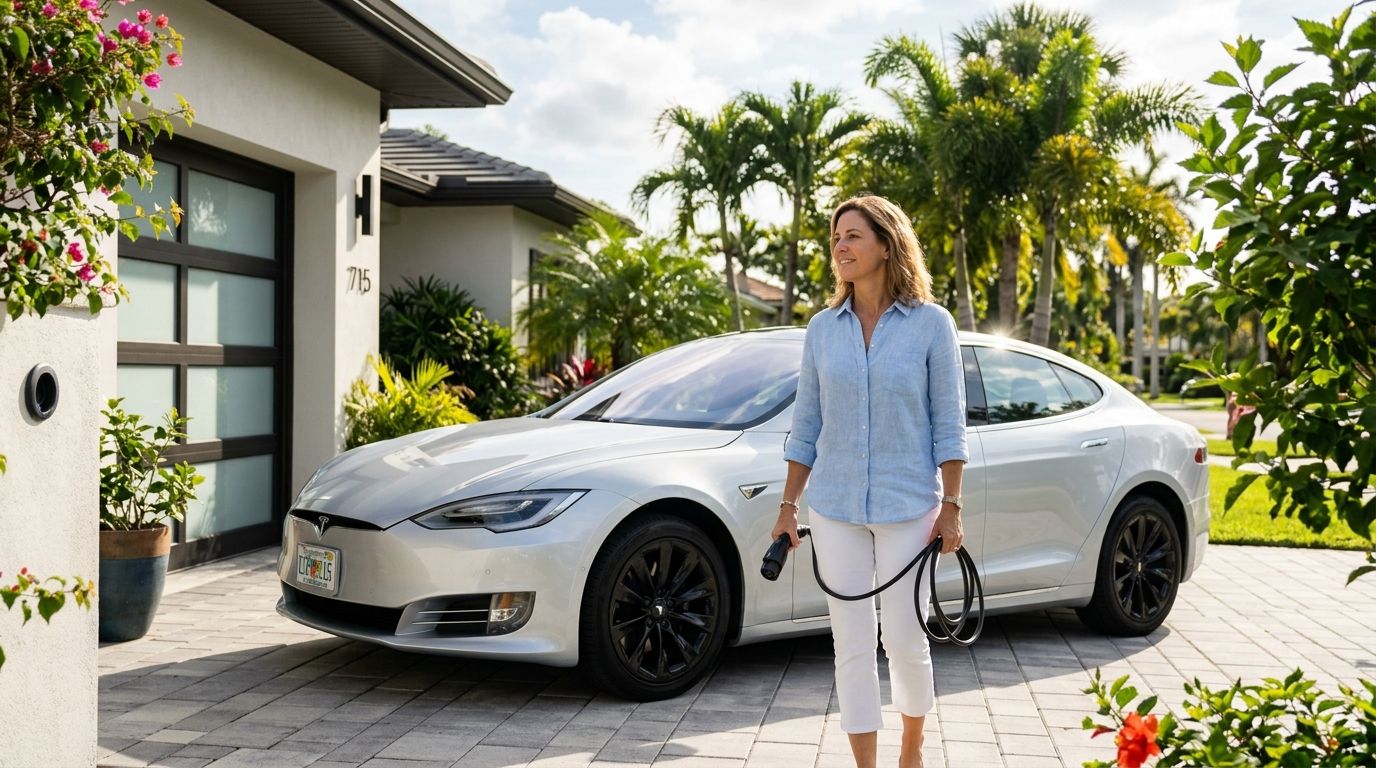
What homeowners usually run into first
The first issue isn't brand. It's location.
Do you have a garage, a carport, or an exterior parking pad? Does the charger need to reach one vehicle or two? Is the electrical panel close by, or are we crossing a long run through finished walls, attic space, or exterior conduit? In older West Palm Beach homes, those details change the job fast.
A second issue is timing. Most homeowners don't call before the EV arrives. They call after the first few days of living with it. That's normal, but it means the project needs to move from idea to usable setup without surprises.
Home charging works best when it feels invisible. You park, plug in, and move on with your evening.
What a practical installation should accomplish
A solid EV charging station installation in West Palm Beach FL should do a few things well:
- Match your routine: The charger has to support how you drive, not just what the spec sheet says.
- Fit the house: The install has to respect panel limits, parking layout, weather exposure, and cable reach.
- Pass cleanly: The work needs to line up with code and permitting so you don't run into inspection trouble later.
- Stay simple to use: If the charger location is awkward or the cable is always stretched tight, the setup won't feel finished.
That's the standard homeowners should expect. Not hype. Just a charging setup that works every day without creating a new electrical headache.
Choosing the Right Charger for Your Lifestyle
Most homeowners are really choosing between Level 1 and Level 2 for home use. Public DC fast charging matters, but it's not a home installation strategy for a typical residence. The right choice depends less on the car and more on how often you drive, how much time the car sits parked, and how much electrical capacity your home can realistically support.
West Palm Beach already has a broad public charging network. ChargeHub lists 451 total charging stations, including 325 Level 2 stations and 126 Level 3 stations, which works out to roughly 72% Level 2 and 28% DC fast charging, according to ChargeHub's West Palm Beach charging data. That split tells you something useful. Daily charging still leans heavily on Level 2, while faster public charging fills the gap for travel, convenience, or occasional quick turnaround.
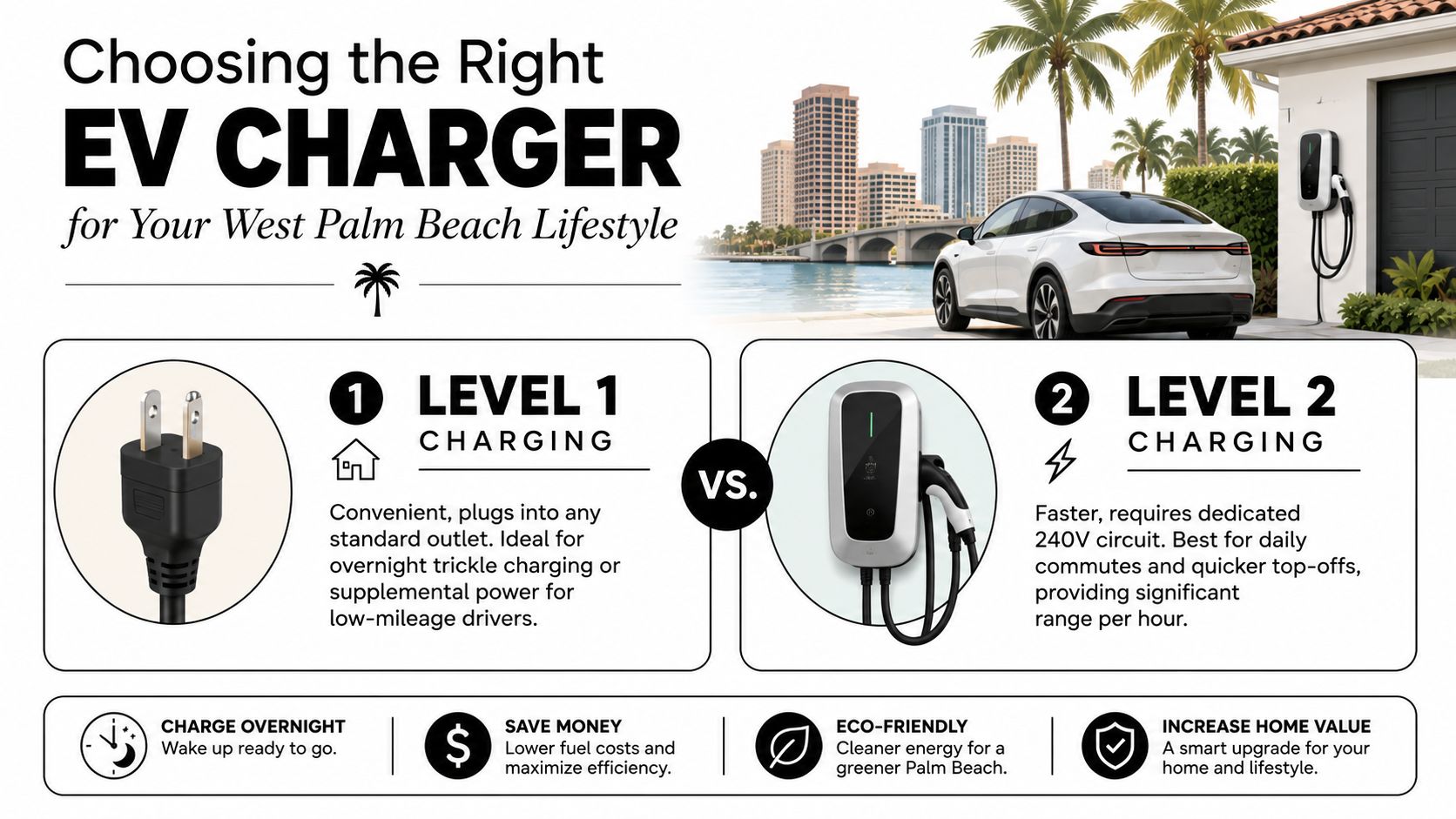
Home EV Charger Comparison
| Feature | Level 1 Charger | Level 2 Charger |
|---|---|---|
| Power source | Standard household outlet | Dedicated 240-volt circuit |
| Installation | Usually minimal if outlet is suitable | Professional electrical installation is usually required |
| Best fit | Low-mileage driving, backup charging, occasional overnight use | Daily commuting, faster overnight recovery, multi-driver households |
| Speed feel | Slow, often workable only with light driving | Practical for most homeowners |
| Electrical impact | Lower immediate demand on the home | Often triggers load calculation and sometimes panel work |
| Typical homeowner experience | Can feel restrictive fast | Usually feels like the setup people expected from the start |
Level 1 works for some people
Level 1 is the cord that often comes with the vehicle. It plugs into a standard outlet. If you drive lightly, work from home, or want a temporary charging method while planning a permanent install, it can do the job.
The problem is that it often becomes frustrating. A good comparison is filling a pool with a garden hose. Water is moving, but not at the desired pace. Homeowners usually outgrow Level 1 once they start relying on the EV as their main car.
Level 2 is the standard most people actually want
Level 2 is what most West Palm Beach homeowners mean when they say they want a home charger. It uses a dedicated 240-volt circuit and gives you a setup that fits regular life better. You come home, plug in, and by the next time you leave, the car is ready without planning your whole day around charging.
Practical rule: If you're asking whether a Level 2 charger is worth it, you probably already want the convenience it solves.
What about fast charging
Public fast charging still has a place. It's useful for road trips, schedule crunches, and the occasional day when home charging didn't happen. But relying on public charging for everyday life gets old quickly. For most homeowners, the strongest combination is simple: Level 2 at home, public fast charging when needed.
The Critical Home Electrical System Checkup
This is the part most online advice skips.
In South Florida, a lot of homes and condos weren't built with EV charging in mind. The issue isn't whether a charger can physically hang on the wall. The issue is whether the electrical system can take on another major load safely and legally. That's why the first real step is not shopping for apps or cable length. It's checking the panel, running a load calculation, and figuring out whether the house has room for the charger you want.
A local service page gets this part right. Many installations in this area need a panel-capacity check, and some need a full service upgrade, especially in older homes or condos where spare amperage may be limited, as discussed in this West Palm Beach EVSE installation overview.
What the electrician is actually looking at
A proper checkup usually answers a few plain-language questions:
- Is there physical breaker space? Some panels are full even before load capacity becomes the issue.
- Is there actual electrical capacity? An open breaker slot does not mean the house can handle a new EV circuit.
- Can the charger be on a dedicated circuit? It should be. Sharing with other major loads creates problems.
- What's the route from panel to charger? Distance, wall type, attic access, and exterior exposure affect labor and materials.
- Is the existing equipment in good condition? Corrosion, age, poor previous work, or outdated gear can change the scope.
What often happens in older homes and condos
Older single-family homes can look fine until the load calculation is done. The home may already be carrying air conditioning, kitchen loads, pool equipment, water heating, or workshop circuits. Add a Level 2 charger and the margin disappears.
Condos add another layer. You may have limited access to house equipment, shared electrical rooms, assigned parking far from the meter, or building rules about exterior conduit and common areas. Even when a charger is possible, the approval path may take longer than the wiring itself.
In many homes, the charger isn't the project. The electrical capacity is the project.
When a subpanel helps and when it doesn't
A subpanel can help with organization and breaker space. It does not magically create more service capacity. If the main service is already tight, adding a subpanel just relocates the problem. That's why homeowners should be cautious about anyone who promises a quick install before evaluating the full load picture.
If you're unsure whether your home is ready, start with a broader home electrical safety check. That kind of assessment helps identify whether the EV charger is a simple add-on or part of a larger upgrade path.
Navigating West Palm Beach Permitting and Codes
Permits frustrate homeowners because they feel like paperwork standing between you and a working charger. In reality, permits protect you. They create a record that the work was reviewed, installed to code, inspected, and approved. That matters for safety now, and it matters later if you sell the house, file an insurance claim, or need to explain the installation to an HOA or property manager.
In Palm Beach County, a compliant EV charger project typically starts with a pre-application review, followed by a permit package that includes electrical and structural drawings, a site plan, load calculations, conduit and panel schedules, and manufacturer specifications, then plan review, corrections if needed, permit issuance, construction, inspections, and finally energization, according to Palm Beach County EV charging design and permitting guidance.
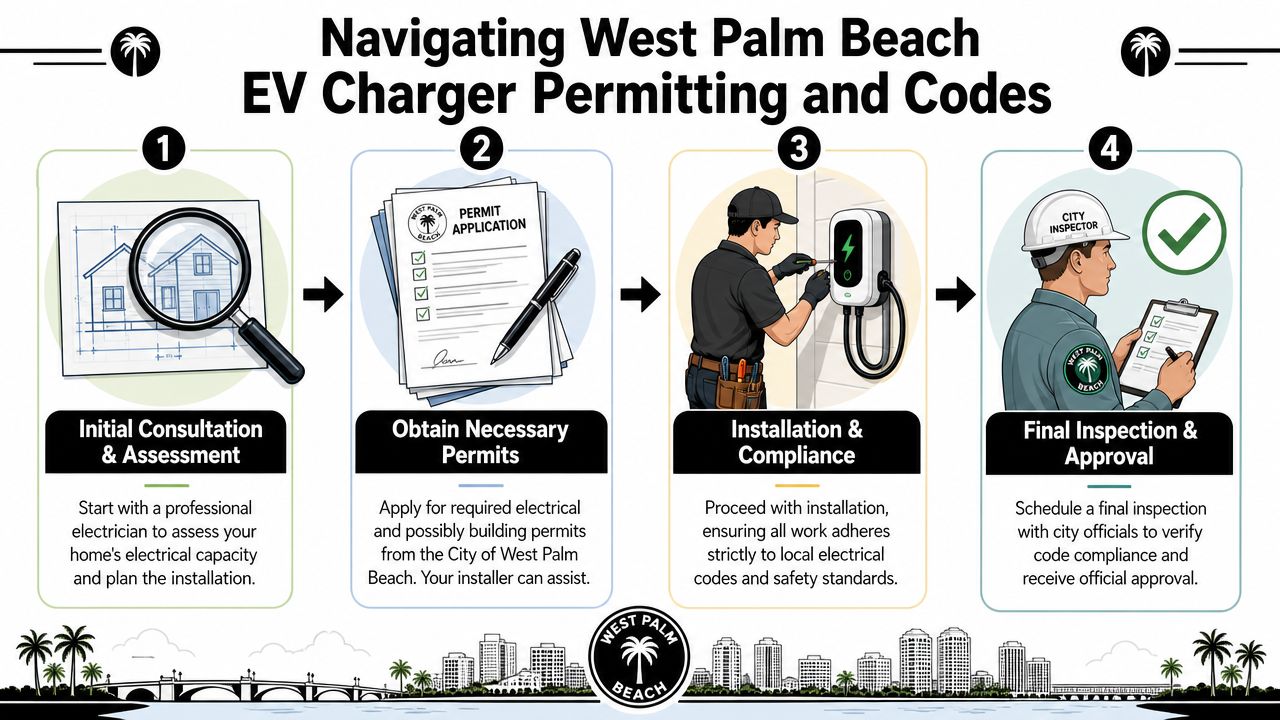
The code details that trip people up
Homeowners don't need to memorize code, but it helps to know what inspectors and electricians are paying attention to. In a market like West Palm Beach, charger circuits are commonly sized so overcurrent protection is 125% of the EVSE rated load, connectors are mounted 24 to 48 inches above grade, and accessible layouts need a 36-inch-wide pathway, as outlined in this EV charging installation code guide.
That level of detail is why “close enough” work often fails inspection.
What usually causes delays
The biggest avoidable problem is mismatch. The approved drawing shows one charger location, one foundation detail, one conduit route, or one ADA layout, and the installed work ends up different. Maybe the charger got shifted to avoid a column. Maybe the owner changed hardware after permit approval. Maybe signage or bollards moved during construction.
Any of that can trigger rework.
Inspection reality: If the field installation doesn't match the approved plans, the inspector may stop the job until the paperwork and the work line up again.
What a homeowner should expect
A smooth permit process usually looks like this:
Assessment and planning
The installer evaluates the home, charger location, and electrical capacity.Permit submission
Plans, calculations, and equipment information go in for review.Corrections if required
Comments come back. The contractor updates and resubmits.Installation and inspection
Work gets done only after permit issuance, then the required inspections follow.
Homeowners don't need to become code specialists. They do need an installer who treats the permit set and field work as one coordinated job.
Budgeting Your Installation Costs and Incentives
The cost question matters, but homeowners should frame it the right way. You are not only buying a charger. You are paying for a complete electrical project that may include equipment selection, circuit installation, protection devices, conduit runs, mounting, permit handling, and sometimes major panel or service work.
That's why two EV charger quotes can look far apart even when they use similar hardware. One may assume a short, easy run from a modern panel in a garage. Another may include exterior conduit, a detached parking area, HOA paperwork, or panel corrections needed before the charger can be installed safely.
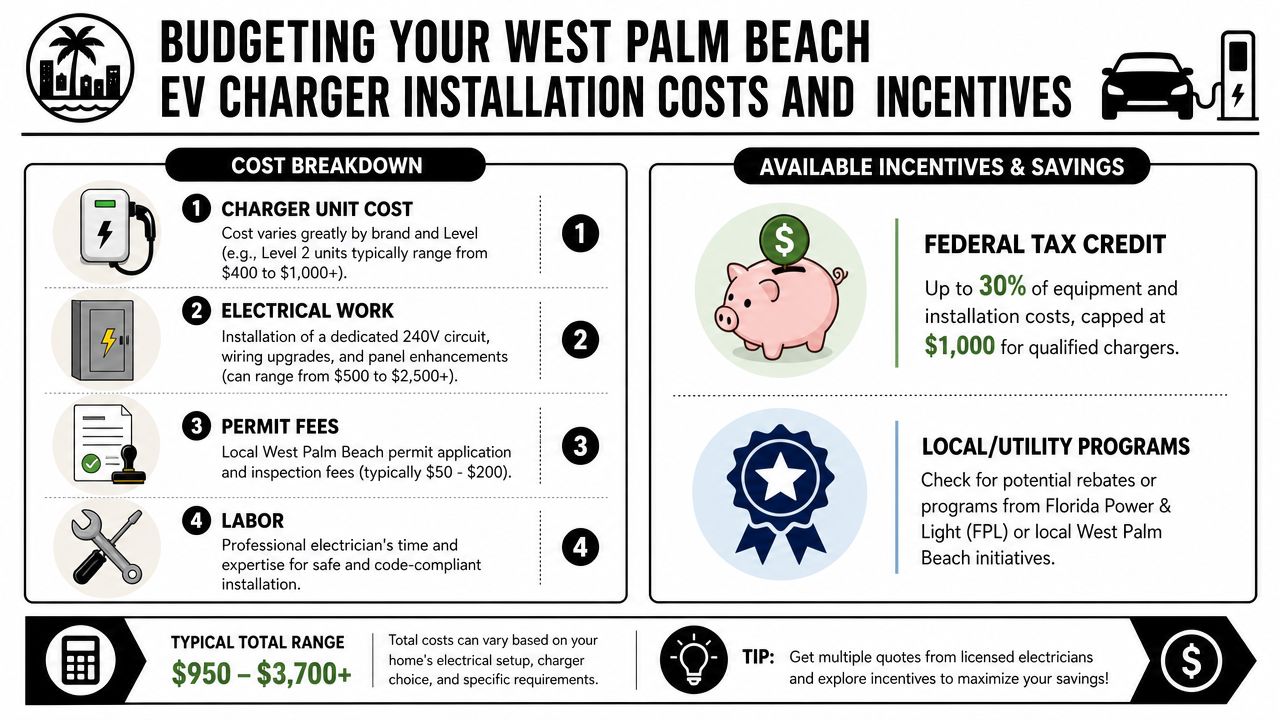
What usually makes up the price
A homeowner quote often includes some combination of these categories:
Charger hardware
Brand, amperage capability, cable length, smart features, and weather rating all affect this line item.Electrical materials
Wire size, breaker type, conduit, fittings, disconnects if needed, mounting hardware, and protection components all add up.Labor
A garage install next to the panel is very different from a long exterior route through block walls or attic spaces.Permit and inspection handling
Even when this isn't the biggest cost, it's part of doing the job correctly.Panel or service work
This is the swing factor. If your existing equipment can support the charger, the job stays simpler. If it can't, the project changes.
The biggest budget mistake homeowners make
They budget for the charger and forget the house.
That's especially common in older West Palm Beach homes. The homeowner picks a charger online, assumes the rest is routine, then learns the panel is full, undersized, or due for replacement. If the panel needs attention, treat that as core project scope, not an annoying add-on. It's what makes the charger safe and usable.
For homeowners trying to understand that side of the job before requesting quotes, a guide on electrical panel upgrades is often more useful than another charger product roundup.
A better way to compare estimates
Don't compare quotes by total alone. Compare scope.
Ask these questions:
- Does the quote include permit handling?
- Is load calculation included, or assumed?
- What charger location is the price based on?
- Does the quote include patching, conduit finish, and weatherproofing where needed?
- What happens if the panel fails evaluation?
A cheap quote can become the expensive quote once the installer starts discovering what wasn't included.
On incentives, check current federal, utility, and local program rules directly before you buy equipment or sign a contract. Eligibility changes, and some programs require approved products, licensed installation, or application timing that can affect whether you qualify.
Choosing Your Electrician and Installation Day
Hiring the right electrician matters more than picking between two charger brands. The installer decides whether the load calculation is accurate, whether the permit package is complete, whether the mounting location makes sense, and whether the final work passes without callbacks.
The cleanest way to vet a contractor is to look for process, not promises. Do they explain the electrical review in plain language? Do they talk about panel capacity before talking about wall-mount aesthetics? Do they acknowledge HOA and condo approval issues instead of brushing them aside?
What to check before you hire
Use a short screening list:
License and insurance
This should be easy to verify and never vague.EV charging experience
Ask what they look at first in older homes and condos. The answer tells you a lot.Clear scope in writing
You want charger model assumptions, circuit scope, permit responsibility, and exclusions spelled out.Familiarity with the local process
In Palm Beach County, the permit package can involve detailed drawings, site information, load calculations, manufacturer specifications, review comments, inspections, and final energization. A contractor who's organized for that process will save you time.
If you want a broader checklist for screening contractors before any major residential work, this guide to hiring a new home electrician is a useful place to start.
What installation day should look like
A professional install day is usually calm and orderly. The electrician confirms the charger location, verifies the route, protects the work area, and completes the circuit and mounting work according to the permit and approved plan. After that comes testing, labeling, and the final walkthrough.
If you're comparing providers, Lighthouse Energy Services is one local option that offers electric car charger installation as part of its residential electrical work. What matters most is that whichever contractor you choose handles the charger, electrical review, and permit coordination as one job rather than handing pieces off without accountability.
What the walkthrough should include
Before the electrician leaves, you should know:
- How to power the charger on and off
- Which breaker serves it
- What normal operation looks like
- What to do if the charger faults
- Whether any final inspection or utility step remains before regular use
A good handoff keeps small questions from becoming service calls later.
Frequently Asked Questions About EV Charging
Do I always need a panel upgrade for a Level 2 charger
No. Some homes already have the capacity and breaker space for a dedicated EV circuit. Others don't. The only honest answer comes after a load calculation and panel review. In older houses and many condo situations, that review is where the real decision gets made.
How long does the full project take
The physical installation may be quick or more involved depending on wiring path and panel conditions. The overall project length usually depends more on approvals, permit review, corrections if needed, and inspection scheduling than on the mounting of the charger itself.
I live in a condo. What should I expect
Expect an approval process before any wiring starts. Condo boards and HOAs often care about common-area access, exterior conduit appearance, assigned parking, power metering, and responsibility for future maintenance. Get those issues clarified early. In multifamily settings, the electrical path is often less difficult than the administrative path.
Can I buy the charger myself and hire an electrician later
Yes, but do it carefully. Some homeowners buy hardware that doesn't fit the home's electrical reality, parking layout, or permit assumptions. It's usually smarter to confirm the electrical side first, then choose the charger that matches the site.
What should I watch for after installation
Pay attention to nuisance breaker trips, fault lights, damaged connectors, loose mounting, or signs of heat at the plug or charger body. If anything seems off, stop using the charger until a licensed electrician checks it.
Why do some electricians lose EV charger and panel jobs
A lot of homeowners want speed and clarity, and some contractors lose work because they respond too slowly or fail to explain scope well. If you're curious how that plays out from the contractor side, this piece on electricians losing panel upgrades and EV charger installs to faster competitors gives useful context.
If you're planning an EV charging station installation at home and want a clear answer on feasibility, code requirements, and whether your panel can support it, contact Lighthouse Energy Services. A proper site review can tell you quickly whether your project is a straightforward charger install or whether the house needs electrical upgrades first.