
You've got the EV in the driveway, the charging cable still in the trunk, and one practical question in front of you. How do you set up home charging without turning it into an expensive electrical surprise?
In West Palm Beach, the answer usually starts with the house, not the vehicle. A lot of new EV owners assume the hard part is picking a charger brand. It usually isn't. The key decision is whether your existing electrical system can support a safe, code-compliant installation without forcing a bigger upgrade than you expected.
The Smartest Upgrade for Your New West Palm Beach EV
West Palm Beach already gives EV owners a solid public charging safety net. ChargeHub reports 451 total charging stations in West Palm Beach, including 325 Level 2 stations and 126 Level 3 stations. It also notes that 72% of stations are Level 2 and 24% are free to use. That's a real benefit when you're first learning your car's range and routines.
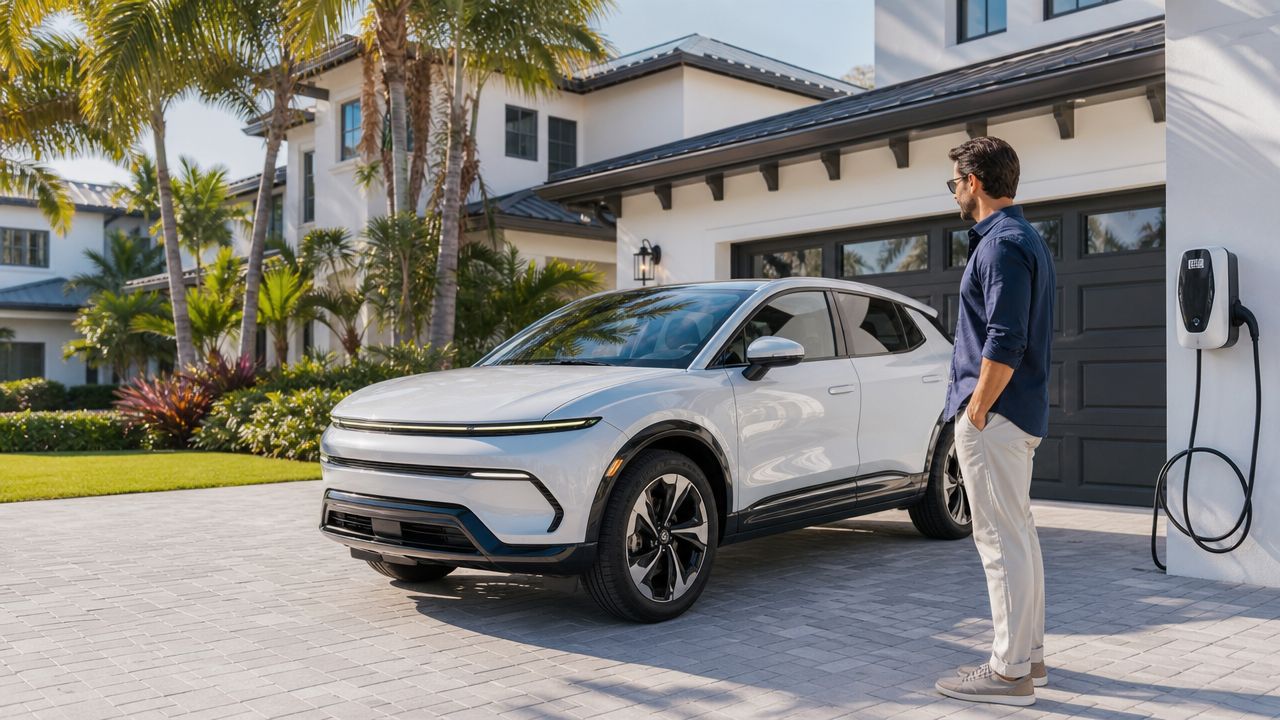
Public charging works well for errands, workday top-offs, and the occasional missed charge at home. It also tells you something important about the local market. West Palm Beach has moved past the early-adoption stage. ChargeHub also notes the city contracted with Blink Charging Company for stations in the City Center Garage, Clematis Street Garage, and Evernia Street Garage, which points to ongoing municipal investment rather than a one-time experiment.
Why home charging still changes everything
Even with plenty of public stations around town, most homeowners eventually want one thing. Predictability.
Home charging means your car starts the day ready. You're not planning around garage availability, retail lot occupancy, or whether a public charger is working when you need it. For most drivers, that's the point where EV ownership stops feeling new and starts feeling easy.
Practical rule: Public chargers are a backup and convenience layer. Your home charger is what gives you daily control.
What makes a project go smoothly
The cleanest home EV charger installation in West Palm Beach FL usually follows a simple order:
- Check the house first: Confirm panel capacity, breaker space, and circuit path before buying equipment.
- Match the charger to the electrical system: Don't oversize the charger beyond what the home can support.
- Handle permits correctly: EV charging is electrical work, not an appliance swap.
- Plan for inspection from the start: A tidy installation with proper materials passes more smoothly.
That last point matters more than people expect. A charger can be excellent on paper and still be the wrong fit for a house with limited capacity, a crowded panel, or a difficult conduit route. The project succeeds when the charger, panel, wiring run, permit paperwork, and inspection all line up.
Start with Your Electrical Panel Not the Charger Catalog
The most common mistake I see is buying the charger first. Homeowners compare apps, cable lengths, and smart features, then call an electrician after the purchase. Sometimes that works. Sometimes the charger they picked pushes the house into a panel problem they didn't know they had.
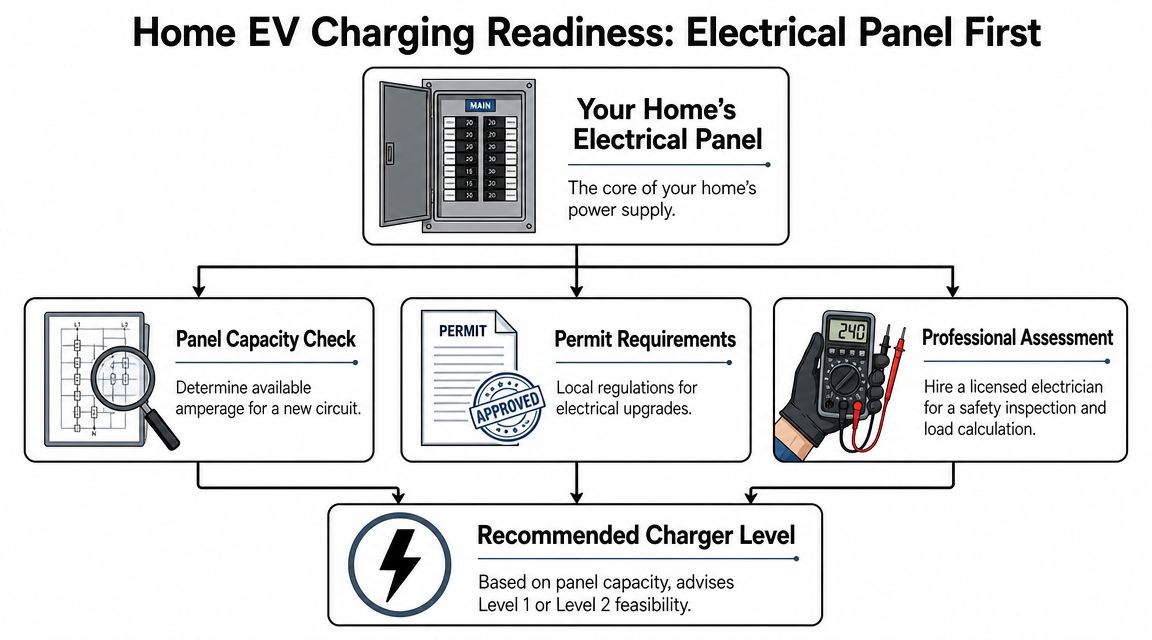
A charger is only as practical as the electrical system behind it. A local EV service page highlights the key question homeowners ask most often: whether the panel can support Level 2 charging without a costly upgrade. It notes that many homes with 200-amp service and two open breaker slots can handle a Level 2 charger, but that only a professional audit can confirm it.
What an electrician checks first
Before talking brands, an electrician should evaluate three things:
Service size
Many homes with 200-amp service are in a workable position for Level 2 charging, but service size alone doesn't settle it.
Breaker space
You need room in the panel for the new dedicated circuit. If the panel is physically full, that changes the plan.
Actual load
The house may already be carrying heavy demand from air conditioning, pool equipment, water heating, cooking equipment, or other large loads. A proper load calculation determines what's available.
The rule that drives circuit sizing
The U.S. EPA advises homeowners to begin with a load calculation and panel-capacity check before selecting equipment. It also notes that many homes with at least 200 amps and two open breaker slots can usually accommodate a Level 2 charger without a major service upgrade. The same EPA guidance says the branch circuit must be sized at 125% of the charger's continuous load, so a 40-amp Level 2 charger requires a 50-amp dedicated circuit, as explained in the EPA's home EV charging guidance.
That rule is where a lot of DIY assumptions fall apart. People see a charger labeled 40 amps and assume they need a 40-amp breaker. They don't. Continuous loads are treated differently, and EV charging falls into that category.
A charger doesn't decide the installation. The load calculation does.
When the panel is the real project
If your panel is outdated, crowded, or undersized, the charger may be the easy part. The electrical upgrade becomes the main job.
That doesn't always mean replacing the whole service. In some homes, reorganizing circuits or adding capacity elsewhere may solve the problem. In others, homeowners start researching options like installing a 200-amp subpanel to understand how additional distribution space can fit into a broader electrical plan. The right choice depends on the actual panel condition, service limits, and layout of the house.
If you already suspect the panel may be the limiting factor, Lighthouse has a useful guide to electrical panel upgrades that helps homeowners understand what usually triggers a larger scope of work.
What doesn't work
A few shortcuts cause trouble fast:
- Buying for maximum output without checking capacity: More amperage isn't automatically better if the house can't support it.
- Assuming an unused outlet is good enough: Most Level 2 setups need a dedicated 240-volt circuit.
- Treating the panel like a formality: If the panel fails the audit, the charger choice may have to change.
- Skipping the load calculation: That's how projects get repriced after equipment has already been purchased.
If you want the project to stay predictable, start at the panel door.
Choosing Your Charger Level and Budgeting for the Project
Once the panel assessment is done, charger selection gets much easier. At that point, you're not shopping by marketing claims. You're choosing a charger that fits your house, your vehicle, and how you drive.
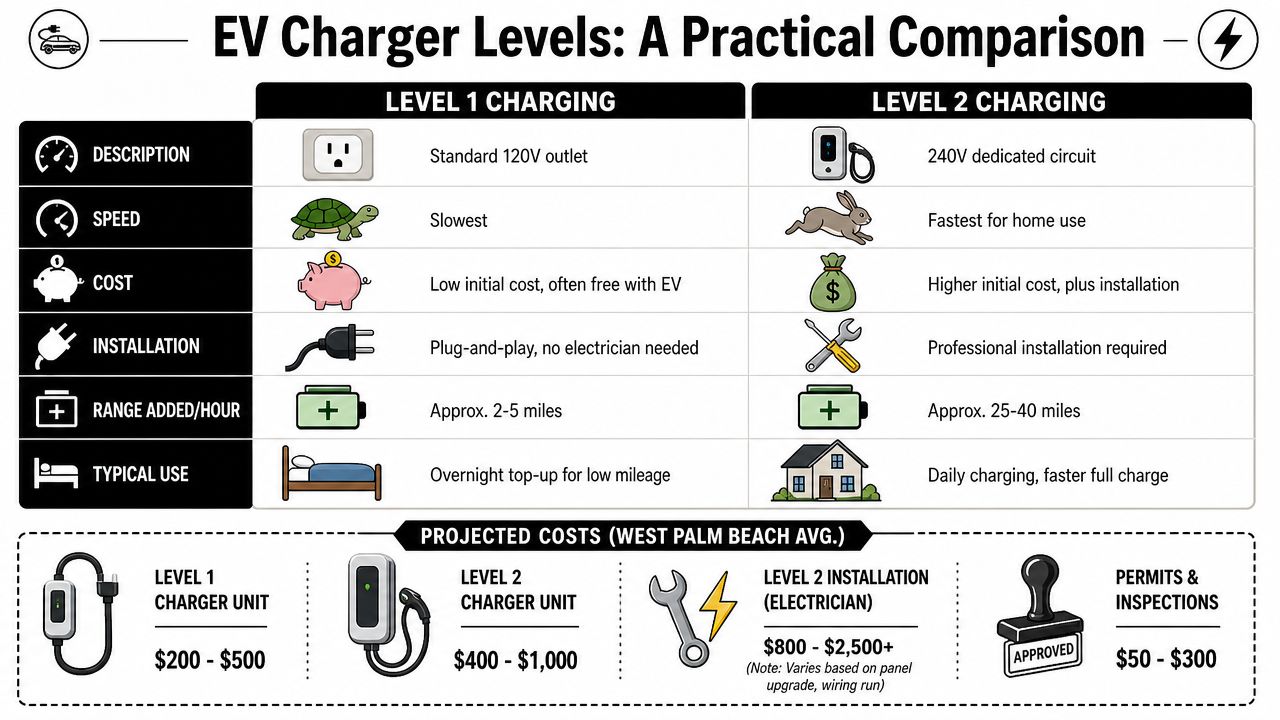
In West Palm Beach, the cost gap between basic and higher-capacity home charging is clear. ProMatcher's local estimates put a Level 1 charger installation at about $237.60 on average, with a range of $181.03 to $294.17. A Level 2 charger installation is about $1,313.03 on average, with a range of $1,260.99 to $1,373.35. ProMatcher also indicates that installation costs typically include the charger, necessary wiring, and permitting fees.
Level 1 versus Level 2 in real life
Here's the practical difference:
| Option | Best fit | Main trade-off |
|---|---|---|
| Level 1 | Drivers with light daily mileage or a temporary charging plan | Slower charging |
| Level 2 | Homeowners who want dependable overnight charging | Higher upfront cost and dedicated electrical work |
For most homeowners, Level 2 becomes the standard choice because it better matches normal life. You get home, plug in, and the car is ready the next day without much thought.
Budget the job, not just the charger
A lot of people budget for the wall unit and forget the rest of the project. The charger is only one line item. The final price can also reflect:
- Dedicated circuit work: Wire size, breaker selection, and route length all matter.
- Mounting location: Garage wall, exterior wall, and distance from the panel affect labor.
- Permit handling: Local approvals are part of a proper installation.
- Panel-related scope: If the earlier audit finds limitations, the charger budget changes.
Estimating discipline matters. Homeowners comparing proposals often benefit from understanding how contractors build electrical estimates. Tools such as Exayard electrical estimating software are useful examples of how professionals organize labor, materials, and project scope instead of throwing out a rough price.
Choosing features that actually matter
Smart features are useful if they solve a real need. Scheduling can help you control when charging starts. Usage tracking can help if you want visibility into charging habits. But none of those features make up for a charger that doesn't fit the circuit plan.
Buy the charger that matches the electrical design, not the one with the longest feature list.
For homeowners getting quotes and comparing electricians, Lighthouse also has a practical guide to hiring a new home electrician that can help you evaluate how thoroughly a contractor is thinking through the work.
Navigating Palm Beach County Permits and Inspections
Permits are where many EV charger projects either stay clean or go sideways. Homeowners sometimes treat permitting as optional because the charger feels like a convenience upgrade. From an electrical standpoint, it isn't optional. You're adding a new dedicated load to the house, and the work has to meet code.
The EPA's guidance is direct on this point. A safe installation begins with a load calculation and panel audit. It also states that a 40-amp Level 2 charger requires a 50-amp dedicated circuit because the branch circuit must be sized at 125% of the continuous load. In Florida localities like Palm Beach County, that work typically requires an electrical permit, plan review, and post-installation inspection to ensure compliance, as described in the EPA's earlier-cited home charging guidance.
What the local process usually looks like
The workflow is straightforward when handled correctly:
Project review
The electrician confirms panel capacity, circuit design, charger location, and routing.
Permit submission
The permit package goes to the local jurisdiction for review.
Installation
After approval, the dedicated circuit and charger are installed according to plan.
Inspection
The inspector verifies that the installation matches code and approved scope.
Why permits protect the homeowner
Permits aren't just about satisfying the county. They help protect the homeowner in practical ways.
- Safety: The work gets reviewed against code requirements.
- Insurance clarity: Documented, permitted work is easier to stand behind if questions come up later.
- Resale confidence: Buyers and home inspectors routinely ask whether electrical additions were permitted.
- Reduced rework risk: A permitted job is less likely to need correction after the fact.
If you're comparing contractors, one of the first things to ask is whether they routinely manage local approvals and inspections. Lighthouse lists its work in this category through its government-approved electrical contractor services, which is the kind of qualification homeowners should confirm with any company they hire.
What causes permit trouble
Most delays come from preventable issues. The charger gets purchased before capacity is confirmed. The installation plan changes after the permit is filed. Or someone tries to avoid the process entirely and ends up with a failed inspection, or no inspection at all.
A clean permit path starts with accurate electrical information. That's why the panel review comes first.
What to Expect on Installation Day and Beyond
By the time installation day arrives, most of the important decisions should already be made. The charger model is selected. The circuit path is planned. The permit has been handled. What happens on site should feel organized, not improvised.
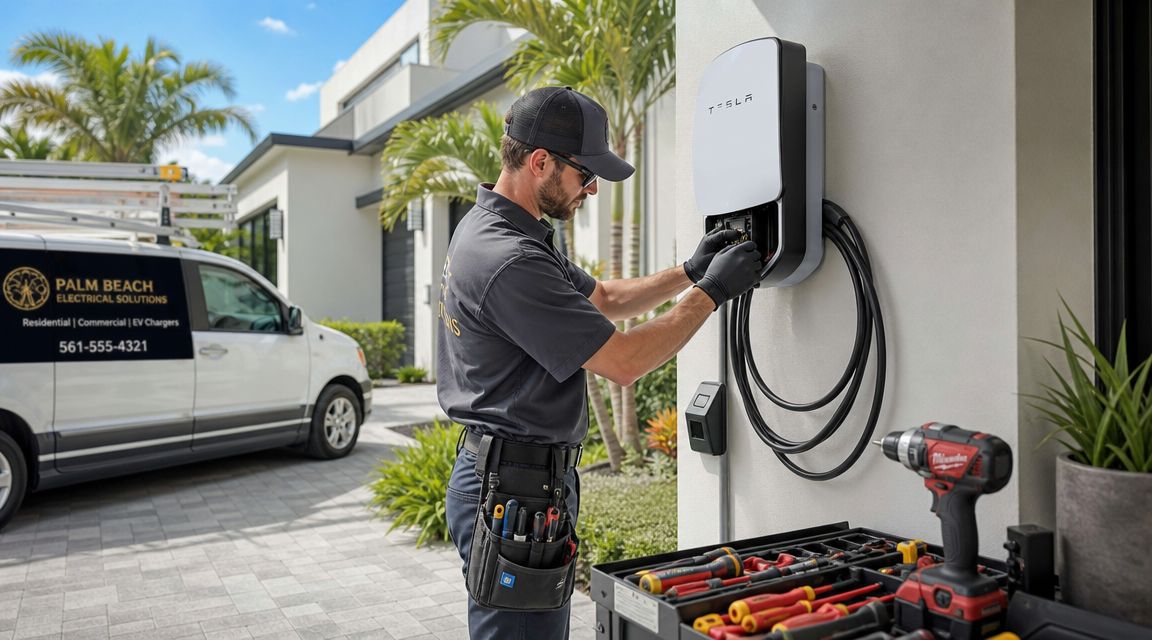
One Palm Beach County installer reports that the physical field work for a typical home EV charger install often takes 2–4 hours, but the full project timeline can stretch to weeks or months because of permitting and approval delays, according to Gator Electric's EV charger installation page. That difference matters because homeowners often expect the whole project to move at the pace of the on-site labor.
What the crew should do on site
A professional installation day usually includes several visible steps:
- Walkthrough first: Confirm the charger location, cable reach, and access path before tools come out.
- Circuit installation: Run the new dedicated circuit using the planned route.
- Mounting and termination: Secure the charger and make up all electrical connections.
- Testing: Verify power, charging function, and proper operation before wrapping up.
The work itself is usually not dramatic. A good crew protects finished surfaces, keeps the route neat, and leaves the area cleaner than most homeowners expect.
Why some jobs feel simple and others don't
Two homes can have the same charger and very different installations. A panel mounted close to the garage wall creates one kind of job. A long run to an exterior parking area creates another. Older homes can add complexity even when the charger choice is straightforward.
That's why a site visit matters. On paper, many projects look simple. In the field, routing, wall construction, access, and existing panel conditions decide how smooth the work will be.
The installation day is only quick when the planning was done properly first.
After the charger is installed
The job isn't finished the second the charger powers on. The final stage is approval and long-term reliability.
You should expect:
- Operational testing: The charger should be verified with the vehicle or according to manufacturer procedure.
- Inspection readiness: The installation should be left in a condition that aligns with the approved scope.
- Basic owner handoff: You should know how to start charging, what normal operation looks like, and what to do if the unit shows a fault.
If the project timeline seems longer than the physical work suggests, that's normal. The electrical work may take hours. The fully approved project takes as long as permits and inspections require.
Why West Palm Beach Homeowners Choose Lighthouse Energy Services
A successful home EV charger installation in West Palm Beach FL comes down to disciplined electrical work. The charger has to fit the house. The circuit has to fit the load calculation. The permit has to match the actual installation. The finished work has to pass inspection and hold up over time.
That's why homeowners usually don't need a sales pitch. They need an electrician who understands Palm Beach County process, residential panel realities, and the difference between a fast install and a complete one.
Lighthouse Energy Services fits that kind of work. The company serves Palm Beach County, handles residential electrical projects, and offers electric car charger installation as part of its service lineup. For homeowners, that matters because EV charging isn't a stand-alone gadget purchase. It's a code-governed electrical project tied directly to the rest of the house.
What homeowners usually care about most
The priorities are consistent:
- A real panel assessment first: No guessing, no selling the charger before the house is evaluated.
- Clear project scope: Homeowners want to know if the job is a straightforward circuit addition or part of a broader electrical upgrade.
- Permit and inspection competence: Local process matters as much as the wiring.
- Reliable communication: Questions come up before, during, and after installation.
The practical takeaway
If you've just brought home an EV, start with the electrical system. Don't buy the biggest charger you can find and hope the panel can support it. Don't skip permits because the unit looks simple. And don't assume a quick installation means a simple project.
The homes that get the best results are the ones where someone checks capacity, sizes the circuit correctly, handles the paperwork, installs cleanly, and leaves the owner with a charger that works every day without drama.
If you're planning a home charger and want the job evaluated the right way, contact Lighthouse Energy Services. They can review your panel, explain the likely scope, and help you move from EV purchase to a safe, code-compliant home charging setup in Palm Beach County.