
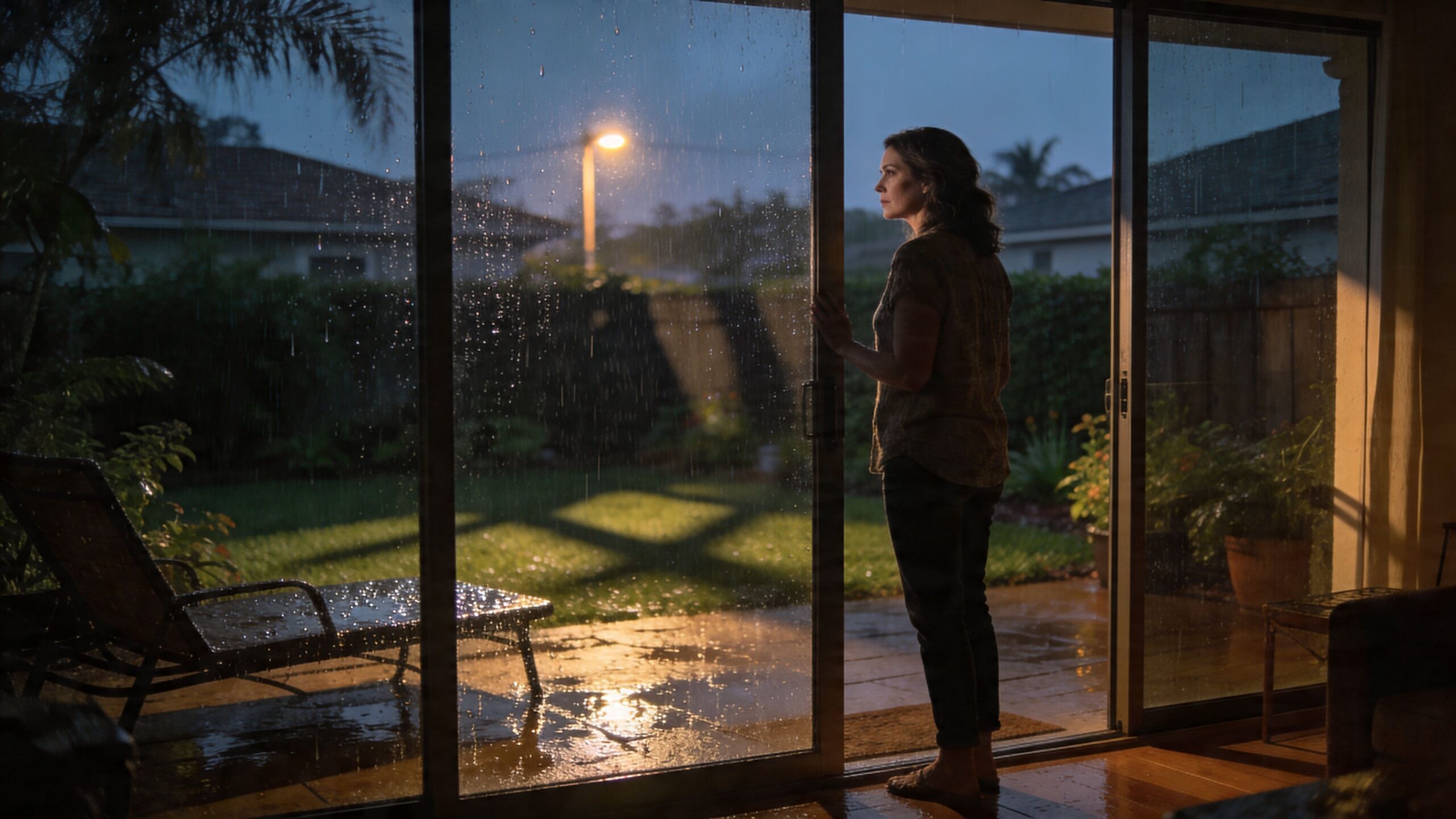
If you're standing at the back door after sunset and noticing how much of your yard disappears into shadow, you're not overthinking it. In Palm Beach County, those dark gaps around side gates, driveways, pool equipment, and garage corners matter. A storm rolls through, a lamp quits, palm fronds shift, and suddenly the house feels less secure than it did last week.
Outdoor security lighting fixes that, but only when it's installed with a plan. A bright fixture over the garage doesn't help much if the side yard stays black. A cheap motion light won't last long if the wiring isn't sealed against humidity and salt air. And a rushed DIY job can turn into nuisance tripping, false triggers, or an inspector's correction list.
That demand for better exterior lighting isn't slowing down. The global outdoor security lighting market reached $15 billion in 2025 and is projected to reach approximately $27 billion by 2033, driven largely by property owners investing in safety and LED efficiency, according to Data Insights Market.
In South Florida, generic advice misses the parts that usually cause trouble. Coastal corrosion is real. Wind exposure changes how you mount fixtures. Local permitting can matter even for what seems like a simple hardwired light. If you're learning how to install outdoor security lighting, the right approach is safety first, then placement, then weatherproofing, then code.
Brighten Up Your Peace of Mind
A lot of homeowners start this project for the same reason. They come home after dark, pull into the driveway, and notice one corner near the garage stays dim. Or they let the dog out and realize the side yard has become a blind spot. Sometimes it happens after a storm. Sometimes a neighbor mentions a break-in down the block and the dark areas around the house suddenly look different.
What good security lighting actually does
The job isn't just to make the house brighter. Good security lighting does three things well:
- Deters approach: It removes the easy hiding spots near doors, fences, and parked cars.
- Improves recognition: It helps you, your neighbors, and your cameras see who's there.
- Makes movement obvious: Motion-triggered lighting changes the feel of a property fast.
In Palm Beach County, I tell homeowners to think less about "adding a light" and more about closing gaps in visibility. That's the difference between a fixture that looks useful and a system that changes how the property feels at night.
Why Florida changes the install
South Florida is hard on outdoor electrical work. Heat, rain, salt air, irrigation overspray, and storm season all work against fixtures and connections. A light that lasts in a dry inland climate may fail early here if the housing, fasteners, gasket, or wiring method isn't right.
Practical rule: If an outdoor connection isn't sealed and supported, Florida will find the weak point.
That doesn't mean a capable homeowner can't handle a straightforward job. Many can. But the job has to be approached like outdoor electrical work, not like hanging a decorative lantern.
The line is simple. If you're replacing an existing fixture on a sound box with proper wiring and clear access, that's one thing. If you're adding new hardwired lighting, extending circuits, trenching, or dealing with uncertain wiring in an older home, that's where the risk climbs fast.
Strategic Planning for Effective Illumination
Before you touch a breaker or open a box, walk the property at night. Not at dusk. At night, when the shadows are honest. Stand where someone would approach the house and look for the places where a person could move without being seen.
Strategic placement matters as much as fixture quality. Research summarized in the National Library of Medicine found that strategically deployed street lighting reduces crime by an average of 20%, with some studies showing reductions as high as 40%. That's why placement comes first, not last, according to this lighting and crime review.
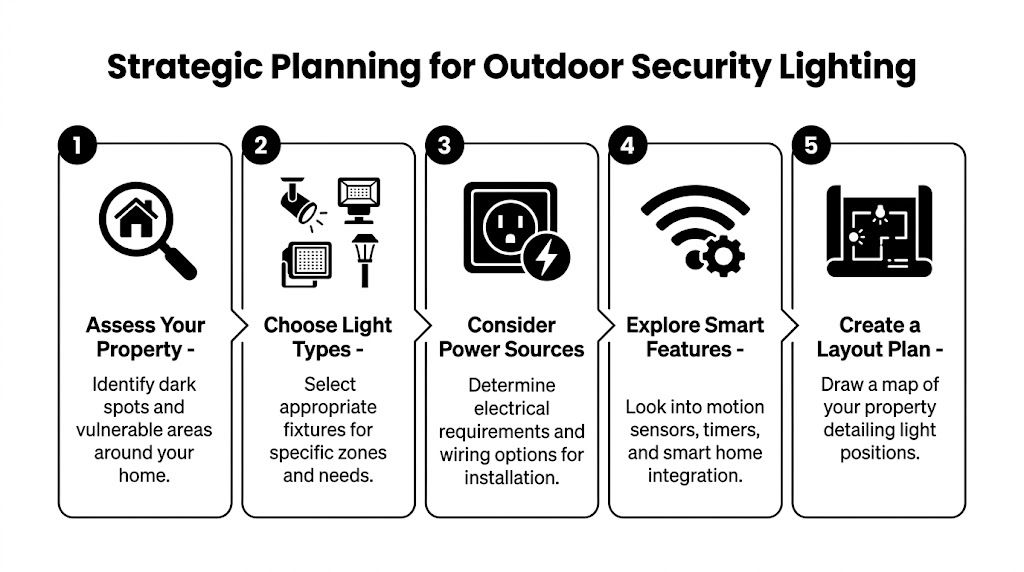
Audit the property like an intruder would
Don't start by asking where a light would look good. Ask where someone could stand unseen.
Focus on these areas first:
- Primary entries: Front door, garage entry, back door, and any door hidden by landscaping.
- Side yards and gates: These are common blind spots on Florida homes with narrow setbacks.
- Driveway edges: Especially where parked vehicles create shadow.
- Ground-floor windows: Not every window needs a fixture, but vulnerable corners matter.
- Equipment zones: Pool pumps, AC condensers, and service paths often sit in darkness.
Walk each zone and note what the light needs to do. A driveway needs broad coverage. A gate may need a tighter beam. A rear patio may need enough spill to show movement without blasting into bedroom windows.
Use height and angle to your advantage
Mounting height changes everything. For hardwired security fixtures, a practical benchmark is 8 to 12 feet high, which gives a better field of coverage and makes tampering harder. Too low, and the fixture creates harsh hot spots. Too high, and the beam can flatten out or miss the area that matters.
Aiming matters just as much. Think of it as painting with light. You want overlap, not glare.
A few field-tested habits help:
- Cross-light corners: Put light on the approach path, not just directly above the door.
- Avoid straight-out aiming: Light thrown flat across a yard often blinds the viewer and leaves dark ground.
- Watch neighboring property lines: A poorly aimed floodlight starts arguments fast.
- Check camera sightlines: If you use security cameras, don't wash out the image with direct glare.
Light the person, not the fixture. If all you see is a blazing lamp and a black yard, the beam is pointed wrong.
Match fixture type to the area
One common mistake is using the same fixture everywhere. Different areas need different behavior.
For example:
- A motion flood works well at a driveway or rear corner.
- A dusk-to-dawn light makes sense near a main entry or walkway that should never go dark.
- A focused wall light can cover a side gate without spilling into the whole yard.
If you're comparing layout ideas or planning a broader system, Lighthouse Energy's exterior lighting page shows the kinds of exterior applications homeowners usually combine rather than treating the entire property as one lighting zone.
Draw the layout before you buy
A rough sketch saves time and return trips. Mark doors, windows, paths, gates, and existing power sources. Then mark fixture positions and beam direction.
Keep the drawing simple, but include:
| Layout item | Why it matters |
|---|---|
| Existing boxes and switches | Tells you where hardwired options are realistic |
| Dark zones | Keeps you focused on security, not decoration |
| Sensor direction | Helps prevent false triggers from traffic or neighbors |
| Trees and palms | Moving foliage can trigger sensors if you aim carelessly |
Planning isn't glamorous, but it's where a good installation starts to look professional.
Choosing Your Power Source Hardwired vs Solar
Palm Beach County homeowners usually narrow the choice to two paths. Hardwired lighting gives you steady power and stronger installation options. Solar lighting avoids running cable and can be useful in spots where wiring would be disruptive.
Neither is automatically right. The better choice depends on where the fixture is going, how critical that zone is, and how much maintenance you're willing to accept.
The local decision factors that matter
Florida changes the conversation.
A solar light mounted in a sunny spot can work well on a fence line or detached gate. But several cloudy days, storm debris on the panel, or poor panel orientation can leave you with less output when you want reliable nighttime coverage. Hardwired lights don't have that particular weakness, but they require proper circuit planning, weatherproof boxes, and code-compliant installation.
Salt air affects both. Cheap finishes pit early. Thin gaskets fail. Mild steel hardware rusts. Wind exposure matters too. A fixture mounted on a wall that takes storm-driven rain needs better sealing and more secure fastening than what many online tutorials show.
Hardwired vs. Solar Security Lighting for Palm Beach County
| Factor | Hardwired Lighting | Solar Lighting |
|---|---|---|
| Reliability | Consistent output when wired correctly and supplied by a sound circuit | Depends on sun exposure, panel cleanliness, and battery condition |
| Brightness consistency | Better choice for areas where full output matters every night | Can vary with weather, shade, and battery charge |
| Installation difficulty | Higher. May involve boxes, cable, breakers, permits, and inspection | Lower for standalone units with no branch-circuit work |
| Best use cases | Garage walls, main entries, driveways, rear corners, commercial perimeters | Detached fences, sheds, gates, or spots where trenching isn't practical |
| Storm resilience | Strong if mounted correctly with corrosion-resistant hardware | Useful in remote spots, but panel placement and fixture mounting need care |
| Maintenance | Wiring and seals should last if done right, but repairs are more technical | Batteries, lenses, and panels need regular attention |
| Long-term control options | Easier to integrate with switches, photocells, sensors, and broader electrical work | Often simpler as a self-contained product, but with fewer robust options |
What works in practice
If the area protects a main path of travel or a primary entry, I lean hardwired. That's where reliability matters most. If the goal is supplemental light at a remote edge of the property, solar can make sense.
For wired installations that also involve low-voltage runs, control wiring, or planned expansion, it's smart to think through the infrastructure early. Homeowners looking at broader exterior systems often benefit from understanding residential low voltage wiring before they start mixing fixture types and controls.
A simple rule for choosing
Use hardwired lighting when you need dependable performance. Use solar where access is difficult and the lighting role is secondary.
If you're torn, ask one question. If this fixture failed on a stormy week, would the property still feel adequately covered? If the answer is no, hardwired is usually the better path.
A Step-by-Step Guide to a Safe Installation
The safest DIY installation is a straightforward replacement or a simple new run where the electrical path is clear, the mounting surface is solid, and local requirements are understood before any work begins. The details matter more outdoors because heat and moisture punish every shortcut.
For a hardwired installation, use UF-B rated outdoor cable, mount fixtures 8 to 12 feet high, shut off power at the breaker and verify with a tester, use UL-listed wire nuts, and seal entry points with silicone caulk because moisture ingress causes 40% of outdoor light failures, as noted in this outdoor security light installation guide from PacLights.
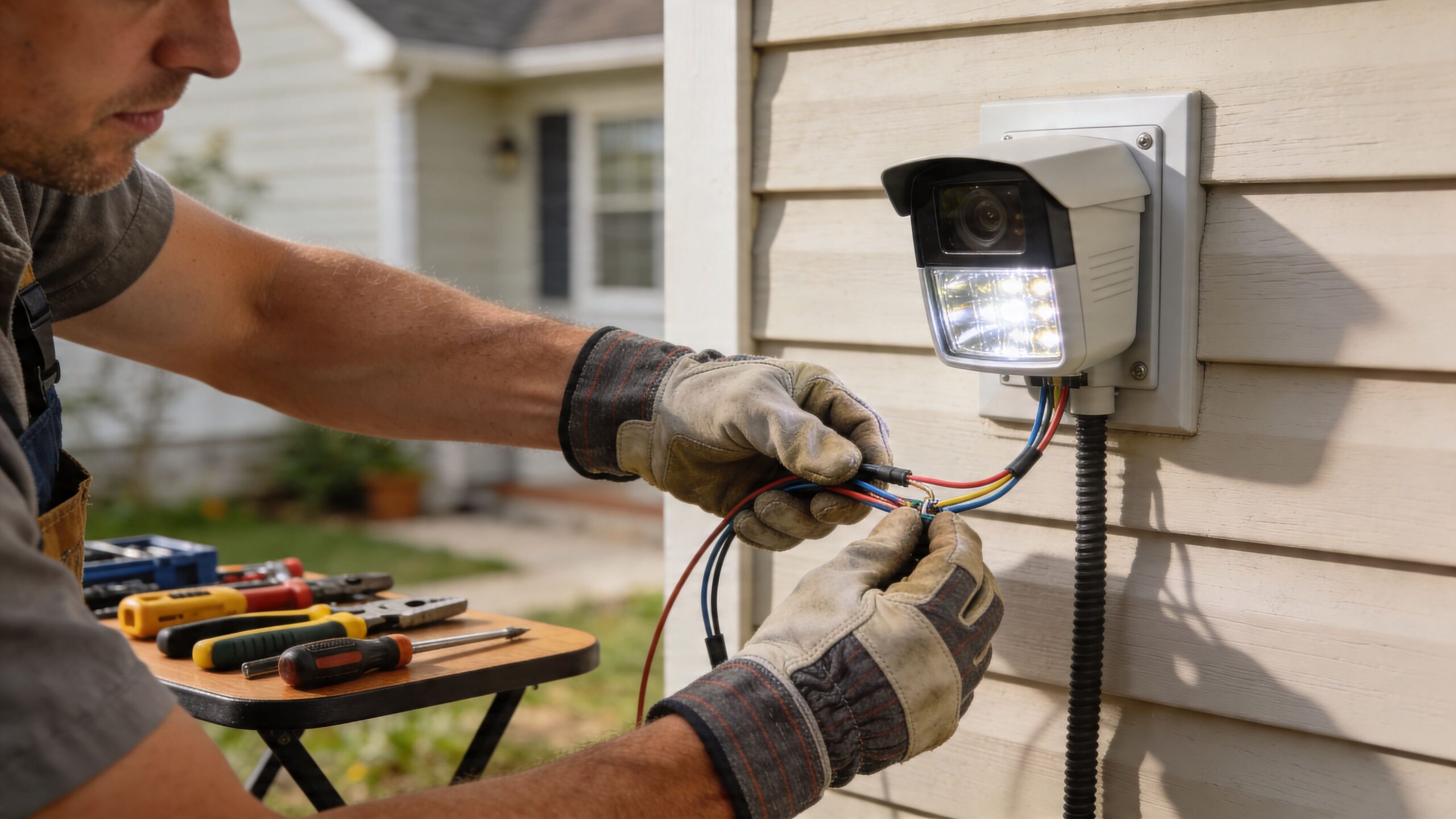
Gather materials that belong outdoors
Many DIY jobs go wrong when homeowners use indoor hardware, whatever cable is on the shelf, or a box that isn't right for wet locations.
For a proper hardwired install, gather:
- Weatherproof junction box: Use an outdoor-rated box that matches the mounting surface and fixture.
- UF-B rated cable: For exterior use where that cable type fits the installation.
- Corrosion-resistant screws: Stainless fasteners hold up far better near the coast.
- UL-listed wire connectors: Use listed wire nuts or other listed connectors suitable for the application.
- Silicone caulk and sealing materials: Seal penetrations so water can't track into the box or wall.
- Non-contact tester and meter: Verify power is off.
- Proper anchors or masonry fasteners: South Florida homes often require concrete or block fastening.
- Dielectric grease: Useful at terminals where moisture and corrosion are concerns.
If you want another practical reference on mounting and fixture replacement details, this guide on installing exterior light fixtures is a useful supplement to manufacturer instructions.
Make the area safe before opening anything
Turn off the breaker. Then verify with a tester. Never assume the label in the panel is right, especially in older homes where circuits have been extended over time.
Once the power is confirmed off, remove the old fixture or open the planned box location. Inspect the box, wiring insulation, and mounting surface. If the box is loose, rusted, cracked, shallow, or poorly located, fix that before thinking about the new fixture.
A security light is only as solid as the box behind it.
Run and protect the cable properly
If you're adding a new hardwired fixture, route the cable with outdoor conditions in mind. Keep the run protected, supported, and appropriate to the wiring method. Where cable enters the box or wall, seal the opening so rain and humid air don't travel inward.
If the run is longer, voltage drop becomes more important and wire sizing matters more. If that part isn't clear to you, stop and get a licensed electrician involved before you pull cable you may need to replace.
Make clean, tight, dry connections
Inside the box, connect conductors by function. Hot to hot, neutral to neutral, ground to ground. Keep the grounding path intact and don't leave bare copper exposed where it shouldn't be.
Then focus on weatherproofing. That means:
- Seat the fixture gasket correctly: A twisted gasket will leak.
- Seal wall penetrations: Caulk around entries, not over drain paths the fixture is designed to keep open.
- Support the splice area: Don't force a crowded bundle into an undersized box.
- Keep the box orientation correct: Some boxes and fixtures depend on proper top and bottom placement for drainage.
A connection can be electrically correct and still fail early if moisture gets to it.
Grounding and GFCI protection aren't optional
Outdoors, grounding and shock protection matter even more because water is part of the environment. Any exterior installation needs to respect grounding requirements and the applicable protective measures for the circuit and location.
If you're not fully confident identifying grounding conductors, box bonding requirements, or whether GFCI protection applies to the circuit you're working on, that's the point to stop. This isn't the place to guess.
For homes adding efficiency controls or power-related upgrades around exterior systems, one option that sometimes comes up in broader electrical planning is the Smartcool ECO3 device offered by Lighthouse Energy Services. It's separate from the security light fixture itself, but it's relevant when homeowners are looking at electrical efficiency and outdoor-related upgrades as part of the same project.
Mount and aim the fixture like a pro
Once the fixture is wired and fastened, take time to aim it properly. Proper aiming often distinguishes a good install from a frustrating one.
For motion fixtures, adjust sensitivity with the property in mind. In Palm Beach County, moving palms, shrubs, and even reflected movement from wet pavement can create nuisance triggering. Lower sensitivity may be better near landscaping. Higher sensitivity may be appropriate on a long driveway with a clean line of sight.
A few practical setup points:
| Adjustment area | What works better |
|---|---|
| Motion head direction | Aim across the path of travel, not straight down |
| Sensitivity | Start lower near landscaping, then increase only if needed |
| Timer setting | Use enough on-time for identification without leaving the area lit too long |
| Photocell orientation | Keep it away from reflected light that can confuse dusk-to-dawn operation |
For output, match the fixture to the area. A driveway or garage zone often needs stronger coverage than a path or side gate. Don't chase maximum brightness if it creates glare. Security lighting should reveal detail, not blow it out.
Know When to Call a Licensed Electrician
There's no prize for forcing a DIY installation past the point where it stops being safe. A smart homeowner knows where the line is. In Palm Beach County, that line often shows up earlier than online tutorials suggest because local conditions and local enforcement make outdoor electrical work less forgiving.
The biggest red flag is circuit capacity. Many DIY guides skip it, but that's where trouble starts.
A critical oversight in many DIY installs is failing to verify whether the existing circuit can support the added load. Exceeding 80% of a circuit's capacity can trip breakers or create a fire risk, and a licensed electrician can perform a proper load calculation before new fixtures are added, as explained in this security light installation article from Deep Sentinel.
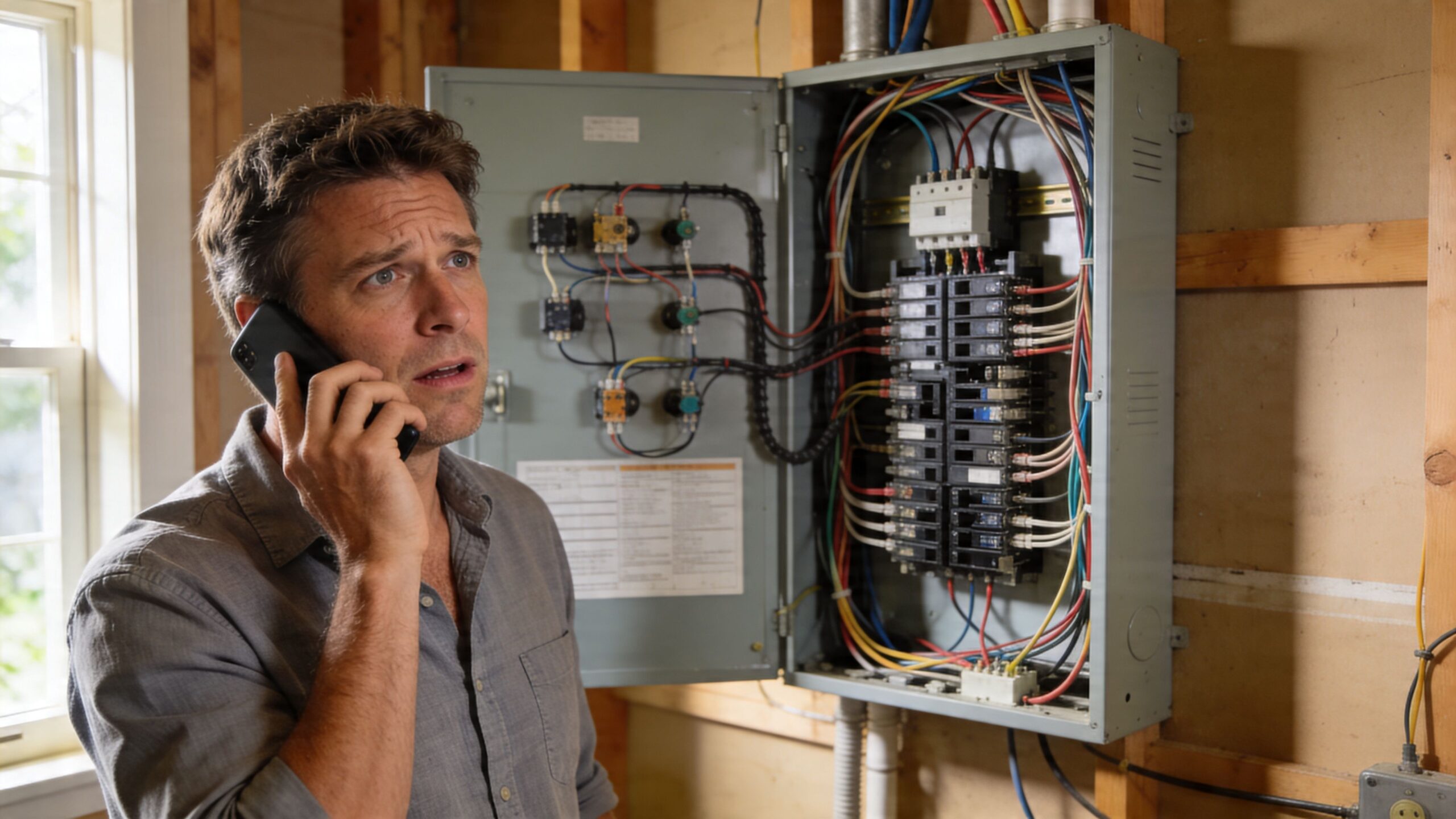
Situations that shouldn't stay DIY
Some jobs move out of homeowner territory quickly.
- The panel work isn't simple: If you need a new breaker, a new circuit, or panel evaluation, that's electrician work.
- The home has older wiring: Unknown modifications, crowded boxes, and aged conductors raise the stakes.
- The run requires trenching or conduit: Exterior routing has code details that matter, especially on long runs or exposed paths.
- The lighting system is part of something larger: Cameras, smart controls, photocells, and multi-zone switching add complexity fast.
- You see aluminum wiring or heat damage: Stop immediately and get professional help.
Palm Beach permitting and inspection issues
Local permitting isn't something to shrug off. Depending on the municipality and the scope of the work, hardwired exterior lighting may require a permit and inspection. That's especially true when a new circuit, new box location, or more substantial wiring work is involved.
This matters for two reasons. First, inspection catches problems before they become hidden failures. Second, unpermitted work can come back to haunt you during insurance questions, resale, or later electrical upgrades.
Hiring a licensed electrician isn't giving up on the project. It's choosing a finished result that won't have to be reopened.
When professional help saves money
Homeowners often think the professional route only costs more. Sometimes it prevents the expensive version of DIY, which is doing the work twice.
A licensed electrician can sort out circuit loading, grounding issues, permit questions, and mounting details in one pass. If you're comparing what falls under broader home electrical work, Jolt Electric has a straightforward overview of residential electrical services that helps show how quickly "just one light" can overlap with larger electrical concerns.
For local code compliance and permitted work in Palm Beach County, a licensed electrical contractor is the right lane when the installation goes beyond a simple fixture swap.
Testing, Troubleshooting, and Palm Beach Maintenance
Once the fixture is mounted and the cover is on, restore power and test the system methodically. Don't just flip the breaker and call it done. Verify that the fixture energizes correctly, the motion sensor sees approach paths, and the dusk-to-dawn function responds as it should.
Test the fixture under real conditions
Check operation in a way that matches actual use.
- Confirm switch behavior: Make sure manual override functions, if included, work as intended.
- Walk the detection zone: Approach from the driveway, gate, and walkway to see how the sensor reacts.
- Check for glare: Stand at doors, windows, and curbside to make sure the beam helps visibility instead of hurting it.
- Watch shutoff timing: The light should stay on long enough to identify movement, then reset cleanly.
If the fixture won't trigger reliably, revisit sensor angle first. If it stays on too often, lower sensitivity and check for moving vegetation or reflected light.
Troubleshoot the usual problems
Most post-installation problems come from a short list.
| Problem | Likely cause |
|---|---|
| Light doesn't turn on | Power issue, loose connection, incorrect switch or sensor setting |
| Light flickers | Loose splice, moisture intrusion, or failing fixture component |
| Light stays on | Sensor aimed at movement source, sensitivity too high, or photocell confusion |
| Range is poor | Mounting angle is wrong or the sensor is partially blocked |
Don't keep resetting the same fixture without inspecting the connections. Repeated nuisance behavior usually points to installation or placement, not bad luck.
Maintain it for the Florida climate
Palm Beach County is rough on exterior electrical equipment. In humid climates like this, corrosion affects 50% of non-sealed electrical units within 2 years, and regular maintenance that includes checking seals, cleaning fixtures, and applying dielectric grease can triple the life of the installation, based on the field guidance in this outdoor security light maintenance article.
That means maintenance isn't optional. It should be routine.
Use a simple schedule:
- After coastal storms: Wipe salt residue from lenses and sensor faces.
- Before hurricane season: Inspect caulk lines, gaskets, and fasteners for failure.
- During vegetation trimming: Make sure palms and shrubs haven't grown into the detection zone.
- During bulb or fixture checks: Look for rust bleed, insect intrusion, and water marks inside the lens.
A well-installed security light should fade into the background of daily life. It turns on when needed, stays off when it should, and keeps dark areas from becoming weak points around the property.
If you'd rather have the wiring, permitting, weatherproofing, and troubleshooting handled by a local pro, Lighthouse Energy Services provides residential and commercial electrical work throughout Palm Beach County, including exterior lighting installations, repairs, surge protection, and dedicated circuit work for properties that need a code-compliant setup.