
A breaker keeps tripping. One room goes dark. You reset it, and it trips again before you’ve even finished closing the panel door.
That’s the point where a lot of homeowners go from mildly annoyed to tempted to start pulling devices apart. Slow down. If you’re trying to figure out how to find electrical short in house wiring safely, the right approach is not guesswork. It’s controlled diagnosis, strict safety, and knowing where homeowner troubleshooting ends.
In Palm Beach County, this matters even more. Older homes, humid conditions, exterior equipment, attic heat, and aging insulation can turn a “small electrical nuisance” into a real hazard fast. You can do some safe triage. You should not treat hidden wiring faults like a weekend project.
Recognizing the Warning Signs of a Household Electrical Short
The most common starting point is simple. A breaker trips and won’t stay reset. Sometimes lights flicker first. Sometimes an outlet stops working. Sometimes you notice a sharp electrical smell, or a lamp works until you plug in one specific device.
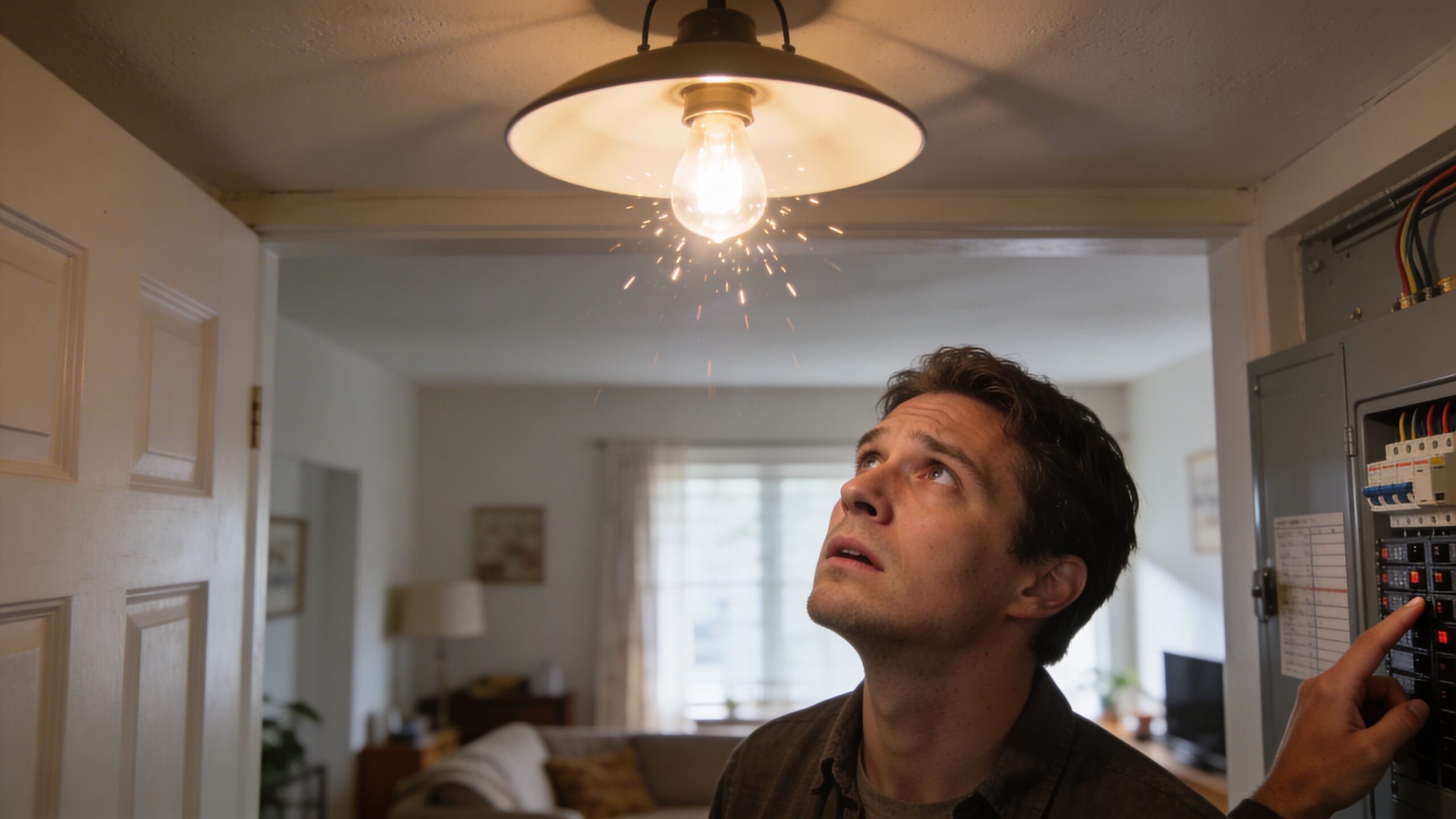
A short circuit happens when electricity takes an unintended path. Instead of traveling through the load it was meant to power, it jumps where it shouldn’t. That creates heat quickly. Breakers trip to stop damage, but the breaker tripping is the warning, not the problem itself.
What a short usually feels like in a real house
It rarely announces itself with technical language. It shows up as behavior:
- A breaker that trips repeatedly: Especially after you reset it properly and the load hasn’t changed.
- Flickering or dimming lights: Not every flicker is a short, but repeated flicker on one circuit deserves attention.
- A dead outlet or switch: Particularly if nearby outlets are acting strangely too.
- Burn marks or hot plastic smell: That points to overheating and requires caution.
- A breaker that trips when one appliance is plugged in: That often suggests the problem is in the device or cord, not the branch wiring.
If you’re seeing repeated trips, it helps to understand why a circuit breaker keeps tripping before you start testing. Not every trip is a dead short, but repeated trips always mean something needs attention.
Why this deserves more respect than most homeowners give it
A lot of people treat a tripping breaker like a nuisance. Electricians don’t. We treat it as the electrical system doing exactly what it was designed to do. It’s shutting power off before heat buildup gets worse.
That caution is backed by hard numbers. Residential electrical shorts and malfunctions caused 23,700 fires in 2023, leading to 305 deaths, 800 injuries, and $1.5 billion in property damage, according to the US Fire Administration’s residential electrical fire data.
Practical rule: If you smell burning plastic, see scorching, or hear arcing, stop diagnosing and shut the circuit down.
Older Florida homes add another layer of risk
In older homes, a short may not start at the obvious place. It may be inside a wall box, at a damaged light fixture lead, in attic wiring, or in an exterior run affected by age and moisture. That’s one reason short-finding in Florida homes can be deceptive. The visible symptom might be in the kitchen, while the fault is in an attic splice or weathered exterior cable.
Homes with older wiring methods also leave less room for DIY mistakes. A brittle conductor, a cracked insulation jacket, or a loose connection inside a device box can become dangerous the moment someone starts tugging wires around.
What this article can help you do
The useful goal is not “repair everything yourself.” The useful goal is to safely determine which of these buckets the problem falls into:
- A faulty appliance or cord
- A bad outlet, switch, or light fixture
- A likely hidden wiring fault that needs a licensed electrician
That distinction saves time, reduces risk, and helps you avoid making the fault worse while trying to find it.
Safety First Your Pre-Diagnostics Checklist
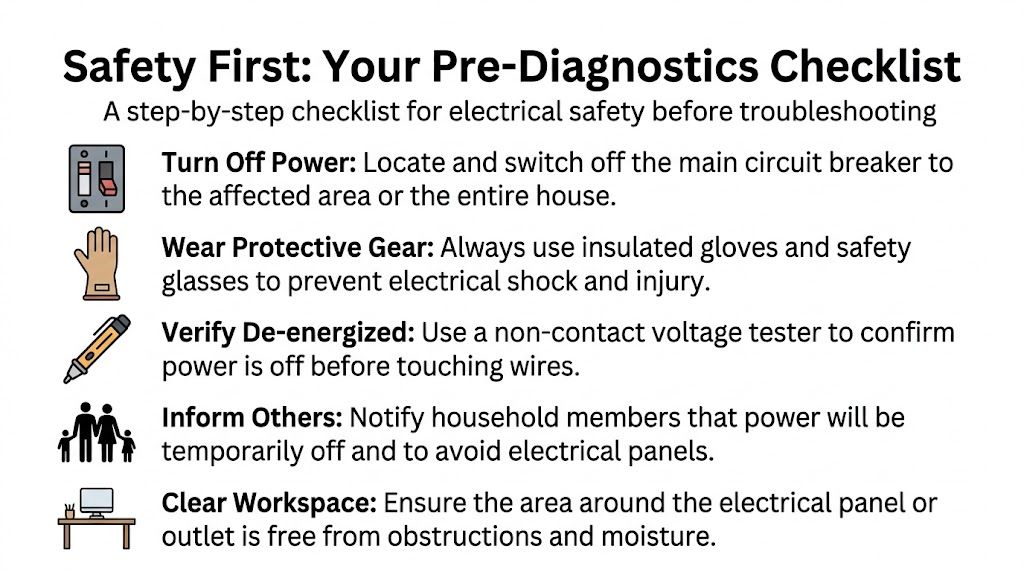
Before you touch a breaker, outlet cover, or tool, decide whether the situation is even safe to investigate. That decision matters more than the meter you use.
Stop conditions that mean you should not proceed
Do not continue with homeowner diagnostics if any of these are present:
- Smoke or active sparking
- A hot breaker panel
- Melted insulation or charred receptacles
- Water near the panel, outlet, or suspected fault area
- Buzzing inside the panel
- A main breaker issue instead of a single branch circuit issue
If any of those are happening, shut power off if you can do so safely and call a licensed electrician.
The safety checklist that actually matters
Basic electrical troubleshooting starts before the first test.
- Shut off the affected circuit: Don’t trust a wall switch. Use the breaker.
- Reset the breaker fully off before turning it back on: Partial movement can mislead you.
- Verify the circuit is dead: Use a tester before touching any conductor.
- Keep the area dry and clear: Garage floors, patios, utility rooms, and exterior locations create extra risk.
- Tell other people in the house what you’re doing: Someone flipping a breaker back on while you’re testing is a real hazard.
Older homes need even more caution. Guides often miss the risk in pre-1960s wiring, and CPSC reports indicate amateur DIY probing can worsen faults by up to 30% in misdiagnosed circuits, as summarized in this older-home short-circuit safety discussion.
If the house has older wiring and the fault isn’t obvious, the safest move is usually diagnosis only. Not disassembly, not repair.
What to wear and what to set aside
You don’t need a truck full of gear to do safe first-pass troubleshooting. You do need to avoid casual mistakes.
Wear:
- Insulated gloves: For basic protection while handling covers and devices after power is verified off.
- Safety glasses: Small debris, brittle plate covers, and accidental arcs are enough reason.
- Rubber-soled shoes: Especially on tile, concrete, garage slabs, and exterior areas.
Avoid:
- Bare feet or socks
- Wet hands
- Metal ladders near energized work
- Loose jewelry
Essential Toolkit for Finding an Electrical Short
| Tool/Equipment | DIY Use | Professional Use & Advantage |
|---|---|---|
| Non-contact voltage tester | Confirms a device or box is likely de-energized before closer inspection | Used as a first screening step, then verified with contact testing |
| Digital multimeter | Checks voltage and continuity during controlled diagnostics | Gives more reliable readings when used with circuit isolation and deeper fault tracing |
| Insulated screwdriver | Removes plates and device screws with power off | Used alongside methods that preserve wiring layout for proper reassembly |
| Flashlight | Helps inspect dark boxes, attics, and panel labels | Critical for spotting subtle discoloration, insulation damage, and overheated terminations |
| Notebook or phone photos | Records breaker numbers, device locations, and wire positions | Helps document branch layout and repeat testing without losing track |
| Circuit tracer | Usually not part of a homeowner kit | Lets pros track hidden wiring paths and narrow faults inside walls with less guesswork |
| PPE | Basic gloves and eye protection reduce exposure during inspection | Combined with training, procedure, and advanced tools for safer diagnostics in complex systems |
A broader home-prevention mindset helps too. If you’re reviewing household hazards beyond one tripping circuit, this fire safety inspection checklist is a useful companion for spotting conditions homeowners often overlook.
One check worth doing before any fault-hunting
If your home hasn’t had a recent electrical review, a full electrical home safety check makes more sense than chasing one symptom at a time. That’s especially true in homes with aging panels, renovated additions, outdoor equipment, or circuits that have “always been a little weird.”
Isolating the Problem Circuit and Performing a Visual Inspection
Most short-circuit calls start with elimination, not meters. The first job is to figure out whether the breaker is reacting to a plugged-in load or to the house wiring itself.
Start at the panel and be deliberate
Go to the breaker panel and identify the tripped breaker. Don’t assume it will look fully off. Many tripped breakers sit between on and off.
Push it fully off first. Then turn it back on.
If it immediately trips again with nothing changed, stop and pay attention. That usually means you’re not dealing with random nuisance behavior. Something on that circuit still has a fault.
The unplug-everything method works for a reason
This is one of the few homeowner steps that is both simple and useful.
Unplug everything on the affected circuit:
- lamps
- chargers
- countertop appliances
- televisions
- fans
- space heaters
- computer equipment
- anything hidden behind furniture
Then reset the breaker.
If the breaker now holds, start plugging devices back in one at a time. Give each one a moment. When the breaker trips after one specific item is connected, you’ve likely found the suspect.
That’s not theory. It’s how a lot of real faults reveal themselves. A cord pinched under a bedframe, a coffee maker with internal damage, or a lamp with a crushed plug can look harmless until load is applied.
A common real-world split
There are usually two paths at this stage.
Path one: The breaker stays on until a certain appliance is plugged in.
That points toward a device, attachment cord, or plug issue.
Path two: The breaker trips with everything unplugged.
That points toward the fixed electrical system, such as an outlet, switch loop, light fixture, junction box, or hidden cable damage.
When the breaker trips with nothing plugged in, stop suspecting the toaster and start suspecting the circuit.
What to inspect with the power off
With the breaker off and the circuit verified dead, begin a visual inspection. This is not the time to start disconnecting a dozen wires. You’re looking for evidence.
Check accessible outlets, switches, and fixtures on that circuit for:
- Discoloration on the cover plate
- Burn marks on the receptacle face
- Melted plastic near plug slots
- Acrid odor inside the box
- Cracked devices
- Loose devices that move in the wall
- Pinched cords at lamps or appliances
- Exterior fixtures with signs of moisture intrusion
Remove the cover plate if needed, but don’t start removing conductors unless you know how to document and restore the wiring correctly.
Where shorts hide in Florida houses
Palm Beach County homes create a few repeat trouble spots.
Attics and heat-stressed wiring
Attics are rough on insulation. Heat, age, past work by other trades, and stored items pressing on cable can all create damage. A cable jacket may look intact from a distance while a staple or abrasion has compromised the conductor inside.
Exterior runs and weather exposure
Outdoor lighting feeds, garage outlets, patio receptacles, pool-adjacent gear, and exterior light fixtures are all worth extra suspicion. Weather exposure and moisture are hard on terminations and devices.
Behind furniture and appliances
Some of the simplest faults are the easiest to miss. A recliner pinches a lamp cord. A dresser presses a plug sideways. A washing machine walks its own cord into a sharp edge. These aren’t dramatic failures. They’re hidden, ordinary damage that eventually trips a breaker.
Inspect like a detective, not a repair tech
A good visual inspection is about pattern recognition.
Ask:
- Did the problem start after a new appliance was added?
- Is the issue tied to one room, one receptacle, or one fixture?
- Does the breaker trip only when a switch is turned on?
- Are there signs someone replaced a device poorly in the past?
- Did the issue begin after storms, cleaning, painting, or furniture moving?
Those answers matter. If the breaker trips only when a vanity light switch is used, don’t waste time chasing kitchen countertop devices. If the issue began after patio work, inspect exterior boxes and buried or exposed runs first.
What does not work well
Homeowners often lose time doing the wrong things:
- replacing a breaker before proving the breaker is the problem
- swapping outlets at random
- wrapping damaged cords with tape and plugging them back in
- assuming “it’s fine now” because the breaker held once
- opening multiple boxes at once and forgetting what went where
That last one creates its own service call. If you open a device box, take clear photos before you disturb anything.
Using a Multimeter for Deeper Diagnostics
A multimeter helps after the obvious causes are ruled out and the circuit has been narrowed down. It can confirm that a receptacle is seeing proper voltage, show whether a disconnected part has continuity, and help you decide whether the likely problem is a bad device or damaged wiring. It cannot safely diagnose every fault in a finished wall, and it should never be treated as permission to keep probing a dangerous circuit.
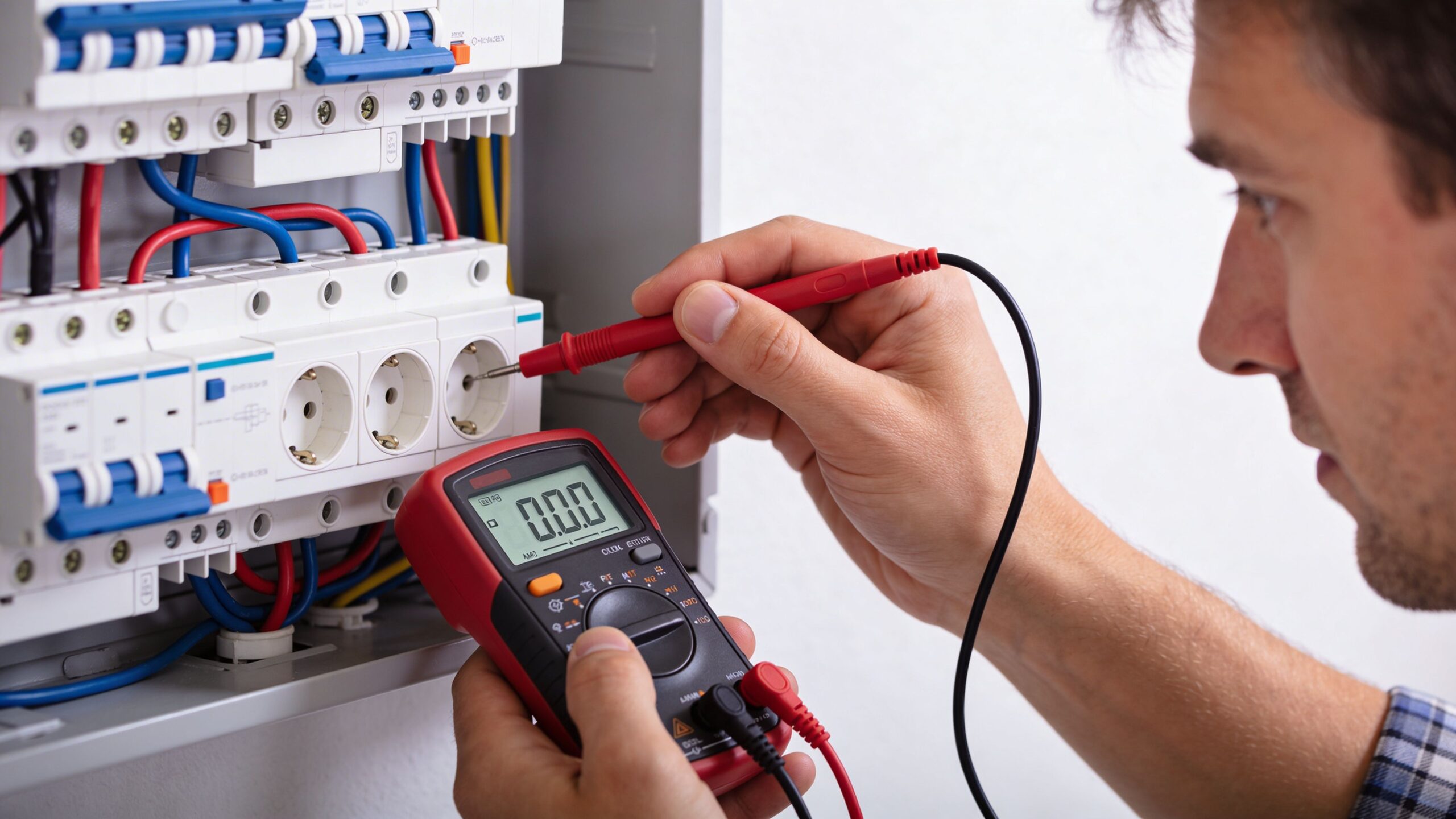
Older Florida homes add a layer of risk here. Humidity, salt air near the coast, aging receptacles, aluminum branch wiring in some eras, and DIY additions over the years can all skew what looks like a simple short. A meter still helps, but the readings need context.
What the multimeter can actually tell you
For household short-tracing, a digital multimeter is useful for three jobs:
- Checking whether voltage is present and roughly normal on a live circuit
- Checking continuity or resistance on a fully de-energized, isolated part
- Comparing one suspect device or wire segment against another
That last step matters more than many homeowners realize. The meter is often best at narrowing the field, not declaring the final answer.
Voltage testing on the affected circuit
Set the meter to AC volts on a range suitable for a standard residential branch circuit. If you are not fully comfortable placing probes on a live receptacle, stop here and call for service. Live testing is where capable DIY work turns into injury fast.
On a standard 120-volt circuit, the reading should be close to normal household voltage. A noticeably low reading, a fluctuating reading, or voltage that disappears under load points to a circuit problem, but not necessarily a dead short. Loose terminations, damaged conductors, overloaded circuits, failing devices, and corrosion can all cause abnormal voltage. Fluke's guidance on measuring voltage with a digital multimeter is a better baseline reference than informal videos because it focuses on meter setup and safe interpretation.
Treat abnormal voltage as a warning, not a challenge.
If an outlet on the problem circuit reads strangely and the breaker has been tripping, avoid resetting it repeatedly just to gather more data. In older homes, repeated energizing can worsen heat damage at a loose connection or damaged splice.
Continuity testing with power off
Continuity and resistance checks are more useful for short hunting, but only after the circuit is confirmed dead and the part being tested is isolated as much as possible. NEC-based safety guidance from the NFPA on electrical safety in the home supports the basic principle here. De-energize before handling conductors or testing resistance.
Start with this process:
- Turn the breaker off.
- Verify the circuit is de-energized with an appropriate tester.
- Disconnect the device or wire segment you want to test.
- Set the meter to continuity or ohms.
- Test the part by itself, not through lamps, electronics, or other connected loads.
A continuity beep or very low resistance can indicate an unwanted path, but there is no single homeowner-safe magic number that proves every short in every situation. The reading depends on what is still connected, the length of the wire, the meter, and the fault type. What matters is whether the circuit section shows continuity where it should be open, especially after you have removed switches, bulbs, fixtures, and plug-in loads from the equation.
A practical way to narrow the fault
Start with the most suspicious point on the circuit. That may be the receptacle that sparked, the exterior box that got wet during a storm, or the light fixture that trips the breaker the moment the switch is flipped.
Then work in short, controlled steps.
Test one suspect device at a time
With power off, remove the device from the box and inspect it. If the receptacle, switch, or fixture shows cracking, heat discoloration, brittle insulation, or loose backstab connections, that device is already high on the suspect list. Disconnect it and test again so you can tell whether the problem follows the device or stays in the branch wiring.
Isolate wire segments where you can reach both ends
If you can safely access both ends of a disconnected cable run, check for continuity between conductors that should not be connected. For example, hot to neutral or hot to ground continuity on an isolated cable can point to damaged insulation or a hidden staple strike. This method is limited, but it can save time before a service call.
Compare switched and unswitched paths
If the breaker trips only when a switch is used, isolate the switch leg and the fixture. In Florida homes, I see this often with bathroom vanity lights, exterior lanterns, garage lights, and attic fixtures where heat and moisture shorten the life of wirenut connections and fixture leads.
Where DIY testing usually reaches its limit
A meter works best on accessible parts. It works poorly on faults inside walls, in attic runs buried under insulation, or in exterior circuits with moisture intrusion that appears only during rain or heavy humidity.
That is common in this region. A patio light can test fine on a dry afternoon and trip the breaker after an overnight storm. A corroded exterior box can create leakage to ground without leaving an obvious visual clue. If your home is older and you are trying to sort out whether the issue is aging wiring, a past remodel, or original equipment at the end of its service life, this guide on choosing an electrician for an older or recently purchased home will help you ask better questions before work starts.
If you do hire someone, use the same standard you would for any high-risk trade work. Verify licensing, insurance, and scope in writing. Homeowners who are not sure how to screen service companies can review this practical guide on how to hire contractors.
Common multimeter mistakes that create bad conclusions
Bad readings usually come from bad setup.
- Testing resistance or continuity on a live circuit
- Trusting a breaker label without verifying the circuit is dead
- Leaving bulbs, appliances, or electronics connected during continuity tests
- Measuring through a device and assuming the wire behind it is bad
- Touching probe tips poorly and chasing unstable numbers
- Assuming one normal reading clears the whole circuit
Use the meter to answer a narrow question. Is voltage present? Does the isolated device appear faulty? Does this disconnected cable show an unwanted path?
That is enough for many homeowners. It is also enough to know when the problem has crossed into work that requires a licensed electrician with fault-finding tools beyond a handheld meter.
When DIY Is Not Enough Calling a Professional Electrician
A breaker that trips once can be a nuisance. A breaker that trips again after you have unplugged loads, checked visible devices, and tested what you can safely reach is a fault in the fixed electrical system until proven otherwise.
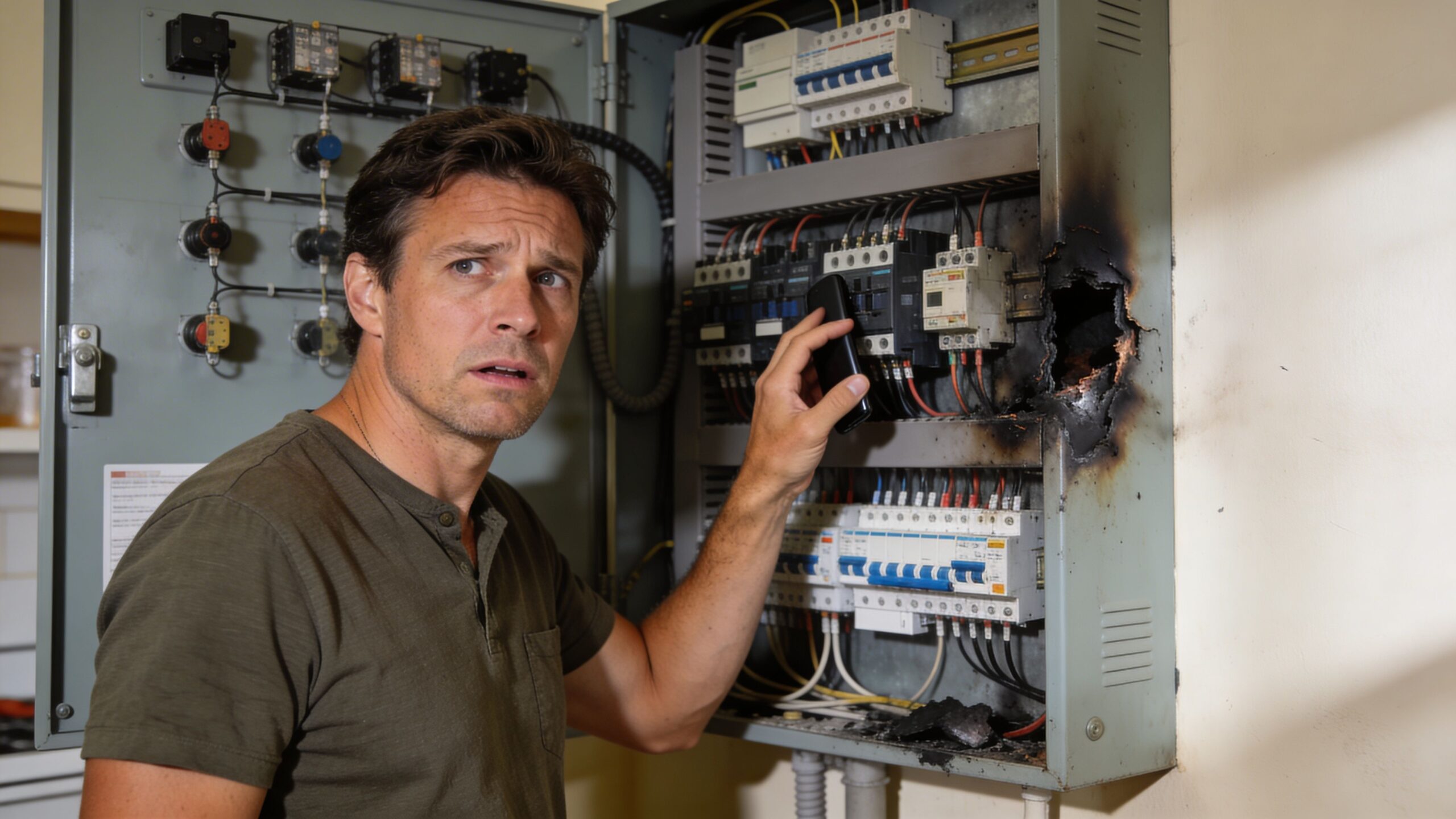
In older Florida homes, I take that seriously for a reason. Heat, humidity, wind-driven rain, salt air near the coast, older panels, attic wiring, exterior boxes, and decades of remodel work can all hide damage that does not show up in a quick outlet check. A circuit can look normal in the morning and fail after afternoon heat, moisture, or load changes.
Red flags that mean stop and call
DIY troubleshooting should end if you find any of these conditions:
- The breaker trips immediately with the circuit disconnected from normal plug-in loads
- You hear buzzing at the panel, meter can, or a device box
- You smell burning, fishy odor, or hot insulation
- You see scorch marks, arcing, melted wire insulation, or damaged bus connections
- The problem involves the main panel, service conductors, or meter equipment
- The likely fault is inside a wall, attic, slab, soffit, or exterior raceway
- Water intrusion is part of the story, especially at outdoor receptacles, pool equipment, garages, or lanai circuits
- The home has aluminum branch wiring, cloth-insulated wiring, or mixed old and new wiring methods
Those are hazardous conditions, not a cue to keep opening boxes.
The hard faults are usually hidden
The cases that stall capable homeowners are often intermittent. A bathroom GFCI trips only during heavy rain. A bedroom circuit holds all day, then trips after the attic heats up. An outside light works until moisture gets into a box or fixture whip. In older Florida properties, those patterns often point to insulation breakdown, loose terminations, damaged cable, wet exterior equipment, or a bad splice buried in past work.
The Noyafa article on hidden-wire short detection makes the same basic point from a troubleshooting angle. Hidden faults are difficult to confirm with basic homeowner tools. That matches what we see in service work. Once the fault is likely behind finished surfaces or tied to intermittent conditions, random drywall cuts usually waste time and create repair costs without finding the underlying failure.
What a licensed electrician brings to the job
A professional is not just bringing a better meter. A good troubleshooter brings a method.
That includes load isolation, circuit tracing, insulation resistance testing where appropriate, panel evaluation, and enough field experience to separate a failed device from a damaged cable or a panel problem. In older homes, that distinction matters. A homeowner may replace three receptacles and still miss the loose splice in the attic junction box or the wet exterior connection feeding the whole run.
At Lighthouse Energy, we also look at the house as a system. Florida homes often have additions, service upgrades, pool equipment, exterior lighting, detached structures, and older branch circuits tied together in ways the panel directory does not explain clearly. That is where accurate diagnostics save money. You fix the fault once instead of replacing parts until the symptom changes.
Choose a troubleshooter, not just an installer
Licensing and insurance are the baseline. Diagnostic ability is the key filter. If you are comparing companies, ask who will perform the troubleshooting, what testing they use before opening walls, and how they document findings. Homeowners who want a practical screening process can review this guide on how to hire contractors.
If the fault is showing up in a recently purchased home, an older property, or a house with renovation history, this guide to hiring an electrician for an older or newly purchased home will help you ask better questions before authorizing repairs.
Where the DIY line should end
Stop once the evidence points to hidden wiring, panel components, service equipment, water-damaged electrical parts, or a fault that appears and disappears without a clear visible cause.
That is the point where a 24/7 service electrician becomes the safe call. The goal is not to get the breaker to hold for one more day. The goal is to find the actual failure, repair it correctly, and make sure the circuit is safe to put back in service.
Your Next Steps for a Safe and Secure Home
Finding an electrical short is not about moving fast. It’s about moving in the right order.
Recognize the warning signs. De-energize the circuit safely. Isolate the load. Inspect visible devices and cords. Use a multimeter only when you understand what you’re testing and what the reading means.
The workflow that keeps people out of trouble
Keep the process simple:
- Treat repeated breaker trips as a safety issue, not an annoyance
- Rule out plugged-in appliances before suspecting hidden wiring
- Inspect for visible heat damage with the circuit off
- Use meter testing to confirm, not to guess
- Stop when the fault points to hidden wiring, panel components, or unstable conditions
That last step is where a lot of bad DIY work begins. The disciplined move is to stop there.
What solves the problem is not always what finds it
A homeowner can often identify the symptom and sometimes narrow the source. That’s useful. But the ultimate goal is not just to find the short. It’s to restore the circuit safely and keep it from happening again.
That usually means correcting the underlying issue, not just getting the breaker to stay on for the moment. A damaged cable, failing fixture, wet exterior box, loose termination, or compromised splice needs a proper repair.
Why advanced professional diagnostics matter
When the fault is hidden, the tools change. Advanced tools like the Ideal SureTrace circuit tracer have a 95% success rate in locating dead shorts within hidden wiring, while multimeters have a 70% limitation for that task, and the tracer can narrow faults to within ±6 inches, according to this SureTrace field demonstration and methodology reference.
That’s the difference between controlled diagnosis and destructive guesswork.
The safest conclusion
If your testing points to a bad lamp, damaged cord, or obvious failed device, you may have your answer.
If the breaker still trips with devices removed, if the evidence points inside walls, ceilings, attics, or exterior runs, or if the problem appears and disappears without a clear pattern, the smart move is professional service. That isn’t overreacting. It’s how safe homes stay safe.
Electrical faults reward discipline. They punish assumptions.
If you need a licensed electrician to diagnose a tripping breaker, hidden short, or recurring outage in Palm Beach County, contact Lighthouse Energy Services. Their team provides true 24/7 electrical service, transparent pricing, and experienced troubleshooting for residential, commercial, and industrial properties, with no extra after-hours charges.