
A lot of Palm Beach County electrical calls start the same way. The lights blink once, then twice. The air handler sounds wrong. A breaker trips during a storm, and suddenly you’re standing in a hot hallway or a dark lobby trying to decide whether this is a nuisance, a fire risk, or the start of a very long night.
That’s usually when people start searching names like try for electric inc and comparing whoever answers first. In a real emergency, that choice matters more than most homeowners and property managers realize. You’re not just hiring someone to restore power. You’re trusting them to make safe decisions around live equipment, storm-damaged circuits, service panels, rooftop systems, and in some cases code-sensitive lighting that can’t stay down for long.
The good news is that a rushed situation doesn’t have to lead to a bad hire. A few practical checks can tell you a lot about whether an electrician works like a pro or just talks like one.
When the Lights Go Out Your Guide to Palm Beach Electrical Emergencies
A summer storm moves through fast here. Wind pushes rain sideways, lights flicker, and then one part of the house goes dark while the rest stays on. In a condo building, maybe the hallway lights are still on but a unit panel keeps tripping. In a retail space, the sign is lit but the back office has no power. Those details matter.
The first mistake people make is treating every outage as “just a breaker.” Sometimes it is. Sometimes it’s a wet exterior connection, a failing breaker, a damaged appliance, or a neutral issue that needs a technician right away. If you want a quick primer before you call, it helps to understand what can cause a breaker to trip, because the pattern of the failure often points to the next safe step.
What to do in the first few minutes
Keep it simple and safe.
- Check scope first: Find out whether one room, one panel section, or the whole property is affected.
- Smell and sound matter: If you notice burning odor, buzzing, or crackling, stop touching switches and call for emergency service.
- Don’t keep resetting: A breaker that trips once may be overloaded. A breaker that trips again immediately is warning you about a fault.
- Protect equipment: If power is unstable, shut off sensitive electronics and HVAC controls if you can do it safely.
Practical rule: If you don’t know why it tripped, one reset is troubleshooting. Repeated resets are gambling with wiring.
Palm Beach property owners also deal with a local reality that generic advice misses. Storm exposure changes how electrical problems show up. Salt air, rooftop equipment, wet disconnects, and older exterior components can turn a small issue into a stubborn one.
Why contractor choice gets harder under pressure
The electrical trade is crowded, and it’s getting busier. The U.S. electrical contractors market reached USD 225 billion in 2022 and is projected to grow to USD 283.74 billion by 2028, which is one reason it’s smart to choose carefully instead of calling the cheapest name you find first (industry data).
That growth is good for the trade. It also means more noise for consumers. Some companies are excellent. Some send whoever is available. Some answer emergencies with a call center script and no technical guidance at all.
If you’re in the middle of an outage, it helps to compare your situation against a practical local guide like this Palm Beach emergency electrician resource: https://lighthouseenergyco.com/emergency-electrician-palm-beach-guide/
A calm process beats panic every time. Confirm the hazard, stop unsafe guessing, and then start screening the electrician.
Your First Call What to Ask and How to Verify
The phone call tells you a lot. Not everything, but a lot.
If the person answering can’t talk clearly about the issue, can’t explain licensing, or avoids direct answers about insurance and permitting, move on. A good electrical contractor doesn’t need to oversell. They should be able to explain how they’ll assess the job, what they need from you, and whether the problem sounds urgent enough for same-day dispatch.
Start with license and insurance
Before anyone touches your panel, check that they’re properly credentialed. For Palm Beach County homeowners and property managers, that means confirming an active Florida license and asking for proof of insurance.
Use this sequence:
Verify the contractor license
Search the company and qualifier through Florida’s DBPR system. Confirm the license is active and the classification matches electrical work.
Ask for a certificate of insurance
You want current proof of general liability and worker’s compensation coverage. If the company hesitates, that’s a problem.
Match the paperwork
The business name on the quote, vehicle, invoice, and insurance certificate should line up. If they don’t, ask why.
For a deeper look at what a properly credentialed contractor should have in place, this reference is useful: https://lighthouseenergyco.com/licensed-electrical-contractor/
Questions worth asking on the first call
Not all good electricians sound polished. Plenty of strong field people are blunt. That’s fine. What matters is whether the answers show discipline.
Ask questions like these:
- Who’s diagnosing the issue? You want to know whether a licensed professional is involved in triage.
- Will you pull permits if required? Repairs and replacements don’t all need the same paperwork.
- Do you provide written estimates? Verbal numbers create arguments later.
- How do you handle emergency calls? Ask plainly whether after-hours pricing changes.
- Do you document panel findings? Photos and notes matter, especially for HOAs and commercial sites.
The best call responses sound specific, not slick. “We’ll inspect the panel, identify the failed component, and tell you if the repair needs a permit” is a strong answer. “We do everything” is not.
Listen for signs they do the small things right
A lot of electrical failures start with basics done poorly. Loose terminations are a classic example. According to the NFPA, skipped torque checks on electrical connectors can lead to 12% of connection failures within two years, which is why serious electricians follow manufacturer torque specs instead of tightening by feel (reference).
That sounds like a shop detail, but it tells you how the company thinks. A contractor who talks about torque values, load conditions, breaker compatibility, and documentation is usually more reliable than one who shrugs and says they’ve “been doing it forever.”
A quick screen for property managers
If you manage condos, retail, offices, or mixed-use buildings, ask one more set of questions:
| Concern | Ask this | Good sign |
|---|---|---|
| Tenant disruption | How do you isolate work areas? | They discuss scheduling and shutoff planning |
| Documentation | Will you provide service notes? | They mention written findings |
| Repeat issues | Do you track recurring faults? | They look for root cause, not just reset and leave |
People often search try for electric inc because they need help fast. Fast is fine. Blind trust isn’t. Verify first, then schedule.
Decoding Electrical Quotes Beyond the Bottom Line
Bad hires don’t start with a crazy high bid. They start with a vague one.
A proper electrical quote should tell you what’s being diagnosed, repaired, replaced, installed, or excluded. If it doesn’t, you’re comparing prices without comparing scope. That’s how homeowners end up paying twice, and how property managers end up arguing over change orders that should have been obvious at the start.

What a clean quote usually includes
A solid estimate doesn’t need to be long, but it does need to be clear.
Look for these parts:
- Scope of work: Replace breaker, troubleshoot branch circuit, install EV charger, repair lighting circuit, or similar.
- Material description: Panel components, wire type, disconnects, devices, fittings, weatherproof parts.
- Labor basis: Flat-rate task, diagnostic fee, or quoted labor for a defined install.
- Permit handling: Included, excluded, or not required.
- Warranty language: What’s covered, and for how long.
- Exclusions: Drywall patching, painting, utility coordination, specialty lift access, or after-discovery repairs.
If a quote says only “electrical work as needed,” that’s not enough.
Cheap bids usually hide one of three problems
I’ve seen low quotes win jobs for the wrong reasons.
One leaves out permit responsibility. Another assumes existing wiring is reusable without testing it. Another prices the visible work and ignores access, weatherproofing, or replacement of failed supporting parts. The number looks great until the job starts.
A low number isn’t savings if the scope is missing half the job.
This is one reason estimating discipline matters. Even if you’re not in the trade, you can get a feel for how professionals organize labor, materials, and scope by looking at how electrical estimating software structures bids. Good estimates aren’t guesses. They’re built.
Value isn’t only the repair
Palm Beach owners should also read quotes with operating cost in mind, especially when the job involves HVAC load or EV charging. Pairing a Smartcool ECO3 with new electrical installations like EV chargers can significantly reduce AC load and create notable savings on combined electricity use, which can matter more over time than shaving a little off the install price.
That won’t apply to every service call. It does matter when you’re comparing upgrade proposals for homes, offices, and retail spaces where cooling load and added electrical demand hit the same utility bill.
Red flags that deserve a hard no
Skip the contractor if the quote shows any of these patterns:
- No detail: You can’t tell what equipment or labor is included.
- Pressure tactics: “Sign tonight or the price changes.”
- Cash-only language: Especially on permit-sensitive work.
- No mention of inspection or code compliance: A problem on larger upgrades.
- Blame-first posture: They’re already preparing to say everything hidden will cost extra.
Here’s a simple way to compare two proposals:
| Quote feature | Weak quote | Strong quote |
|---|---|---|
| Scope | Vague | Specific task list |
| Materials | Generic | Identified components |
| Permits | Not mentioned | Clearly stated |
| Warranty | Hand-wavy | Written |
| Added efficiency options | Ignored | Discussed when relevant |
If you’re reviewing try for electric inc against another contractor, compare the paperwork line by line. Don’t reward the shortest estimate. Reward the clearest one.
From High Rises to Hangars Specialized Service Considerations
Not every electrical contractor should handle every kind of property. A house panel swap, a high-rise common area issue, an industrial temperature loop, and a tower lighting fault may all fall under “electrical,” but they don’t call for the same habits, tools, or compliance knowledge.
That’s where people get tripped up with searches for try for electric inc. They assume any licensed electrician can take on any electrical problem. In practice, specialty experience matters.
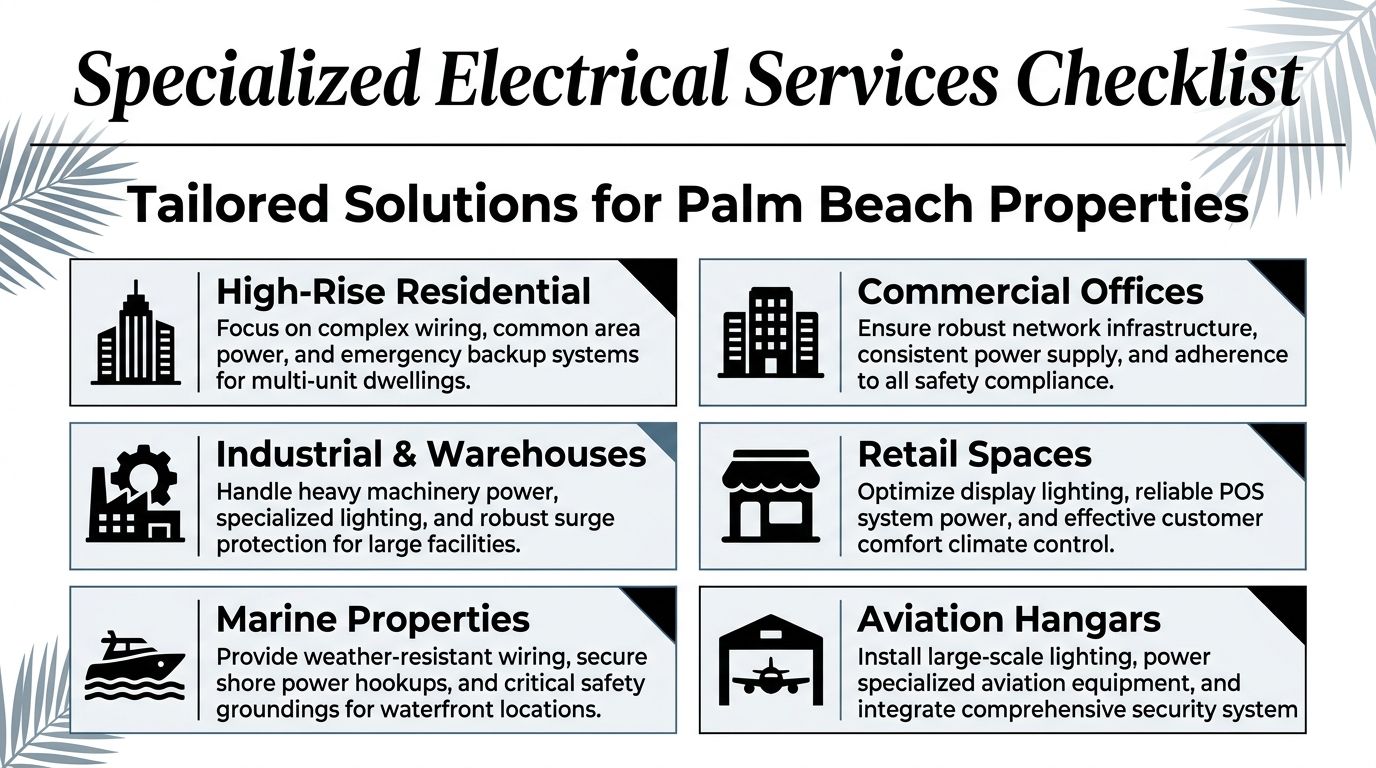
Residential and HOA properties
For homes, condos, and HOA-managed buildings, the best contractor usually isn’t the one who talks the biggest. It’s the one who can diagnose recurring nuisance trips, bad devices, damaged exterior components, and aging panels without turning every call into a full rewire pitch.
In Palm Beach County, storm prep should be part of that conversation.
A contractor worth keeping will talk about:
- Exterior equipment exposure: Disconnects, meter areas, and outdoor connections need attention after severe weather.
- Common-area reliability: For HOAs, lighting, gates, pumps, and life-safety-adjacent systems need organized maintenance.
- Clear shutdown planning: Residents need notice, especially in multi-unit properties.
Commercial and retail spaces
Commercial work has a different pressure. Downtime hurts tenants and staff immediately.
An office buildout or retail repair needs more than code compliance. It needs practical sequencing so work can happen without taking down the wrong circuits or disrupting network gear, registers, signage, or climate control longer than necessary.
For property managers, the right question isn’t only “Can you do the work?” It’s “Can you do the work while the building still functions?”
Industrial sites and controlled systems
Industrial electrical work is less forgiving.
Instrumentation, control loops, and hazardous-location equipment require better documentation and tighter installation discipline. For example, precise temperature monitoring systems require calibration accuracy within ±0.1% of span and installation compliant with ATEX/IECEx certifications for hazardous locations, which is a level of detail that separates general electrical service from qualified industrial work (spec reference).
That matters in warehouses, process environments, and facilities with sensitive equipment. A contractor who mainly swaps devices in houses may not be the right fit for those systems.
Aircraft obstruction lighting is its own category
This is one of the most overlooked service areas in Palm Beach County.
If a building, rooftop structure, or tower has aircraft obstruction lighting, you need more than a basic lighting repair mindset. These systems affect compliance and public safety. A 2025 FAA report noted that 15% of near-miss incidents in South Florida were linked to unmaintained tower lights, with non-compliance fines reaching up to $10,000 per violation (reference).
Those are not casual stakes.
Storm season complicates this further. Water intrusion, failed photocells, control issues, damaged fixtures, and monitoring failures can all leave a property owner exposed. The right contractor should be able to troubleshoot the lighting path, controls, fixture condition, and reporting process without treating the issue like a routine bulb change.
If your property includes this kind of system, this specialized Palm Beach reference is worth reviewing: https://lighthouseenergyco.com/aircraft-obstruction-lights/
If a contractor can’t explain how they handle rooftop access, storm-related failures, and verification of restored operation, keep looking.
Efficiency upgrades need to fit the property
Energy upgrades also vary by building type.
In a single-family home, the question may be whether AC optimization makes sense alongside an EV charger or panel work. In a commercial property, the question is whether the retrofit integrates cleanly with existing HVAC operation and tenant schedules. In an industrial setting, the focus shifts to whether efficiency changes affect controls, process loads, or maintenance access.
The job isn’t to install every gadget on the market. The job is to choose improvements that fit the building, the load profile, and the owner’s operating priorities.
Making Your Final Choice A Decision Checklist
By the time you’re down to two or three names, the decision usually gets framed as price versus speed. That’s too narrow. The better question is which contractor is least likely to create a second problem while solving the first one.
For homes, that means safe repairs and clean communication. For commercial and industrial sites, it means documentation, compliance, and predictable execution. If a contractor handles controlled systems, that bar gets higher. As noted earlier, some industrial temperature monitoring equipment requires ±0.1% span calibration accuracy and hazardous-location compliance under ATEX/IECEx, which is the kind of work that demands precision rather than improvisation.
Use this checklist before you hire.
Electrician Hiring Checklist
| Decision Criterion | What to Verify | The Gold Standard (Why It Matters) |
|---|---|---|
| Licensing | Active Florida electrical license under the correct business name | The company verifies credentials openly and doesn’t dodge the qualifier question |
| Insurance | Current certificate of insurance with relevant coverage | They send proof quickly and the documents match the quote and company name |
| Emergency response | How after-hours calls are handled | A real technical conversation, not just an answering service taking your address |
| Quote quality | Scope, materials, permits, exclusions, warranty | You can tell exactly what you’re buying and what could change |
| Troubleshooting approach | Whether they diagnose root cause or only reset/replace | They ask about symptoms, load behavior, prior failures, and site conditions |
| Workmanship discipline | Torque specs, testing, labeling, documentation | They describe process, not just years in business |
| Property type experience | Homes, HOAs, retail, industrial, rooftop systems | They can discuss your kind of building without speaking in generalities |
| Compliance awareness | Permit, inspection, and specialty system obligations | They flag code and access issues before the work starts |
| Communication | Who answers, who shows up, who explains the result | Clear chain of responsibility avoids confusion during urgent work |
| Long-term fit | Maintenance mindset and availability for future needs | Good contractors think past the single ticket |
A deciding factor often overlooked
Pick the company that makes fewer assumptions.
That sounds small, but it isn’t. Good electricians ask better questions at the beginning, inspect more carefully in the middle, and leave a clearer record at the end. That lowers risk for everyone involved.
Reliability starts before the first tool comes out of the truck.
If you’re comparing try for electric inc with other options, don’t ask who promises the most. Ask who verifies the most.
Building a Relationship with Your Electrician
The best outcome isn’t finding someone once. It’s finding someone you’d call again without hesitation.
That matters in Palm Beach County because electrical needs rarely stay one-time events. A homeowner who starts with a storm-related repair may later need panel upgrades, outdoor lighting corrections, or EV charging. A property manager who calls for an emergency may later need recurring maintenance, documentation, and help planning capital work instead of reacting to failures.
A good long-term electrician learns the property. They remember the panel condition, the recurring weak points, the previous repairs, and the systems that need special attention during storm season. That history saves time and avoids bad guesses.
Trust also tends to show up in the little things. Calls get returned. Scope stays clear. If conditions change on the job, the explanation makes sense.
That’s worth more than chasing a new low bid every time. With electrical work, familiarity and accountability usually age better than bargain pricing.
Your Electrical Questions Answered
Is there a difference between a handyman and a licensed electrician for small jobs?
Yes. A licensed electrician is the safer choice whenever the work touches panels, breakers, new circuits, service equipment, or anything permit-sensitive. Even “small” electrical work can hide bigger issues.
Can I reset a tripped breaker myself?
Usually, once. If it trips again, stop. Repeated resetting can mask a fault and make damage worse.
How often should a property manager have electrical systems checked?
There isn’t one schedule that fits every property. Age, storm exposure, load demands, and the type of equipment all matter. Buildings with recurring nuisance issues or rooftop systems should be more proactive.
What’s a sign a circuit may be overloaded?
Frequent tripping, warm devices, flickering under load, and power problems that show up only when certain equipment runs are all warning signs.
Is try for electric inc the right fit for every kind of job?
Not necessarily. The right contractor depends on the property type, urgency, and whether the job involves specialty systems like industrial controls or aircraft obstruction lighting. Match the contractor to the actual work, not just the company name.
If you want a contractor that handles residential, commercial, industrial, emergency, and specialized rooftop lighting work with real Palm Beach County experience, Lighthouse Energy Services is worth calling. They offer true 24/7 response, transparent pricing, and phones answered by licensed electrical professionals, which is exactly what you want when the problem can’t wait until morning.