
Understanding Your Federal Tax Credit for Panel Upgrades
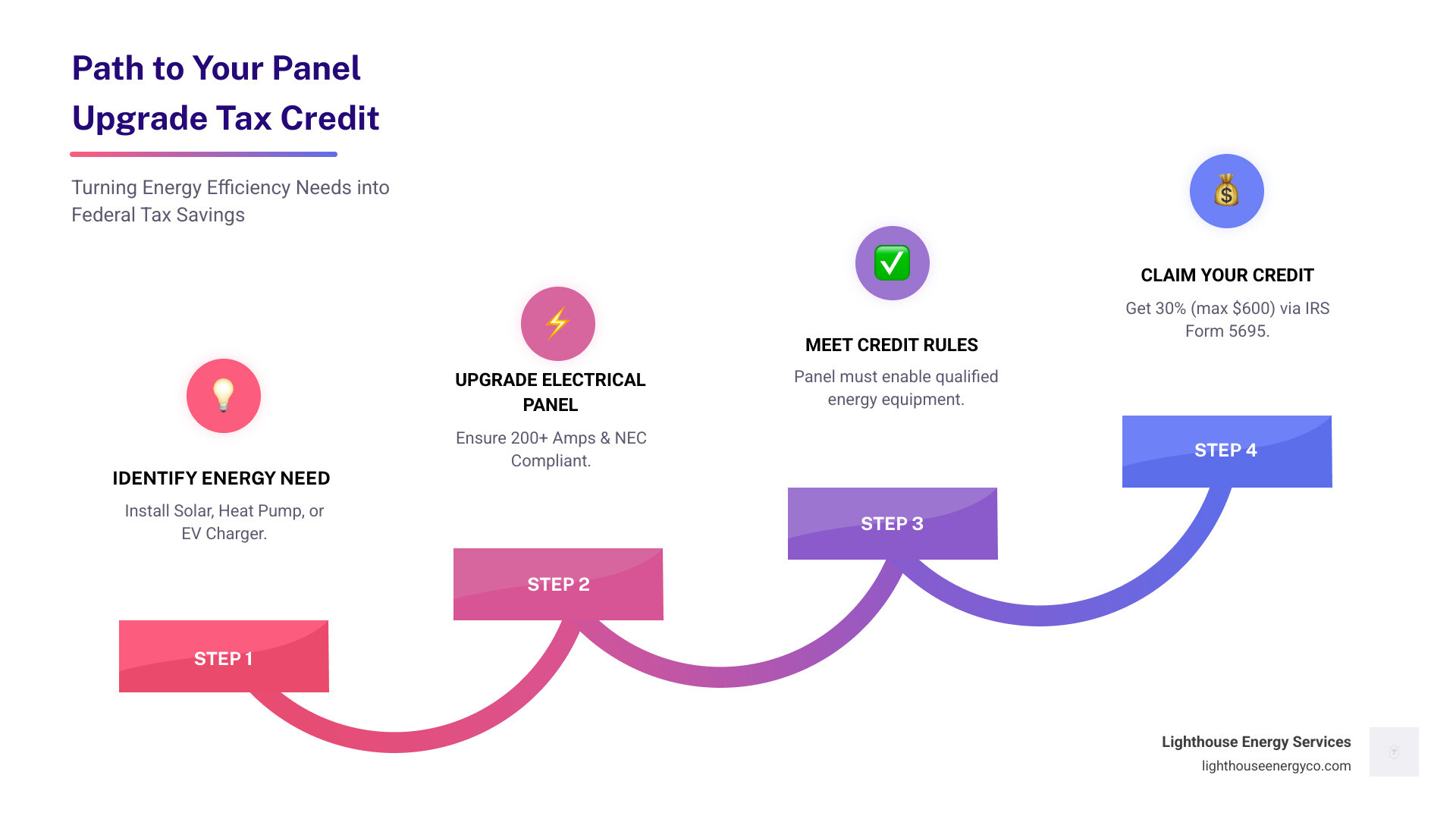
Are electrical panel upgrades tax deductible? Yes, they can qualify for a federal tax credit of up to $600, but there’s an important catch: the panel upgrade must be installed alongside another energy-efficient improvement like a heat pump or EV charger.
Quick Answer:
- Credit Amount: 30% of project cost, up to $600 maximum
- Effective Dates: January 1, 2023 through December 31, 2025
- Key Requirement: Panel must enable installation of qualified energy-efficient equipment
- Minimum Panel Capacity: 200 amps or more
- Who Qualifies: Homeowners and renters (not landlords)
- Form Needed: IRS Form 5695
Upgrading your electrical panel is often a necessary step when modernizing your home with solar panels, an EV charger, or a heat pump, as your existing panel may lack the capacity for these new demands. Recognizing this, the Inflation Reduction Act created a tax credit to help offset these costs.
The catch is that the panel upgrade can’t stand alone; it must be part of a larger energy-efficiency project to qualify, which requires strategic planning.
Understanding whether are electrical panel upgrades tax deductible is crucial for homeowners planning these essential improvements. This guide will help you maximize your tax benefits while ensuring your home is ready for the future.
Understanding the Energy Efficient Home Improvement Credit (25C)
The Energy Efficient Home Improvement Credit, or 25C tax credit, was improved by the Inflation Reduction Act of 2022. This federal program helps homeowners invest in energy efficiency.
For your electrical panel, you can claim 30% of your project cost as a tax credit, with a maximum of $600 for the upgrade. This is the direct answer to the question: are electrical panel upgrades tax deductible? Yes, through this specific credit.
Timing is important. Your panel upgrade must be completed between January 1, 2023, and December 31, 2025. While the Inflation Reduction Act extended many energy credits through 2032, the provision for panels under 25C has this earlier deadline.
It’s also important to know this is a non-refundable credit. This means it can reduce your tax liability to zero, but you won’t get a refund for any amount that exceeds what you owe. For example, if you have a $600 credit but only owe $400 in taxes, the credit will erase your tax bill, but the remaining $200 does not carry over or get refunded.
This is why planning with a tax professional is recommended. They can help you time your upgrades to maximize the benefit based on your specific tax situation.
For official rules, the IRS has comprehensive information available at their Energy Efficient Home Improvement Credit details page. It’s worth a read before you start your project.
Are Electrical Panel Upgrades Tax Deductible? Qualifying for the $600 Credit
So, are electrical panel upgrades tax deductible? Yes, but you can’t claim the credit for a standalone panel upgrade. The IRS requires it to be part of a larger project to make your home more energy-efficient. Your new electrical panel is the foundation that makes other clean energy upgrades possible.
Panel & System Requirements
Your new panel must meet specific technical standards to qualify.
Your panel must have a capacity of 200 amps or more. This capacity is necessary for modern systems like heat pumps, EV chargers, and solar installations. Smart panels that meet this threshold also qualify.
Everything must comply with the National Electric Code (NEC). This is a non-negotiable safety standard. A licensed electrician will ensure compliance, but it’s always good to confirm. You can learn more at the National Electric Code (NEC) website.
A key benefit is that labor costs are included in the credit calculation. The costs for on-site preparation, assembly, and installation of panelboards, sub-panelboards, branch circuits, and feeders all count toward your 30% credit.
The “Enabling” Clause: Combining with Other Energy-Efficient Upgrades
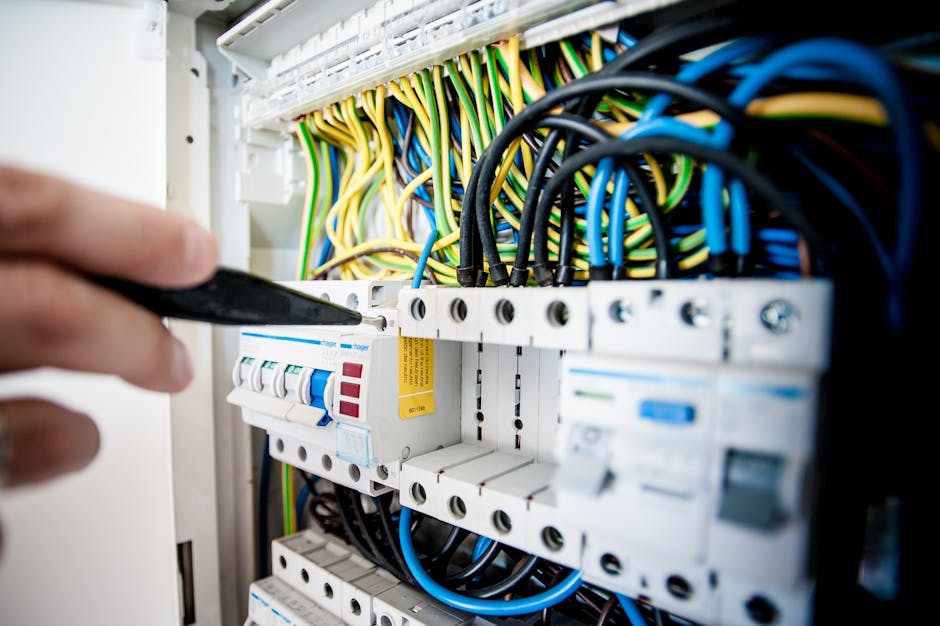
This is the core of answering are electrical panel upgrades tax deductible in a way that lets you claim the credit. Your panel upgrade must be installed to enable other qualified energy-efficient improvements. This “enabling” requirement is the linchpin of the credit.
For example, if you need to upgrade to a 200-amp panel to install an EV charger or add solar panels, that’s a qualifying combination.
A wide range of improvements qualify. Heat pumps provide efficient heating and cooling, and heat pump water heaters use ambient air to heat water. Upgrades to support a high-efficiency central air conditioner (ENERGY STAR rated), a solar energy system, or a Level 2 EV charger also qualify.
The key is to plan the panel upgrade and the energy-efficient improvement together to build a smarter, more efficient home.
Homeowner & Property Eligibility
Finally, let’s cover who can claim this credit.
Your property must be an existing home in the United States that you use as a primary or secondary residence. New construction does not qualify.
Both homeowners and renters can claim the credit, as long as they pay for the upgrade. Renters should get their landlord’s permission.
Landlords cannot claim this credit for rental properties they don’t live in. The credit is intended for residents, so landlords must explore other tax benefits for their rental properties.
Understanding these requirements upfront saves headaches. At Lighthouse Energy Services, we help homeowners in Palm Beach County ensure their upgrades meet all code, safety, and tax incentive requirements.
How to Claim Your Electrical Panel Upgrade Tax Credit: A Step-by-Step Guide
Claiming your tax credit is a straightforward, three-step process: plan, document, and file. Following these steps ensures you capture the savings you’re entitled to.

Step 1: Plan Your Project & Hire a Qualified Electrician
As established, the panel upgrade must enable another qualifying improvement, making the planning stage critical. You’re building the foundation for an energy-efficient home.
Assess your electrical needs. Are you planning to add solar, a heat pump, or an EV charger? A professional electrician can evaluate your system and determine the required capacity.
Your new panel must meet National Electric Code (NEC) standards, so hiring a qualified, licensed electrician is non-negotiable. This ensures the work is safe, compliant, and eligible for the tax credit.
At Lighthouse Energy Services, we specialize in assessing your home’s electrical capacity and performing upgrades that meet all safety and tax credit requirements. Our team understands the nuances of both the technical work and the documentation you’ll need. View our electrical services to see how we can help you plan and execute your project with confidence.
Step 2: Keep Meticulous Records
The IRS requires proof of your expenses. Without proper documentation, you could lose the $600 credit.
Your invoices are your most important documents. They should detail the work performed, itemize costs (including materials and labor), and identify the panel upgrade and the qualifying energy-efficient improvements.
Keep all receipts and proof of payment (bank/credit card statements, canceled checks) to create a clear paper trail. Ensure the invoice includes the contractor’s name, address, and license number to show the IRS you hired a qualified professional.
Create a dedicated folder for these documents to make tax season easier.
Step 3: File IRS Form 5695 with Your Tax Return
With your project complete and documents organized, claim your credit by filing IRS Form 5695, “Residential Energy Credits,” with your federal income tax return.
On Form 5695, Part II covers this credit. You’ll enter the cost of your panel upgrade on line 25a. The form guides you to calculate the 30% credit, up to the $600 maximum.
Submit Form 5695 with your Form 1040. The credit directly reduces your tax liability. For example, a $600 credit on a $2,000 tax bill reduces what you owe to $1,400.
We strongly advise consulting a tax professional. Tax laws are complex, and an expert can provide personalized guidance and ensure you meet all requirements. Tax software can also guide you through the process.
You can download the form and read detailed instructions directly from the IRS: IRS Form 5695 explained.
Maximizing Your Savings: Annual Limits and Strategic Planning
To maximize your savings, it’s important to understand the annual limits of the Energy Efficient Home Improvement Credit. With strategic planning, these limits can work in your favor.
The total credit is capped at $3,200 per year, but this is divided into categories with their own sub-limits.
A $1,200 annual sub-limit applies to home envelope improvements (windows, doors, insulation) and certain energy property. Your $600 panel upgrade credit falls into this category. If you also claim a $600 credit for windows in the same year, you will have maxed out this sub-limit.
There’s a separate $2,000 annual sub-limit specifically for heat pumps and heat pump water heaters.
Timing is everything. Let’s say you need a new panel, windows, and a heat pump. If you do it all in one year, you could claim $600 for the panel, $600 for windows (maxing out the $1,200 sub-limit), and $2,000 for the heat pump, for a total of $3,200.
However, if you also installed new doors and insulation in the same year, you would still be capped at the $1,200 sub-limit for that category, losing out on potential credits for those additional expenses.
Strategic planning is key. Consider spreading projects across multiple years. For example, do the panel and windows in year one (claiming $1,200), and the heat pump ($2,000) and insulation ($1,200) in year two. This approach could yield $4,400 in credits over two years, versus being capped at $3,200 in a single year.
The credit for electrical panels is available through 2025, giving you time to plan. Working with professionals who understand the technical and tax implications can help you create a timeline that fits your home and budget.
Frequently Asked Questions about Electrical Panel Tax Credits
Here are answers to some of the most common questions about the electrical panel tax credit.
Can I claim the credit if the electrical panel is my only upgrade this year?
No. The panel upgrade must be installed in conjunction with another qualifying energy-efficient improvement, such as a heat pump, solar panels, or an EV charger. The panel must enable the installation of this other equipment to qualify for the credit.
Are there state-specific tax credits for electrical panel upgrades in Florida?
While this guide focuses on the federal credit, many states, local governments, and utilities offer their own rebates. These can often be stacked with the federal credit for more savings. Florida residents should check the ENERGY STAR Rebate Finder by entering their zip code to find local incentives.
Does the cost of labor for the installation count towards the credit?
Yes. The total project cost used to calculate the credit includes both materials and labor. This covers on-site preparation, assembly, and installation of the panel and related components. Ensure your invoice itemizes these costs for your tax records.
What federal tax credits are available for electrical panel upgrades?
The primary credit is the Energy Efficient Home Improvement Credit (25C), which offers 30% of the cost up to $600, provided the panel enables another qualified improvement. If the panel upgrade is part of a solar installation, its cost may be included under the Residential Clean Energy Credit (25D), which is an uncapped 30% credit. Consult a tax professional to determine the best option for your project.
What are the eligibility requirements for the electrical panel upgrade tax credit?
To qualify for the 25C credit, your upgrade must meet these key requirements:
- Panel Capacity: The new panel must be 200 amps or more.
- Code Compliance: The installation must meet National Electric Code (NEC) standards.
- Enabling Clause: It must be installed in conjunction with another qualifying energy improvement (e.g., heat pump, EV charger).
- Property: The home must be an existing primary or secondary residence in the U.S.
- Claimant: Homeowners or renters who pay for the upgrade can claim it; landlords cannot for rental properties.
What is the maximum tax credit amount for an electrical panel upgrade?
The maximum credit is $600. The credit is calculated as 30% of your total project cost (labor and materials), but it is capped at $600. For example, a $2,000 project yields a $600 credit (30% of $2,000), while a $3,000 project is still capped at a $600 credit.
What is the timeframe for which the electrical panel upgrade tax credit is effective?
The credit is effective for panel upgrades placed in service between January 1, 2023, and December 31, 2025. Your project must be completed and operational within this timeframe to qualify.
How does the Inflation Reduction Act impact tax credits for electrical panel upgrades?
The Inflation Reduction Act (IRA) significantly improved and extended the 25C credit. It increased credit amounts and, crucially, clarified that supporting infrastructure like electrical panels can qualify when they enable other energy-efficient equipment. The IRA recognized that a modern panel is a necessary first step for electrification (e.g., heat pumps, EV chargers) and made it more affordable for homeowners to make this foundational investment.
Conclusion: Power Up Your Home and Your Tax Savings
Electrical panel upgrades are a foundational investment in a safer, smarter, and more energy-efficient home. As this guide has shown, they can also put money back in your pocket.
So, are electrical panel upgrades tax deductible? Yes, through the federal Energy Efficient Home Improvement Credit, you can claim up to $600 back on your qualifying panel upgrade.
The key takeaway is that the credit requires planning. Your new 200-amp panel must be installed alongside another qualifying energy improvement like a heat pump or EV charger. It’s about building a complete energy-smart system, with the panel as its backbone.
The window for claiming this credit runs through December 31, 2025. Keep your records organized, file IRS Form 5695, and consider spreading projects across tax years to maximize your benefits.
Beyond tax savings, an upgrade improves home safety, prevents fire hazards, and prepares you for future technology like EVs. It’s an investment in peace of mind, lower energy bills, and valuable tax credits.
For professional, code-compliant electrical work in Palm Beach County, trust Lighthouse Energy Services to get the job done right, and done right now. Our qualified electricians understand exactly what’s required for these tax credits. We’re here around the clock to assess your needs, plan your upgrade, and ensure everything meets NEC standards and IRS requirements.
Ready to power up your home and your tax savings? Explore our full range of electrical services and let’s get started on your upgrade today!