
Shore power gets oversold when people talk about it like every berth should be electrified tomorrow. In practice, shore power distribution systems are a targeted infrastructure investment, not a universal decarbonization shortcut. The ports that get the best results start with vessel classes that can use the system, then build the electrical architecture around those calls instead of forcing every terminal into the same template.
That distinction matters because the wrong berth, the wrong schedule pattern, or the wrong electrical interface can turn a clean technology into an expensive idle asset. The right project, by contrast, gives operators a real emissions cut at berth, a clearer compliance story, and a distribution system that holds up under marine conditions rather than looking good only on paper. For a useful framing on underlying energy cost exposure, the guide to grid electricity costs is a good companion resource when you're assessing dockside economics. For facilities that need an adjacent electrical context, the same planning mindset applies to marina electrical systems.
Table of Contents
- Where Shore Power Actually Delivers Results
- Market Growth and Grid Demand Forecasts
- Phased Project Workflow from Design to Commissioning
- System Architectures and Standards Compliance
- Procurement and Contractor Selection Framework
- Commissioning and Long-Term Maintenance Planning
Where Shore Power Actually Delivers Results
The hardest lesson from the dock is that shore power is not equally useful for every berth or vessel class. It works best where vessel schedules are predictable, connections are repeatable, and the ship's onboard electrical system is already compatible with the terminal architecture. That's why cruise ships, large container vessels, and ferries usually come first in serious deployment plans, while mixed-use berths and irregular call patterns often stay on the sidelines until the business case is clearer.
Start with the vessels that can actually plug in
Ports make better decisions when they sort berths by operational fit, not by aspiration. A berth that serves the same vessel class repeatedly is far easier to standardize than a quay that sees a rotating mix of ship types, load profiles, and call durations. The more variable the fleet, the more likely the project needs converters, extra switching logic, or a more conservative rollout plan.
That's where many programs stumble. Teams assume electrification is a terminal-wide package, then discover that only a fraction of calls justify the civil work, switchgear, and utility coordination. The better approach is to identify the calls that make a clean electrical match, then size the first phase around those calls only.
Practical rule: if the berth profile changes every week, the electrical design should stay conservative until the vessel mix stabilizes.
Use operating pattern as the filter
Predictable schedules matter because they reduce integration risk. They also make maintenance windows easier, which is where shore power either becomes a dependable utility or a recurring headache. When a ship arrives on a repeatable cycle, the operator can verify connector compatibility, cable handling, and energization sequence without improvising around every call.
The strongest projects usually combine three things, compatible ships, steady berthing patterns, and a terminal owner willing to treat the connection as core infrastructure rather than an accessory. If one of those pieces is missing, the project may still work, but it's more likely to become a partial solution than a full operational shift. That's why the first capital question is not “Should we electrify?” but “Which berths justify electrification first?”
Use cost and grid context before you commit
Even when a berth looks technically suitable, the economics still depend on local power pricing, demand charges, and available utility capacity. A terminal can't evaluate shore power in isolation from the grid bill. If you're building a preliminary business case, the electricity price guide for Australia is useful as a reminder that energy cost structure can change the payback conversation as much as hardware selection.
The main takeaway is simple. Shore power delivers the most value when it's aligned with ship compatibility, repeat call patterns, and clean electrical boundaries. If those aren't present, it may still belong in the long-term roadmap, but it shouldn't be forced into the first round of capital spending.
Market Growth and Grid Demand Forecasts
The market signal is straightforward, shore power distribution systems are moving from niche projects into mainstream maritime infrastructure. One recent estimate values the global shore power market at USD 2.40 billion in 2025 and projects USD 3.94 billion by 2030, which implies a 10.41% CAGR over that period. A second forecast puts the market at USD 1.78 billion in 2025 and USD 3.03 billion by 2030, or 11.2% CAGR, which points in the same direction even though the base assumptions differ (Mordor Intelligence).
That growth matters at berth level because it changes how projects get queued and executed. As more terminals compete for medium-voltage equipment, converters, and engineering capacity, shore power stops behaving like a one-off retrofit. It starts to look like a capital program with real scheduling risk, especially for teams that wait until the last minute to engage utilities and design partners.
Forecasts and demand ranges at a glance
| Forecast Source | 2025 Value | 2030 Value | CAGR / Demand Range |
|---|---|---|---|
| Market estimate one | USD 2.40 billion | USD 3.94 billion | 10.41% CAGR |
| Market estimate two | USD 1.78 billion | USD 3.03 billion | 11.2% CAGR |
| EU shore power demand analysis | Not stated | Not stated | 6 to 13 TWh per year from 2030 onward in EU ports, with 11.8 TWh, 5.9 TWh, and 13.12 TWh estimates |
Why the European grid number changes the conversation
The European demand analysis shifts shore power from a terminal problem to a grid-planning problem. An expected range of 6 to 13 TWh per year from 2030 onward across EU ports means utilities and regulators have to think about transformer capacity, feeder topology, and connection standards well before commissioning (Sustainable Ships). That is not abstract planning. It affects whether a port can get energized on time or whether it gets pushed into a multi-year queue.
For planners, distributed flexibility and local grid coordination matter. If your terminal also has on-site energy assets, the planning logic should follow the same approach used in the distributed energy resources guide, because the port is part of a wider electrical system rather than a closed island. Shore power changes upstream load management too, not just the load at the quay.
The commercial implication is direct. Projects that engage utilities early can shape the connection strategy before equipment is ordered. Projects that do not often find late that the electrical envelope, substation capacity, or switching architecture needs redesign, and that is where schedules slip and costs rise.
What buyers should read into the growth trend
Rapid market growth does not mean every berth should be electrified at once. It means the supply chain, design workload, and regulatory attention are all increasing together. That combination rewards early technical definition and punishes vague scopes.
For port authorities and asset managers, the right conclusion is simple. The market is expanding, so the technical scope has to be locked earlier than before. That is what keeps a shore power project from turning into a rushed utility interconnect with a marine label on it.
Phased Project Workflow from Design to Commissioning
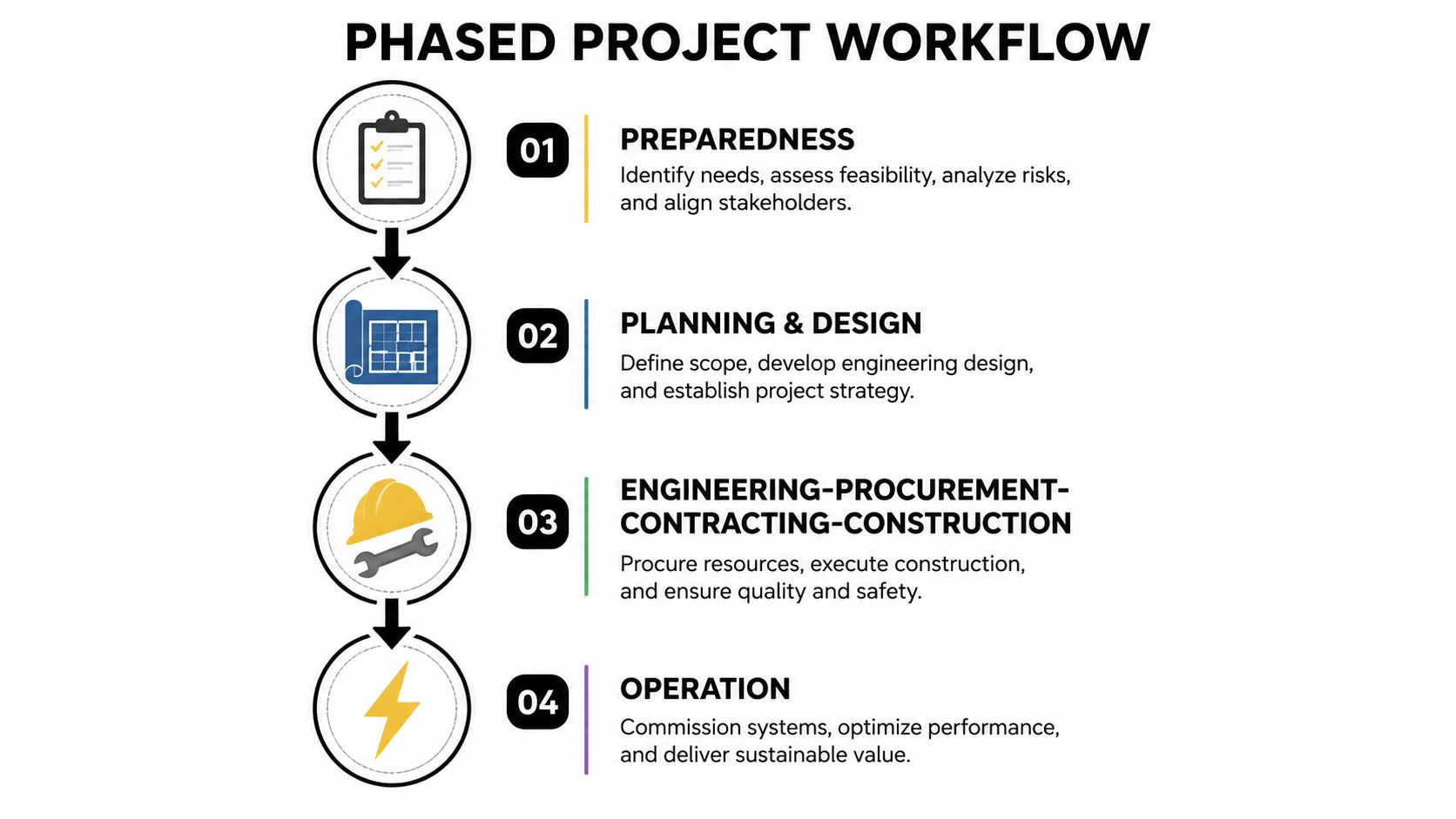
Shore power is built in phases for a reason. A terminal can't solve vessel interface, utility interface, civil layout, protection coordination, and operational procedure in one shot without increasing risk. The strongest programs treat the work as a long-lead capital project, and major guidance points to four phases, preparedness, planning and design, engineering-procurement-contracting-construction, and operation (EMSA guidance).
Preparedness comes before drawings
Preparedness is where most future problems are avoided. At this stage, the team confirms berth use cases, vessel compatibility, utility availability, and the standards envelope before anyone starts ordering gear. If the project skips this step, the later design work becomes a guessing exercise.
The practical deliverable here is a scope that reflects the terminal. That means defining which berths will be served, which vessel classes are in play, and what the operational sequence looks like at the dock. Teams that try to skip to equipment selection usually pay for it later in redesigns, change orders, and delayed approvals.
Planning and design should lock the interfaces
Planning and design are where engineering discipline matters most. The electrical one-line, grounding approach, connector strategy, cable management concept, and utility interconnect all need to line up before procurement starts. This is also where the wrong assumptions become expensive, because a mismatched concept may still look functional on paper.
A useful benchmark from industry guidance is that complete delivery can take about 2 years from design to commissioning (EMSA guidance). That timing is consistent with the need to finish detailed engineering, secure funding, select standards-compliant equipment, and coordinate with all parties before energization. Shortening the schedule by cutting design depth usually backfires.
The fastest projects are rarely the ones that skip engineering. They're the ones that finish engineering early enough to avoid rework.
EPC and construction are execution, not discovery
Engineering-procurement-contracting-construction should be the phase where the design gets built, not where the design gets invented. That only works if the front end is solid. If the specs are vague, the contractor ends up making decisions in the field that should have been settled months earlier.
A common failure mode is underestimating specification quality. The same guidance explicitly favors detailed plans, reputable manufacturers, and engineers experienced in international shore power standards, which tells you where the schedule risk sits (EMSA guidance). If the drawings don't define the interface cleanly, commissioning becomes an argument instead of a test.
Operation needs to be designed early
Operation shouldn't be an afterthought. The team needs to decide how connections will be inspected, who clears faults, how communication with vessel crews works, and what gets logged during each call. If those rules don't exist before startup, the first season becomes trial by fire.
The best projects leave construction with a real operating model, not just energized hardware. That means trained staff, documented procedures, and a service plan that matches the terminal's actual call pattern.
System Architectures and Standards Compliance
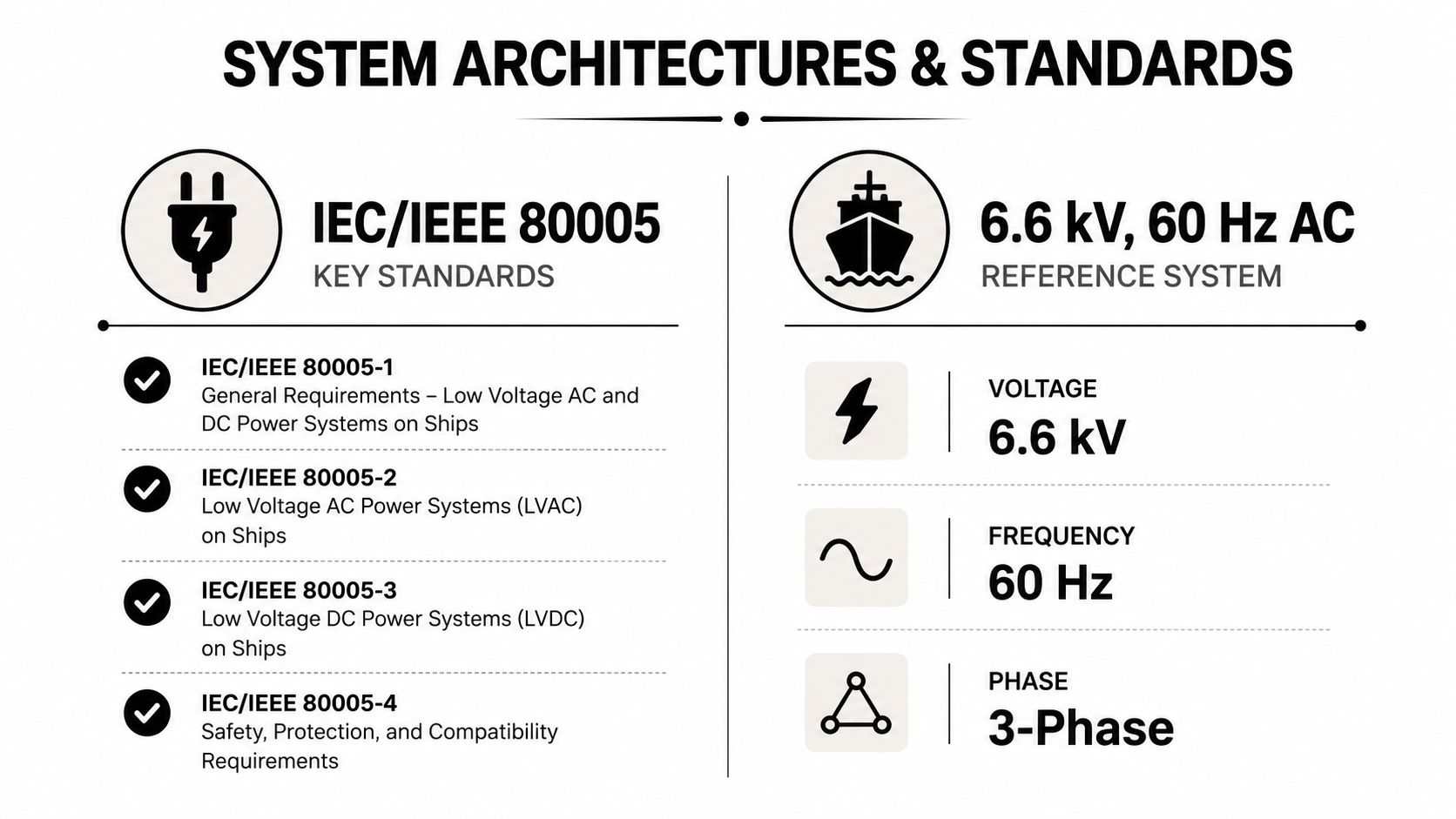
Shore power only works when the berth, the vessel, and the utility side are designed to meet the same electrical assumptions. If the port treats each call as a one-off, the result is a custom-connector problem that never really scales. For marine and offshore shore connections, the IEC/IEEE 80005 series is the main reference family, and tanker projects should also be checked against the recommended shore supply configuration of 6.6 kV AC, 3-phase, 3-wire, with protective earth and 60 Hz at the terminal side (OCIMF). That pushes the terminal design toward medium-voltage protection, switching, and conversion equipment, not the low-voltage auxiliaries that belong elsewhere on the dock.
Standardized design beats improvised connection logic
The value of a standard is repeatability. When the ship and shore systems match on voltage, frequency, grounding, and connector configuration, the terminal can use a simpler architecture with fewer conversion stages and fewer points of failure at the berth.
Mismatch is what drives cost. If voltage or frequency does not align, the project may need converters or transformers to bridge the gap, and those devices add capital cost, space demand, and maintenance burden. The same problem appears with grounding and connector layout, because a poor fit makes commissioning slower and future support harder to manage.
Size the electrical envelope first
The safest engineering approach is to size the gear around the actual high-power envelope from the start. For many large-vessel applications, 6.6 kV and 60 Hz becomes the reference point, so protection coordination, cable handling, and switching logic should be built around that level from the outset (OCIMF). If the terminal later tries to retrofit its way into the right envelope, it usually pays twice, once for the first build and again for the correction.
For broader electrical context on how the pieces fit together, the electrical distribution systems overview is a useful reference. The same rule applies at the port, define the upstream and downstream interfaces before the hardware arrives on site.
Good architecture reduces hidden operating costs
A standards-based shore power system is easier to troubleshoot because the fault tree is narrower. Engineers know what the nominal supply should look like, which simplifies testing and makes anomalies easier to isolate. That matters on the dock, where downtime is visible and each delay affects vessel schedules.
The practical conclusion is straightforward. If the port cannot commit to the right standards for the berth and vessel class it serves, the project should be redesigned before procurement, not patched after energization. Standards compliance is the cheapest place to resolve mismatch, and the most expensive place to ignore it.
Procurement and Contractor Selection Framework
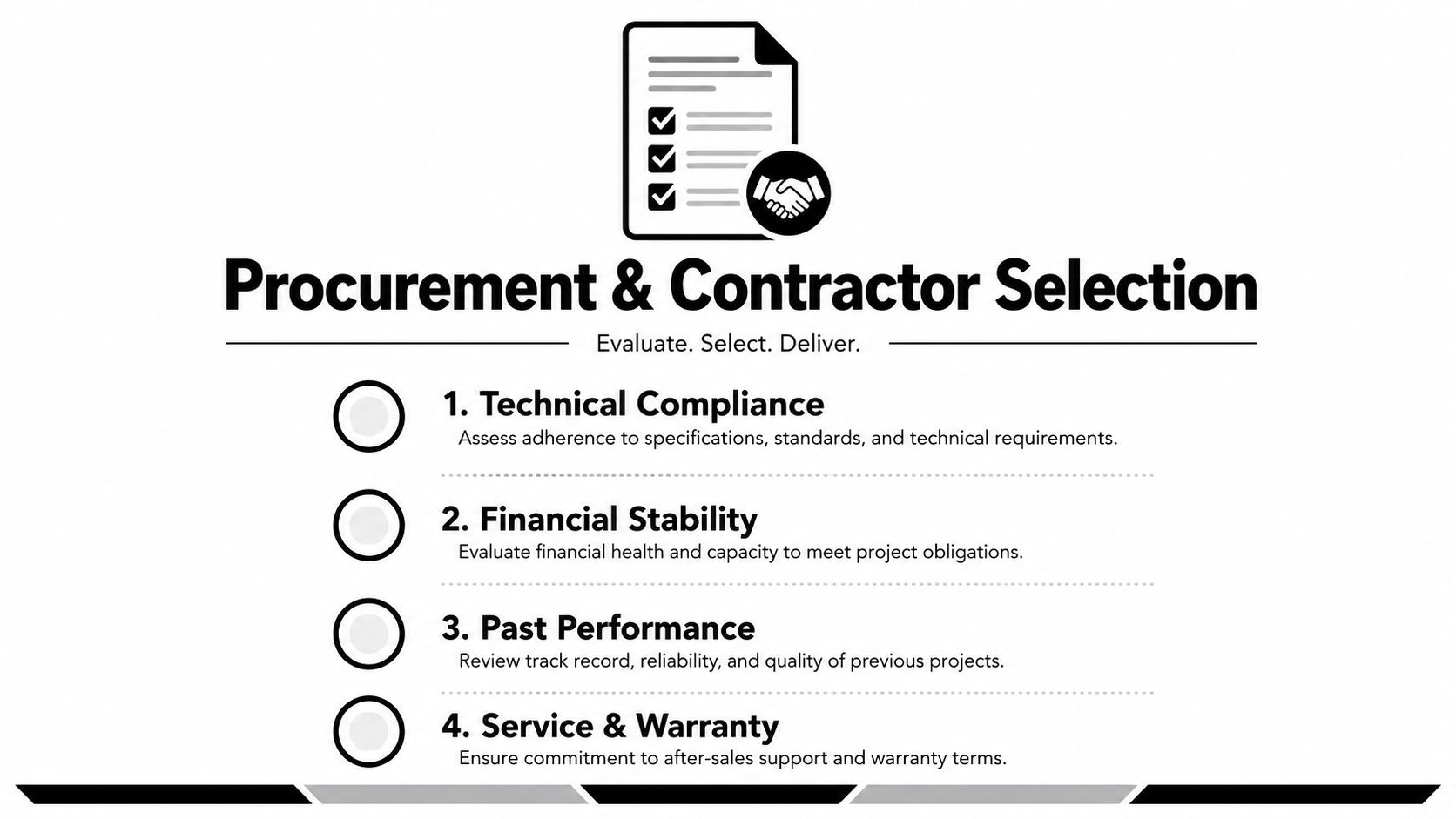
Shore power procurement should reward evidence, not polished presentations. Two bids can look similar on price and still carry very different integration risk, especially if one team has deep standards experience and the other is treating the job like a generic electrical install. The decision needs to combine technical compliance, financial stability, past performance, and service and warranty terms into one scorecard.
Read the proposal for what it leaves out
The best RFP responses don't just say yes to the scope. They explain how the proposer will manage standards compliance, utility coordination, vessel interface, and commissioning risk. If a proposal is vague on any of those points, the omission usually shows up later as change orders or schedule delays.
A good reviewer asks practical questions. Who is handling the detailed engineering? What similar systems has the team delivered? How will warranty claims be supported after startup? Those answers matter more than a glossy summary because shore power is an integration business, not a brochure business.
Verify standards experience, not just electrical experience
A qualified electrical contractor isn't automatically a qualified shore power contractor. The job requires familiarity with international shore power standards, medium-voltage practices, and the operating constraints of marine terminals. That's why selection criteria should explicitly include compliance knowledge and documented experience with comparable interfaces.
Practical rule: if the bidder can't explain grounding, conversion, and interface management in plain terms, keep digging.
Service capability matters too. A system that cannot be supported after commissioning becomes a stranded asset when a connector, relay, or control sequence fails. Contracts should spell out response expectations, spare parts support, and warranty boundaries before any equipment ships.
Protect schedule with cleaner contracting
Shore power projects fail most often when the contract treats critical interfaces as details. The buyer should define who owns utility coordination, who validates vessel compatibility, and who closes out as-built documentation. If those responsibilities are ambiguous, the project can technically be “on time” while still missing the operational handoff.
For organizations that need a broader facilities perspective, the logic is similar to quality assurance for facilities, where the best outcomes come from disciplined verification rather than hopeful turnover. That's exactly how shore power procurement should be run, with verification steps written into the contract, not improvised at the end.
The cleanest procurements usually do one thing well. They force bidders to show how they'll reduce integration risk. That's the right lens for a project where the cost of a mismatch can be far higher than the cost of a disciplined specification.
Commissioning and Long-Term Maintenance Planning
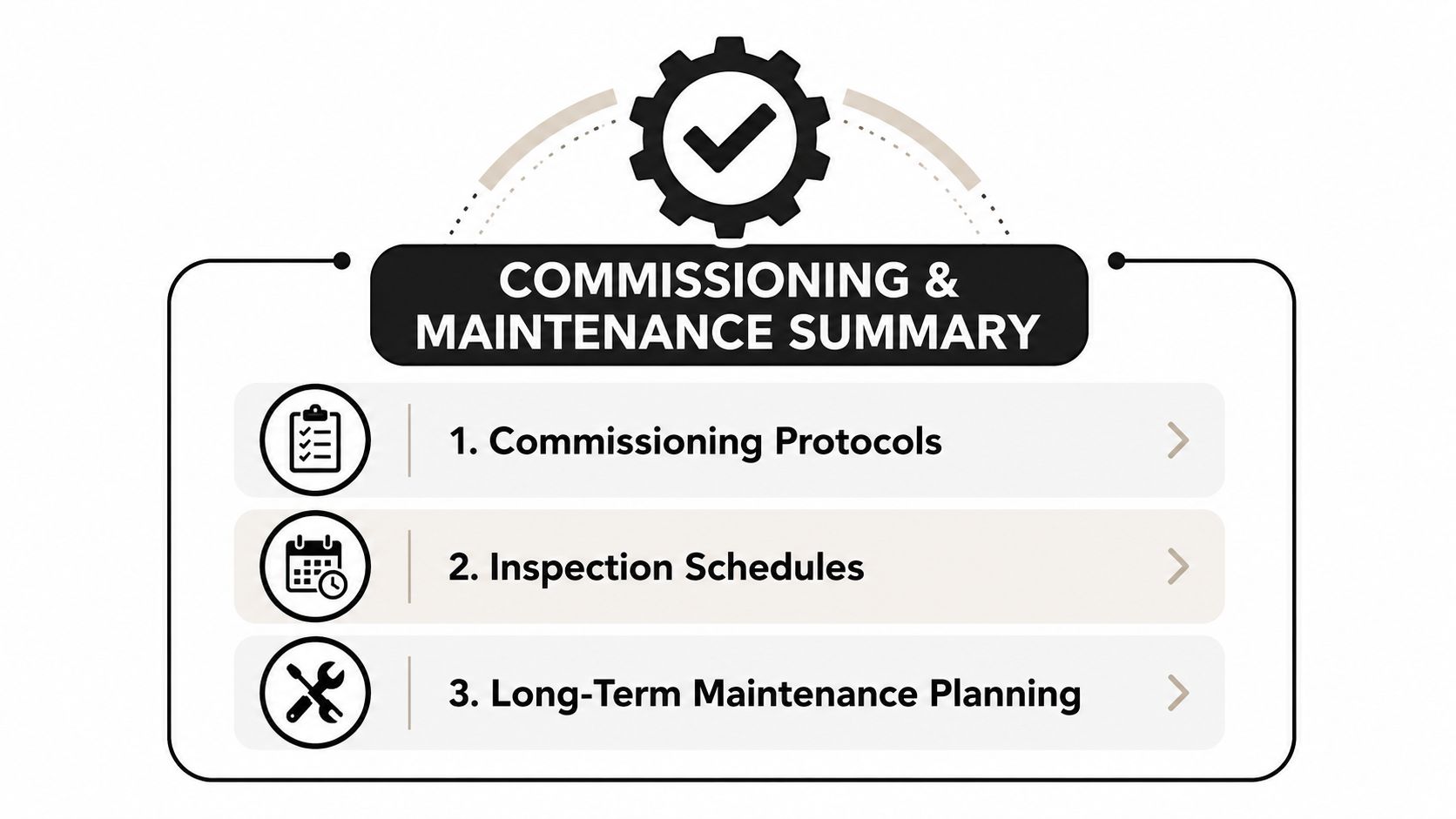
Commissioning is where good shore power projects become reliable shore power assets. The handoff has to prove that the system is safe, standards-aligned, and ready for the ship classes it was built to serve. That means testing the full chain, protection, switching, conversion where applicable, cable handling, grounding continuity, and operator procedure, before the first live call settles into routine.
Commission for the dock, not the drawing set
A terminal can pass paperwork and still fail in real use if the connection sequence breaks down under operational pressure. Commissioning should verify how the equipment behaves with the actual cable management system, the actual berth geometry, and the actual crew workflow. That is where issues like connector wear, grounding drift, and interface confusion show up early enough to fix.
This is also where documentation discipline pays off. The commissioning record should show what was tested, what passed, what was adjusted, and what remains under observation. If that record is thin, maintenance teams inherit uncertainty instead of a baseline.
Build inspection into the operating model
Shore power systems need scheduled inspection, not occasional attention. Protection devices, conversion equipment, connectors, and cable handling components should all be checked against the site's operating environment and duty cycle. Ports that treat maintenance as part of the initial scope usually avoid the worst surprise repairs later because the equipment doesn't get allowed to drift into ambiguity.
A helpful mindset comes from broader commercial electrical maintenance practices, where reliability depends on repeatable inspection, not emergency response alone. The same logic applies here, except the consequences include vessel scheduling and compliance exposure.
Keep the maintenance standard simple. If a crew can't tell whether a component is drifting out of spec, the inspection plan is too weak.
Keep the vessel mix under review
The fleet doesn't stay still, and neither should the maintenance plan. A berth that initially serves one vessel class may later see a different mix of calls, which can expose compatibility gaps the original design didn't need to solve. That's why long-term planning has to include periodic review of the vessel profile, the connection sequence, and the spare parts strategy.
The best-run systems are the ones that stay operational because the port keeps learning from each call. If the team records issues consistently, recalibrates the procedure, and maintains the equipment before failure, the shore power asset does what it was supposed to do in the first place, support the berth without becoming the story.
Lighthouse Energy Services can help you plan, build, and maintain the kind of electrical infrastructure that has to work the first time and keep working under pressure. If your facility or port project needs disciplined power distribution planning, commissioning support, or long-term maintenance, visit Lighthouse Energy Services and get the conversation started with a team that understands complex electrical work.