
If you're in Palm Beach County and the forecast starts tightening up, the same questions come fast. Will the power stay on. How long will the outage last. Can the refrigerator, air conditioning, gate, alarm, well pump, internet, and medical devices keep running if the grid drops.
That's when a lot of homeowners start searching for an accurate whole house generator installation cost, and most of what they find is too generic to be useful. A national price range doesn't tell you much when your property has HOA rules, strict permitting, coastal weather exposure, fuel line challenges, and a panel that may or may not be ready for a standby generator.
A whole-house system is a permanent backup power installation tied into your electrical system and fuel supply. It's not the same as rolling a portable unit out of the garage, pulling extension cords, and hoping you sized it right. In Palm Beach County, the details matter. Placement matters. Code compliance matters. Hurricane season definitely matters.
Table of Contents
- Why Invest in a Whole House Generator for Your Florida Home
- Deconstructing the Whole House Generator Installation Cost
- Major Factors That Influence Your Final Price Tag
- Palm Beach County Installation Rules You Cannot Ignore
- From Quote to Power On A Realistic Timeline and Scenarios
- The Long-Term View Maintenance ROI and Financing
- Frequently Asked Questions About Generator Installation
Why Invest in a Whole House Generator for Your Florida Home
A Palm Beach County outage rarely feels like a minor inconvenience. After a storm, the heat builds inside fast, refrigerators start losing temperature, phones and batteries drain, garage doors become unreliable, and families begin doing outage math hour by hour. If someone in the home depends on refrigerated medication, mobility equipment, or stable cooling, the stress rises even faster.
That's why homeowners who've lived through more than one storm stop looking at standby power as a luxury item. They start treating it like a property protection system.
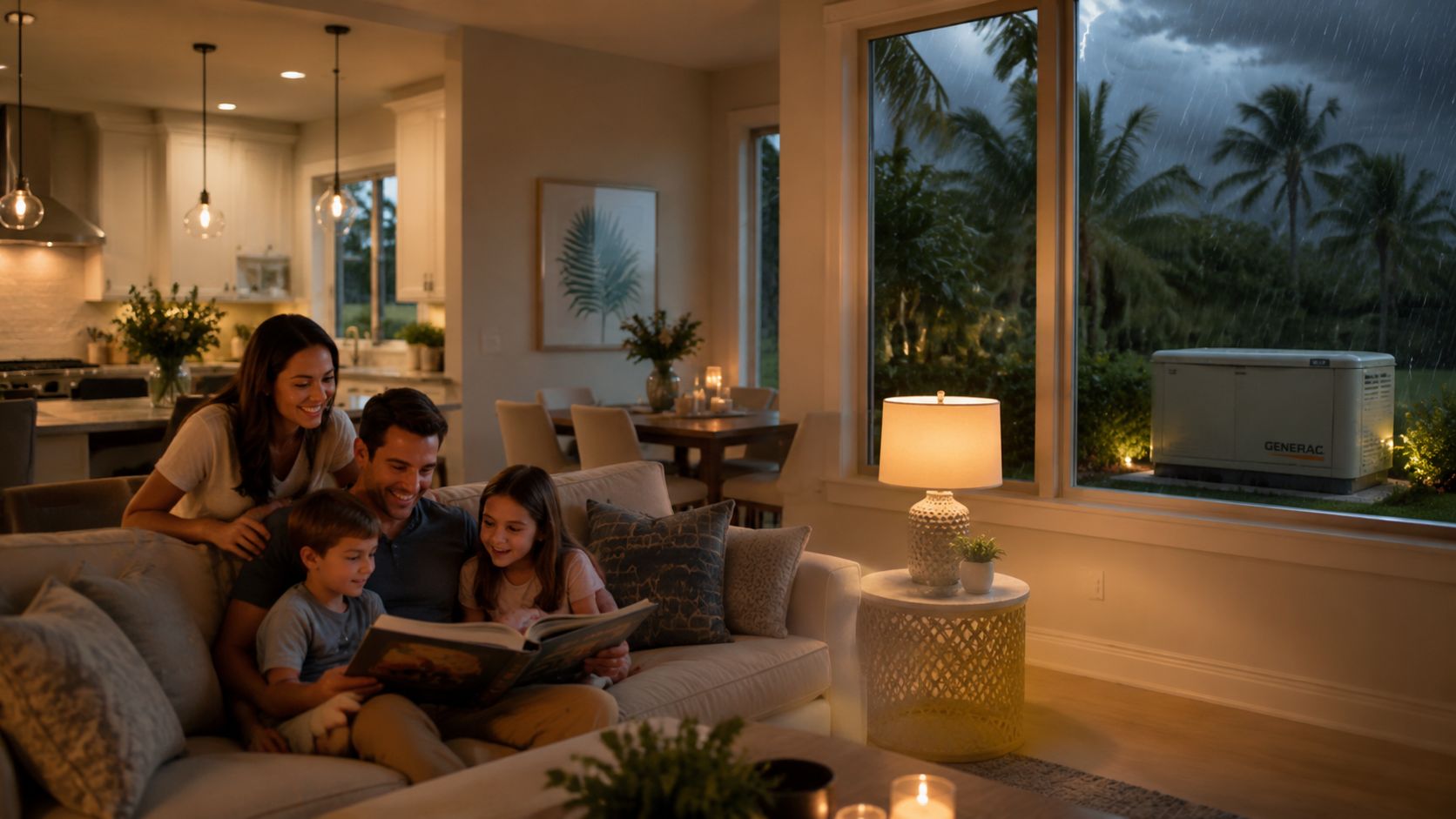
What makes a whole-house system different
A portable generator can keep a few things alive if you manage cords, fuel, startup, and load limits correctly. A whole-house generator is built for a different standard. It sits on a permanent pad, connects to a transfer switch, and responds automatically when utility power fails.
The key piece is the automatic transfer switch, often called the ATS. When the utility goes down, the ATS senses the interruption, isolates the home from the grid, and shifts the electrical load to the generator. When utility power returns and stabilizes, it transfers the home back. The homeowner doesn't need to step outside in wind or rain to make it happen.
Practical rule: If your backup power plan requires extension cords, manual fueling during bad weather, and a trip outdoors to start equipment, it isn't the same level of protection as a standby system.
Why Florida homeowners choose it
The value isn't only comfort. It's continuity.
- Food and refrigeration protection: Outages that stretch beyond a short window can turn a stocked refrigerator and freezer into a loss.
- Climate control: Florida homes trap heat and humidity quickly. Backup power helps protect both comfort and interiors.
- Safety systems: Gates, security devices, lighting, and communications are easier to maintain when the home stays energized.
- Daily life: Remote work, school, internet, charging, and basic routines stay far more manageable.
A standby generator also changes the homeowner's role during an emergency. Instead of scrambling, you're verifying that the system is working the way it was designed to. That shift matters during hurricane season, because the best emergency equipment is the equipment that doesn't require last-minute improvising.
Deconstructing the Whole House Generator Installation Cost
A Palm Beach County homeowner can hear “about ten grand” from one contractor and “closer to twenty” from another for what sounds like the same generator. In the field, those numbers often reflect two very different scopes. One quote may cover the generator, transfer equipment, permits, fuel work, startup, and correction of code issues. The other may only cover the box on the pad and basic hookup.
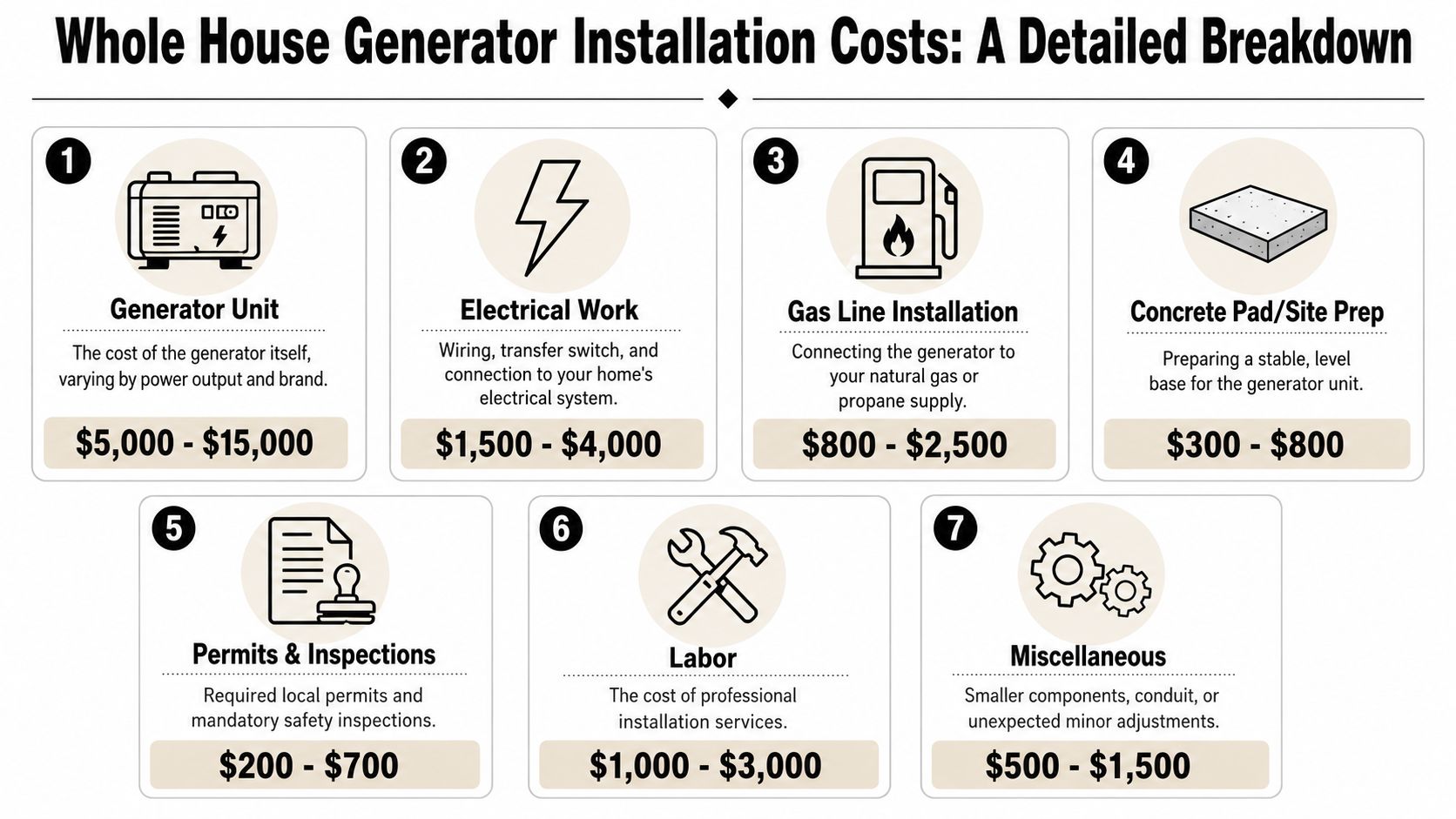
For Palm Beach County homes, the installed price is usually a stack of separate costs: the generator itself, the automatic transfer switch, electrical labor, fuel piping, pad or mounting work, permits, inspections, and any panel corrections needed to make the system safe and code-compliant. National pricing surveys often show broad installed ranges, but those averages do not capture local wind-load requirements, coastal corrosion concerns, flood-zone placement limits, or utility and municipal review that can affect Florida projects.
What the full job usually includes
The generator is only one line item. Equipment cost rises with output, enclosure type, and whether the homeowner wants essentials-only coverage or a system sized to carry larger air conditioning loads, pool equipment, elevators, or other major circuits. That is why a “whole house” label can be misleading. One home may need load shedding and careful circuit selection. Another may need a much larger unit and more switchgear.
Installation labor is the next major bucket. On a straightforward job, the crew can place the unit, set the transfer switch, pull feeders, make terminations, test the system, and finish startup without major obstacles. On a tighter lot or an older home, labor goes up fast because routing conductors, handling limited access, correcting existing panel issues, and coordinating inspections all take time.
Transfer equipment adds real cost too. The switch itself matters, but so does how it integrates with the existing service. Some homes can use a standard whole-house transfer setup. Others need service reconfiguration, load management modules, or work tied to a generator-ready electrical panel upgrade before a safe installation is even possible.
The charges that catch homeowners off guard
Fuel work is one of the biggest surprises. A quote can look reasonable until the gas route is measured in the field and the installer finds a long run, limited meter capacity, propane tank placement issues, or trenching that was not included on paper. For propane systems, tank size and runtime planning matter just as much as the generator size. Homeowners with larger properties sometimes look at broader fuel storage solutions for farms to understand storage trade-offs, but residential generator fuel setup still has to match local code, appliance demand, and the generator manufacturer's requirements.
The pad and site work can also shift the budget. A generator needs a stable, properly located base with required clearances from openings, utilities, and property lines. In Palm Beach County, placement is not only about convenience. It has to hold up in severe weather and pass inspection.
Then there is the existing electrical system.
Older panels, crowded gutters, improper grounding and bonding, corrosion, or undocumented prior work can turn a simple install into a corrective project. I would rather tell a homeowner that up front than leave it buried in a change order after the generator is already on site.
A low quote often means part of the project is missing. Fuel routing, permit costs, startup, load calculations, panel corrections, or final inspection are the usual omissions.
A practical cost breakdown
Use the project budget this way:
| Cost area | What it covers |
|---|---|
| Generator unit | The standby generator, enclosure, and factory features tied to capacity |
| Transfer equipment | Automatic transfer switch, load management components, and related hardware |
| Electrical labor | Placement, wiring, terminations, testing, startup, and inspection coordination |
| Fuel connection | Natural gas or propane piping, regulators, trenching, and utility or supplier coordination |
| Site prep | Pad, grading, mounting, setbacks, and location-specific preparation |
| Permits and inspections | Municipal review, permit fees, and final approval |
| Panel or service work | Corrections or upgrades needed for a safe, code-compliant interconnection |
The main point is simple. “Average cost” is not a job scope. A real estimate for a Palm Beach County generator installation should show what is included, what assumptions were made about the panel and fuel source, and what could change once the site is reviewed. That level of detail is what keeps a hurricane-season backup plan from turning into an unfinished project.
Major Factors That Influence Your Final Price Tag
A quote can look straightforward until the site visit starts. On one Palm Beach County home, the generator pad fits with a short gas run and a clean tie-in at the service. On the house next door, we may be dealing with long conduit runs, limited side-yard clearance, HOA placement restrictions, and an electrical panel that needs correction before we can connect anything safely. That difference is what separates a manageable install from a job that grows in labor, materials, and inspection time.
The biggest cost drivers are usually system size, fuel setup, generator location, and the condition of the existing electrical service. Those four items do more to set the final price than any national average.
Generator size drives both equipment and installation cost
Homeowners often start by asking for a "whole-house" generator, but that phrase means different things on different properties. A 2,000-square-foot home with one air conditioner and gas appliances has a very different backup load than a larger coastal home with multiple HVAC systems, pool equipment, electric water heating, or a lift.
Bigger units cost more to buy. They also tend to require larger transfer equipment, heavier conductors, more careful load planning, and in some cases changes to the fuel supply.
A practical way to approach sizing is to decide what must stay on during a multi-day outage and what can stay off. That usually falls into three categories:
- Critical loads only: Refrigeration, lighting, internet, security, garage access, and selected outlets
- Comfort coverage: Critical loads plus one air conditioner and more general household circuits
- Near full-house backup: Multiple large mechanical loads and broader circuit coverage with fewer compromises during an outage
In Palm Beach County, I advise homeowners to size for storm reality, not wishful thinking. If the plan is to stay in the home after a hurricane, the generator has to support the loads that make that practical.
Fuel type changes the job scope fast
Natural gas can be the simpler option if the meter capacity is adequate and the piping route is short and accessible. If the meter or gas piping cannot support the generator's demand, the fuel side becomes a separate upgrade project. That adds cost before the generator even arrives.
Propane gives more flexibility in areas without natural gas service, but it introduces tank placement, refill planning, and clearance considerations. On larger properties, homeowners sometimes look at broader storage planning ideas outside the generator context. This guide to fuel storage solutions for farms is useful because the same questions come up here. How much fuel is available on site, how easily can it be refilled after a storm, and where can it be placed safely?
Fuel work is one of the most common reasons a low initial quote does not hold.
Existing electrical conditions often decide whether the quote stays intact
The generator itself is only part of the job. The transfer switch, service equipment, grounding and bonding, breaker space, and panel condition all have to support a legal, safe interconnection.
If the panel is outdated, overcrowded, corroded, or poorly labeled, we may need to correct that first. Homeowners who are unsure about that part should review what an electrical panel upgrade for generator compatibility typically involves before they assume the generator quote covers everything.
Common electrical cost drivers include:
- Limited panel capacity: No clean space for the transfer equipment or generator feeder
- Service deficiencies: Existing conditions that need correction before inspection
- Long wiring runs: More conduit, wire, labor, and patching work
- Load management needs: Added controls when the requested generator size does not match the home's demand
Site conditions add labor in ways homeowners do not always see coming
Placement matters. A generator tucked close to the service and fuel source is usually less expensive to install than one located across a finished patio or behind dense landscaping. Finished surfaces, drainage issues, narrow access, and equipment setbacks all affect labor.
Hurricane exposure matters too. In Palm Beach County, the install has to hold up under storm conditions, salt air, and local inspection standards. That pushes the work beyond setting a unit on a pad and hooking up a few wires.
The final price usually rises for clear reasons. More distance, more corrections, more coordination, or more load to carry during an outage. A solid quote should make those variables visible before the project starts.
Palm Beach County Installation Rules You Cannot Ignore
A generator job in Palm Beach County can look straightforward on paper, then stall the moment the inspector reviews placement, clearances, or service conditions. That is usually where homeowners learn the equipment price and the installed price are two different numbers.
In this county, code drives the layout, the scope, and the schedule from day one. If the proposed location is too tight, if the fuel route is not acceptable, or if the existing electrical equipment will not pass, the plan has to change before the unit ever starts.
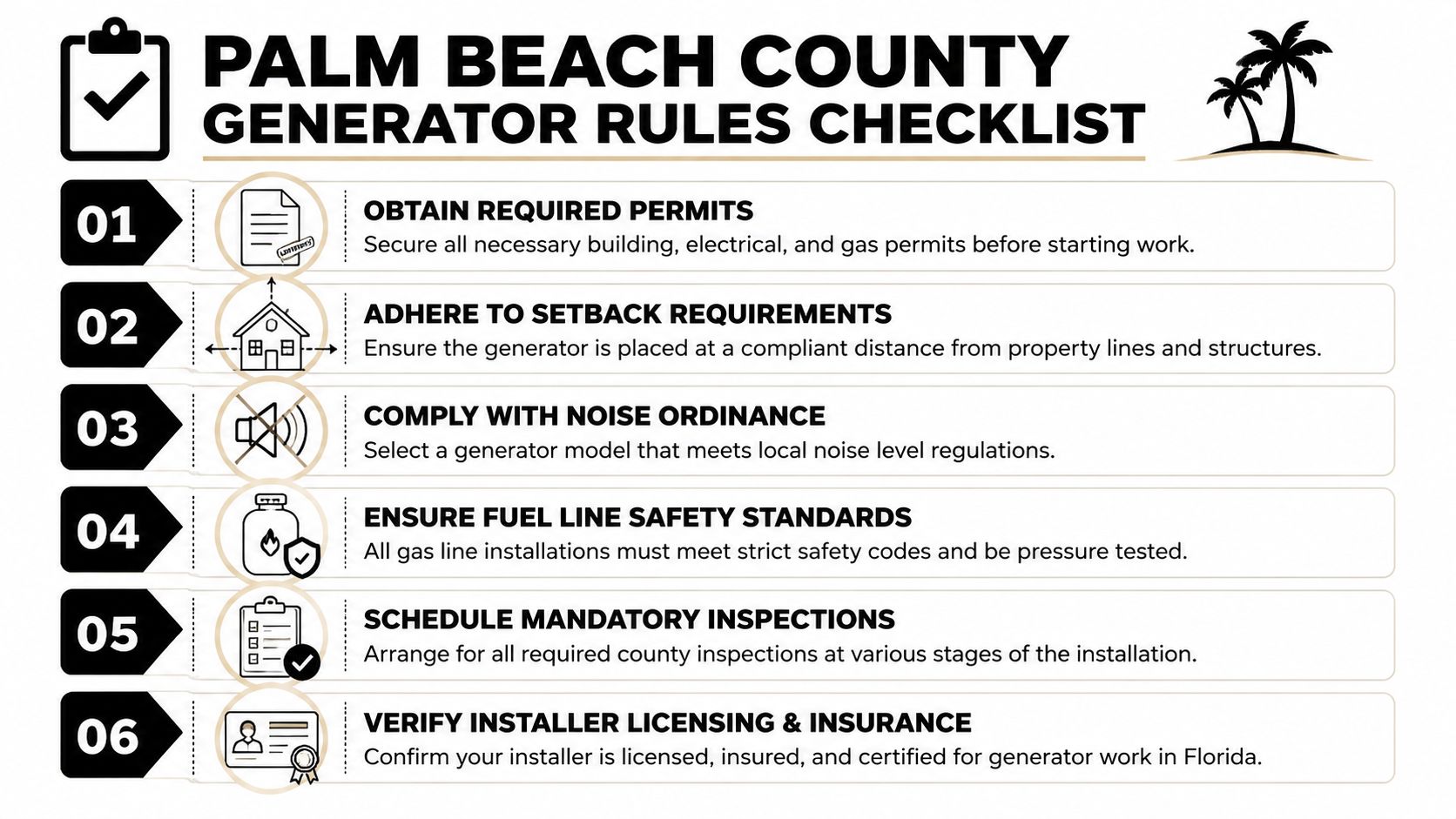
Code compliance is part of the job, not an afterthought
National cost articles tend to flatten the process. Palm Beach County does not. Here, local permitting, inspection standards, wind exposure, and property constraints can add real work that never shows up in a generic online estimate.
The usual pressure points are practical:
- Permit approvals: Electrical and fuel work need permits before installation begins.
- Setback and clearance review: The generator has to be placed far enough from openings, structures, property lines, and service paths to satisfy code and manufacturer requirements.
- Inspection scheduling: Rough and final inspections affect labor timing and project completion.
- Licensed trade coordination: Electrical and fuel work must be performed, documented, and signed off by the right licensed contractors.
Miss one of those items and the job can stop fast.
The local issues that change real costs
Palm Beach County homes bring site conditions that broad pricing guides skip. HOA review can limit placement. Tight side yards can rule out the shortest install path. Waterfront properties often bring added corrosion concerns and stricter thinking about long-term durability. Older homes may also need corrections before a generator can be tied into the service legally and safely.
Fuel routing is another common surprise. A short line on a sketch can turn into trenching around a pool deck, coring through masonry, or restoring finished surfaces after the piping and conduit are in. Those are not optional upgrades. They are part of getting the system installed in a way that passes inspection and holds up in storm season.
I also tell homeowners to look at the house as a system. If you are tightening the building envelope or reducing cooling demand, that can affect generator sizing and load planning. This article on spray foam insulation in Palm Beach County shows the same local pattern. Climate, code, and installation details change the actual cost.
Before you sign a contract, verify who is handling the electrical scope, permit package, and inspection follow-up. A qualified electrical contractor in West Palm Beach, FL should be able to explain the placement limits, identify likely correction items early, and put that scope in writing.
In Palm Beach County, cutting price without checking code usually leads to change orders, failed inspections, and return trips. The cheaper quote often costs more once the actual requirements show up.
From Quote to Power On A Realistic Timeline and Scenarios
A lot of Palm Beach County homeowners call after the first storm track shifts toward South Florida. At that point, everyone wants the same thing at once. A generator on site, permits approved, fuel connected, and the system ready before the next outage. Real projects rarely move that fast.
The actual timeline depends on three things. How clear the scope is at the start, how difficult the site is to build on, and how quickly permits, approvals, and equipment availability line up. In this market, hurricane season pressure changes schedules fast, so a realistic plan matters as much as the budget.
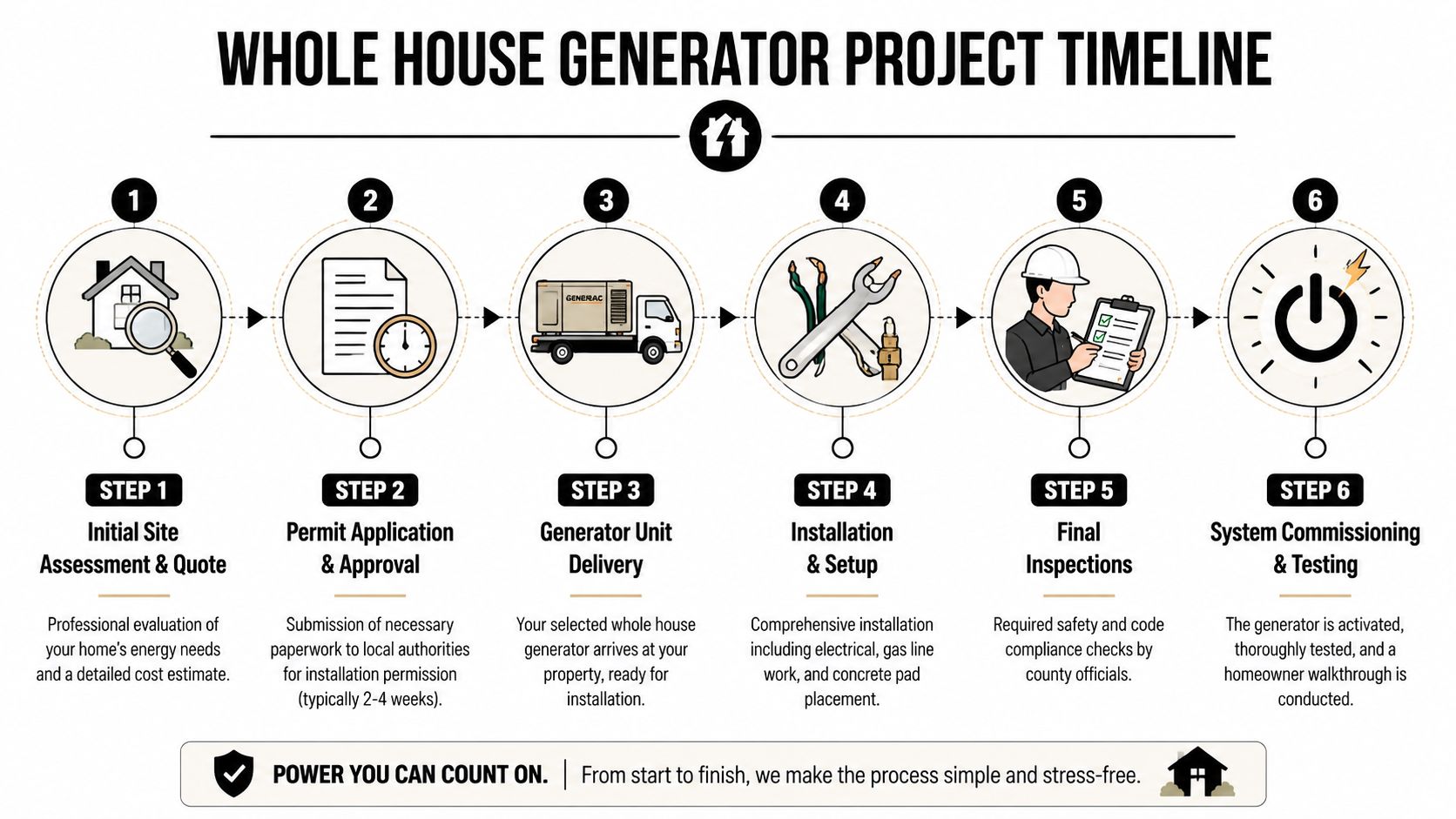
How the project usually moves
Most standby generator jobs follow the same broad sequence, but the time inside each phase can vary.
Site assessment and load review
We confirm what the homeowner wants to keep running, inspect the service equipment, review the fuel source, and identify placement limits before anyone talks seriously about final pricing.Formal quote and scope confirmation
A good proposal lists the generator size, transfer equipment, included electrical work, fuel scope, permit handling, and any correction items that could change the price after the wall is opened or the trench path is marked.Permit and approval phase
In Palm Beach County, this step can hold up an otherwise simple project. Municipal review, utility coordination, and HOA approval can all affect the start date.Site preparation
The pad area gets built or set, access is cleared, and trenching or wall penetrations are completed if the electrical and fuel routes require them.Electrical and fuel connection
The crew installs the transfer switch, feeders, grounding and bonding connections, control wiring, and fuel piping. Then each part gets checked against the approved scope and code requirements.Startup, testing, and walkthrough
The generator is commissioned, transfer operation is tested, alarms are checked, and the homeowner gets a clear explanation of exercise cycles, shutdowns, and service intervals. If problems show up later, prompt whole house generator repair service matters because a standby unit is only useful if it starts under load.
Scenario one essentials coverage in a typical family home
A common Palm Beach County project is a mid-sized home that wants the practical loads covered. Refrigerator, lights, internet, garage door, a few general-use circuits, and limited air conditioning. That approach usually controls both equipment size and installation scope.
These jobs move faster when the homeowner makes decisions early. Pick the priority loads. Approve a code-compliant location before plans are submitted. Accept panel corrections if the existing equipment is not ready for a transfer connection. Delays usually come from changes after the permit set is already in motion.
The price can still climb if the panel is full, the gas route is long, or the only acceptable generator location creates extra labor around hardscape, fencing, or narrow side-yard access.
Scenario two broader backup for a larger property
A larger coastal home usually brings a different level of work. Broader outage coverage means more load planning, larger equipment, longer conductor runs, and more coordination between electrical, fuel, and site crews. On some properties, the primary cost driver is the installation path, not the generator itself.
Homeowners need a practical view of the scope. A wider-coverage system often turns into a small infrastructure project. The work can include service modifications, longer trench runs, concrete or mounting work, selective subpanel changes, and tighter placement review because of setbacks or lot layout. Those details affect schedule just as much as they affect price.
A realistic schedule is built around approvals and readiness, not the day the unit is delivered.
The smoothest projects in Palm Beach County usually start well before peak storm activity. Homeowners who wait until a named storm is approaching often run into the same problems. Permit backlogs, equipment lead times, and overloaded installation calendars. That is why planning before hurricane season usually saves more frustration than chasing the lowest quote at the last minute.
The Long-Term View Maintenance ROI and Financing
A week after a hurricane, the installation price is no longer the only number that matters. The homeowners who feel prepared are the ones who understood the full ownership cost before the first outage, not after it.
A standby generator needs regular service if you expect it to start under load, carry the house safely, and transfer cleanly during bad weather. In Palm Beach County, that matters more than many national articles admit. Salt air, heat, storm exposure, and long stretches between real outage events all put pressure on batteries, fuel components, connections, and exercise performance.
Ownership costs continue after installation
Annual maintenance should be part of the budget from day one. That usually includes inspection, battery testing, fluid and filter service where applicable, exercise verification, transfer switch checks, and fault review. If the unit is connected to natural gas or propane, fuel system checks matter too. Skip service long enough and small issues turn into no-start conditions, nuisance alarms, or transfer problems at the worst time.
Fuel use is the other cost homeowners often underestimate. A larger unit protecting more of the house burns more fuel, especially during long summer outages when air conditioning is part of the plan. In Palm Beach County, that is a real design decision. Broader coverage gives more comfort, but it also raises operating cost during storm season.
Post-install support matters too. If the unit stops exercising, shows a fault, or fails to transfer properly, the fix should be handled quickly and correctly. Homeowners who want to see what that support looks like can review our whole-house generator repair services.
What the return looks like in real life
Generator ROI is practical, not theoretical.
It shows up when the refrigerator stays cold, the house stays habitable, the internet stays up, and a family member using medical equipment does not have to relocate. It also shows up when you avoid hotel costs, food loss, work disruption, and the scramble to find fuel, extension cords, or a safe place to stay after a major storm.
For some households, the return is convenience. For others, it is risk reduction.
A good ROI conversation starts with the house and the family, not a resale formula:
- What has to stay on: Air conditioning, refrigeration, medical devices, well pumps, gate access, security, or home office equipment.
- How long outages affect you: A short outage and a multi-day post-storm outage create very different cost and comfort problems.
- What level of backup you are paying to maintain: Whole-home coverage costs more to install, service, and fuel than a system built around selected circuits.
- How prepared you want to be before hurricane season: Waiting until outages are already happening usually limits your options and increases stress.
Financing can make sense, especially for homeowners who want the protection in place before the next storm cycle. The key is to evaluate the full project cost, including service and fuel, instead of focusing only on the monthly payment. A cheaper payment structure does not fix poor sizing, bad placement, or corners cut on code compliance. In this county, a generator is part emergency equipment, part mechanical system, and part electrical infrastructure. It pays off best when the installation is designed to hold up in real Florida conditions.
Frequently Asked Questions About Generator Installation
Can I install a whole-house generator myself
No practical professional answer is yes here. A standby generator connects to your home's electrical system, transfer equipment, and fuel supply. It involves permitting, code compliance, and inspection. In Palm Beach County, DIY work on a whole-house standby system is exactly where homeowners create unsafe conditions, inspection failures, and insurance problems.
Will a generator run my entire home
It can, but only if it's sized and designed for that goal. Some systems are built for essential circuits only. Others are designed for broader coverage. The right answer comes from a load calculation and a real conversation about what must stay on during an outage versus what would be nice to have.
How loud is a whole-house generator
Noise varies by unit, installation location, and property layout. In practice, placement matters almost as much as the equipment itself. A poor location can make a reasonable unit seem intrusive. A well-planned location can reduce homeowner and neighbor frustration significantly, while also helping with service access and local compliance.
What should I have ready before asking for a quote
Bring clear priorities, not just a budget.
- Your outage priorities: Tell the contractor whether you want essentials-only coverage or a broader whole-home approach.
- Property details: Mention HOA restrictions, narrow side yards, waterfront exposure, or hardscape that may affect routing and placement.
- Known electrical issues: If breakers trip, the panel is old, or previous work was never cleaned up, say so up front.
- Fuel information: Share whether the home has natural gas, propane, or a likely need for new fuel infrastructure.
A good quote starts with honest conditions at the house. That's what keeps the project from turning into a change-order parade after the work begins.
If you're preparing for hurricane season and want a quote built around real Palm Beach County conditions, Lighthouse Energy Services can help you assess your home, identify hidden scope before installation starts, and plan a standby generator system that's safe, code-compliant, and ready when the grid goes down.