
You're usually not searching for a commercial electrician near me because everything is running smoothly. You're searching because a tenant lost power, a panel is overheating, an inspector flagged something, a remodel is stalled, or your maintenance team found a problem that can't wait until next week.
In Palm Beach County, the cost of hiring the wrong electrician rarely shows up on the first invoice. It shows up later as failed inspections, tenant complaints, repeat service calls, equipment damage, permit trouble, and after-hours emergencies that drag into the next business day. Cheap work often becomes expensive work.
That matters in a state where the electrical trade is large and still expanding. As of 2026, Florida's electricians industry includes 21,305 businesses, generates $18.2 billion in market size, and employs 87,887 people, with business growth averaging 4.5% annually from 2021 to 2026 and employment growth averaging 3.7% according to IBISWorld's Florida electricians industry data. A bigger market gives you more options. It also gives you more room to pick the wrong one.
Table of Contents
- What Differentiates a Commercial Electrician from a Residential One
- The Critical Guide to Florida Electrical Licenses and Insurance
- Core Commercial Electrical Services Your Property Will Need
- Evaluating 24/7 Emergency Response What to Look For
- Understanding Commercial Electrician Pricing and Quotes in Palm Beach
- The Hiring Checklist Questions to Ask Before You Commit
- Why Palm Beach Businesses Trust Lighthouse Energy Services
What Differentiates a Commercial Electrician from a Residential One
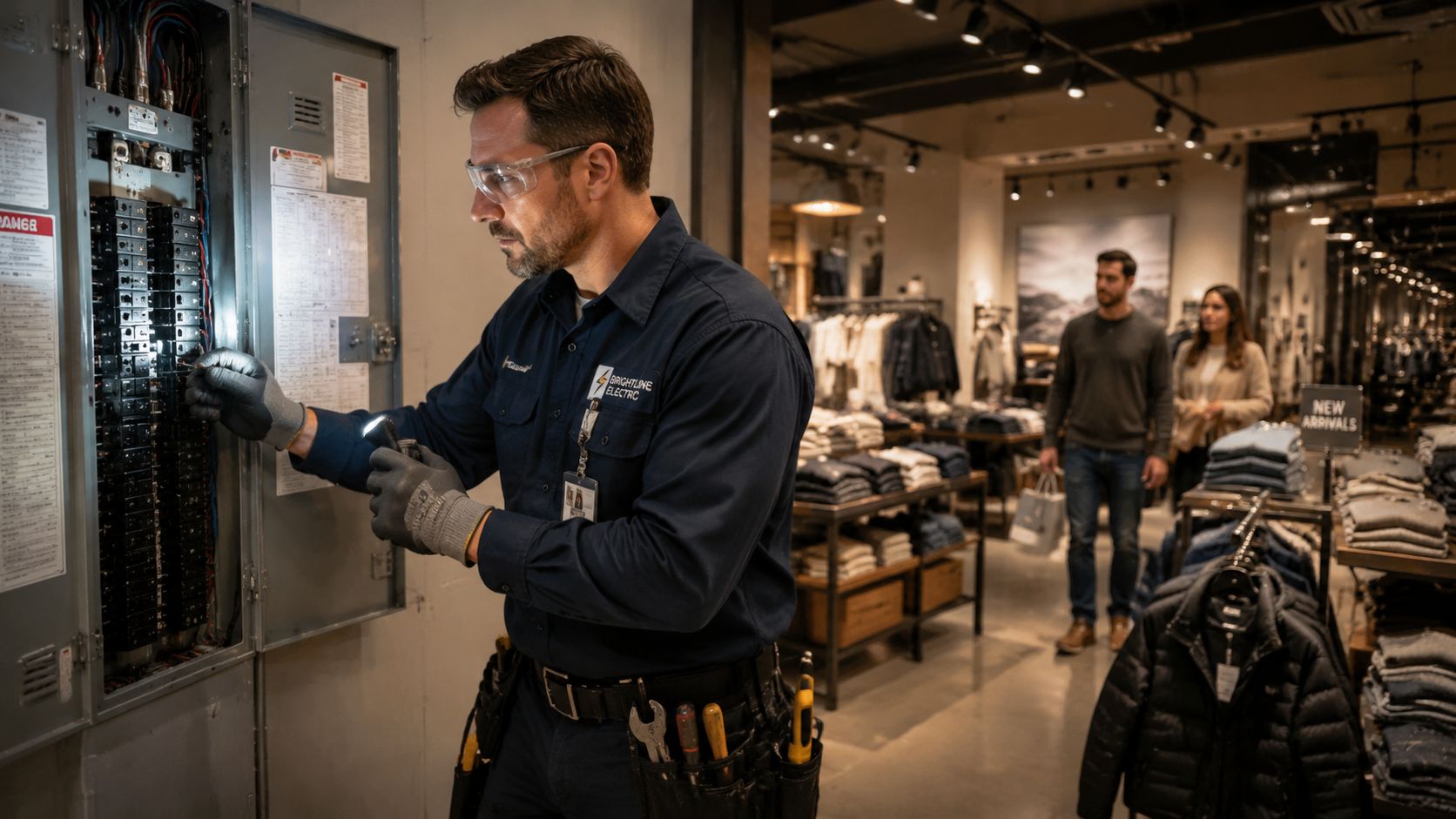
A retail store loses half its lighting at noon. Registers still work, but fitting rooms are dark, a breaker is warm, and employees are trying to keep customers away from one section of the floor. That's not the moment to learn that the electrician you called mainly wires kitchens and replaces ceiling fans.
Commercial electrical work isn't just residential work in a bigger building. It's a different environment with different failure points, different code demands, and different operational consequences.
Why the stakes are different
In a house, an outage is disruptive. In a commercial property, an outage can stop sales, interrupt refrigeration, knock out access systems, disable workstations, and create immediate liability if lighting or emergency circuits are affected.
A residential electrician may be excellent at dwelling-unit service work and still be the wrong fit for a tenant space, office suite, warehouse bay, restaurant, or mixed-use property. Commercial systems often involve heavier loads, more complicated panel schedules, longer conduit runs, dedicated equipment circuits, control wiring, and stricter coordination with inspections and other trades.
Practical rule: If the job affects business continuity, tenant operations, shared building systems, or permit-driven build-out work, treat it as commercial from the first phone call.
That's also why property managers shouldn't assume a contractor who handles residential electrical services in Palm Beach County is automatically the right crew for a commercial panel issue, tenant improvement, or code-sensitive retrofit.
What commercial work actually involves
Commercial electricians deal with systems that have to support operations, not just occupancy. That changes the work in several ways:
- Load planning matters more: A storefront with lighting, POS stations, signage, HVAC-related power needs, refrigeration, or specialized equipment can't be wired by guesswork.
- Conduit and routing are part of the job: In many commercial spaces, exposed work has to be neat, protected, serviceable, and compliant.
- Downtime has a price: The best repair isn't only safe. It also restores function without creating another shutdown next week.
- Inspections carry more operational weight: A failed inspection on a tenant build-out can affect opening schedules, contractor coordination, and lease obligations.
Here's the simplest way to think about it:
| Work type | Residential focus | Commercial focus |
|---|---|---|
| System demand | Daily household use | Continuous business operation |
| Typical consequence of mistakes | Inconvenience, nuisance trips | Downtime, inspection issues, business interruption |
| Installation environment | Homes and small-scale remodels | Occupied tenant spaces, offices, retail, warehouses |
| Coordination required | Homeowner and maybe one trade | Property manager, inspector, GC, tenants, multiple trades |
A strong commercial electrician also thinks past the immediate fix. If a breaker failed, the question isn't only which breaker to replace. The core question is what caused the failure, whether the load is appropriate, whether heat damage traveled, and whether another problem is waiting one circuit over.
That's the difference between service that closes a ticket and service that protects a building.
The Critical Guide to Florida Electrical Licenses and Insurance
If you only ask, “Are you licensed?” you haven't asked enough. In Florida, the type of license matters. The jurisdiction matters. The insurance matters. And whether the contractor pulls permits before starting matters.
Certified versus Registered in Florida
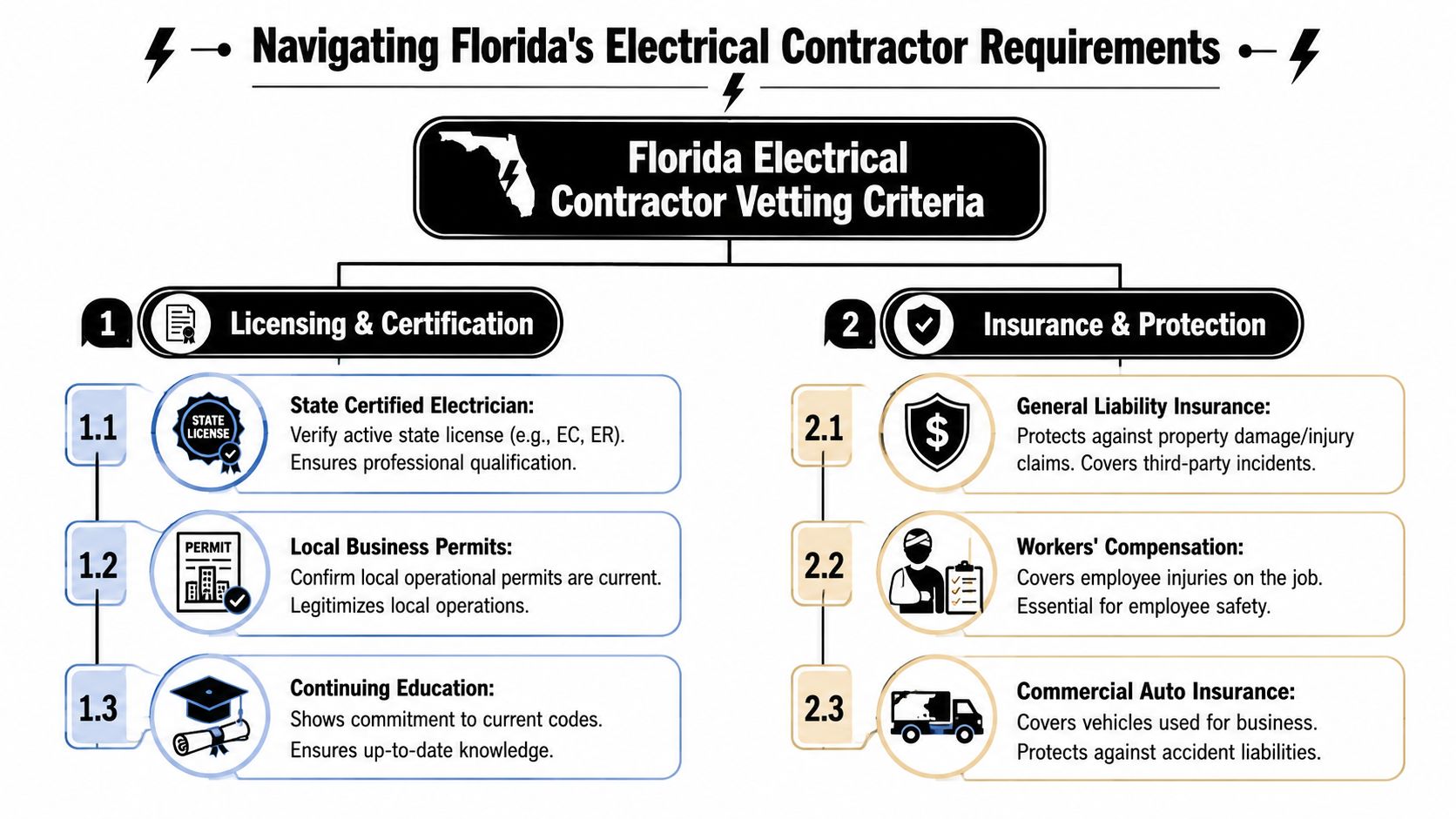
For commercial work in Florida, an electrical contractor must hold either a Certified Electrical Contractor license or a Registered Electrical Contractor license. According to Palm Beach contractor licensing guidance for electrical contractors, a Certified contractor has statewide authority through the Florida Electrical Contractors' Licensing Board, while a Registered contractor is limited to the local jurisdiction that issued the registration.
That's not paperwork trivia. It affects whether the contractor is legally positioned for the job you're hiring out.
A good hiring conversation sounds like this:
- For multi-site owners: “Can you legally perform this work across our properties if the scope expands?”
- For Palm Beach property managers: “Is your license active for this jurisdiction and this type of work?”
- For permit-driven jobs: “Who is pulling the permit, and whose license is attached to it?”
A contractor who gets vague when you ask for a license classification usually gets vague in other places too.
Florida also requires more than a card number. The same licensing framework requires contractors to pass a state exam, provide proof of general liability insurance and workers' compensation, and pull permits through the applicable building department before work begins. Those requirements exist to reduce the risk of code violations, unsafe work, and unaccountable operators.
If you want a second safety perspective outside Florida-specific licensing, this overview of electrical safety for Canadian workplaces is useful because it reinforces a universal point: electrical work is never just about getting power back on. Arc flash exposure, PPE expectations, and task planning all matter when people are working on energized or potentially energized systems.
For local vetting standards, a licensed electrical contractor in Palm Beach County should be able to explain credentials clearly, not dance around them.
What the insurance paperwork is really protecting you from
Property owners often ask for certificates of insurance because they know they should. Fewer ask what those policies protect against.
General liability insurance matters if the contractor damages property, creates a condition that leads to a claim, or causes loss tied to the work. Workers' compensation matters if someone on the crew gets hurt on your site. If a contractor doesn't carry proper coverage, that problem can start walking toward your side of the table fast.
Use this quick filter before awarding a job:
- Ask for matching business names: The license holder and insured entity should line up with the company on the proposal.
- Check date validity: Expired insurance paperwork is the same as no usable paperwork.
- Confirm permit responsibility: If they say permits aren't necessary before they've seen the full scope, slow down.
- Watch for borrowed credentials: One of the oldest tricks in this trade is someone selling under a name that isn't the actual crew doing the work.
The hidden liability isn't only unsafe wiring. It's hiring someone who leaves you holding the administrative and legal mess after a bad outcome.
Core Commercial Electrical Services Your Property Will Need
Most commercial clients first call for a problem. The better ones eventually build a relationship around prevention, upgrades, and long-term planning. That's where real value shows up.
Build-outs and infrastructure that have to be right the first time
Commercial build-outs in Palm Beach County aren't guess-and-go jobs. They require planning around code, equipment needs, layout, future use, and inspection. According to Palm Beach County commercial build-out specifications summarized here, typical minimum infrastructure standards include 200-amp service panels, 120V/20A circuits spaced every 12 feet for outlets, LED flat panels with 0-10V dimming, and one data drop per work desk. The same reference gives a practical example: a 22' x 14' woodworking shop requires three 120V/20A circuits with outlets spaced to support simultaneous tool use.
Those details tell you something important. Commercial electrical work is built around actual use. A good contractor doesn't ask only where you want receptacles. They ask what equipment is going there, how the space will operate, what can run at the same time, and whether expansion is likely.
Common commercial infrastructure work includes:
- Tenant build-outs: New office suites, retail interiors, medical spaces, and reconfigured layouts.
- Panel and service upgrades: Needed when the existing gear no longer supports present loads or code expectations.
- Dedicated circuits: Critical for equipment that can't share loads safely or reliably.
- Lighting layout and controls: Especially when fixture performance, dimming, and energy use affect operations.
Good build-out work feels boring after occupancy. That's a compliment. Lights work, circuits hold, inspections pass, and no one thinks about the electrical system because it was designed correctly.
Repairs, upgrades, and operational efficiency
Not every job is a new build-out. Many of the most important calls happen in occupied buildings where work has to be clean, fast, and coordinated around tenants or business hours.
A capable commercial electrician should routinely handle:
Troubleshooting and repair
Breaker trips, dead circuits, failed lighting, overheated connections, damaged devices, and intermittent power issues.Lighting retrofits
LED conversions, fixture replacements, control updates, and exterior lighting improvements for better reliability and lower maintenance.Preventive maintenance
Panel inspections, torque checks where appropriate, identification of heat or wear issues, and correction of small defects before they become outages.Specialized compliance-driven work
Some facilities need niche electrical services that carry serious safety or regulatory consequences if ignored. Rooftop and tower-related lighting is one example. If your property has structures that require obstruction lighting, you need a contractor who understands that this isn't cosmetic work. It's operational and compliance-sensitive.Efficiency-focused upgrades
A strong contractor should also look at operating cost, not just repair cost. In practice, that can include lighting optimization and controls, as well as devices such as the Smartcool ECO3 when appropriate for HVAC-related efficiency planning.
What doesn't work is hiring one electrician for emergencies, another for build-outs, and a third for upgrades, with none of them documenting the system the same way. Properties run better when one qualified commercial team understands the history of the panels, the tenant changes, the repeated trouble spots, and the future needs.
Evaluating 24/7 Emergency Response What to Look For
The worst time to discover a contractor's “24/7 service” is really a voicemail box is during an outage after hours. By then, your choices are already shrinking.
The difference between a real emergency service and an answering service
A real emergency response starts with the first call. Someone answers. That person can gather useful information, identify immediate hazards, and move the problem toward action. A fake emergency service takes a message, promises a callback, and leaves your facility team guessing whether they should wait, shut down, or start calling around again.
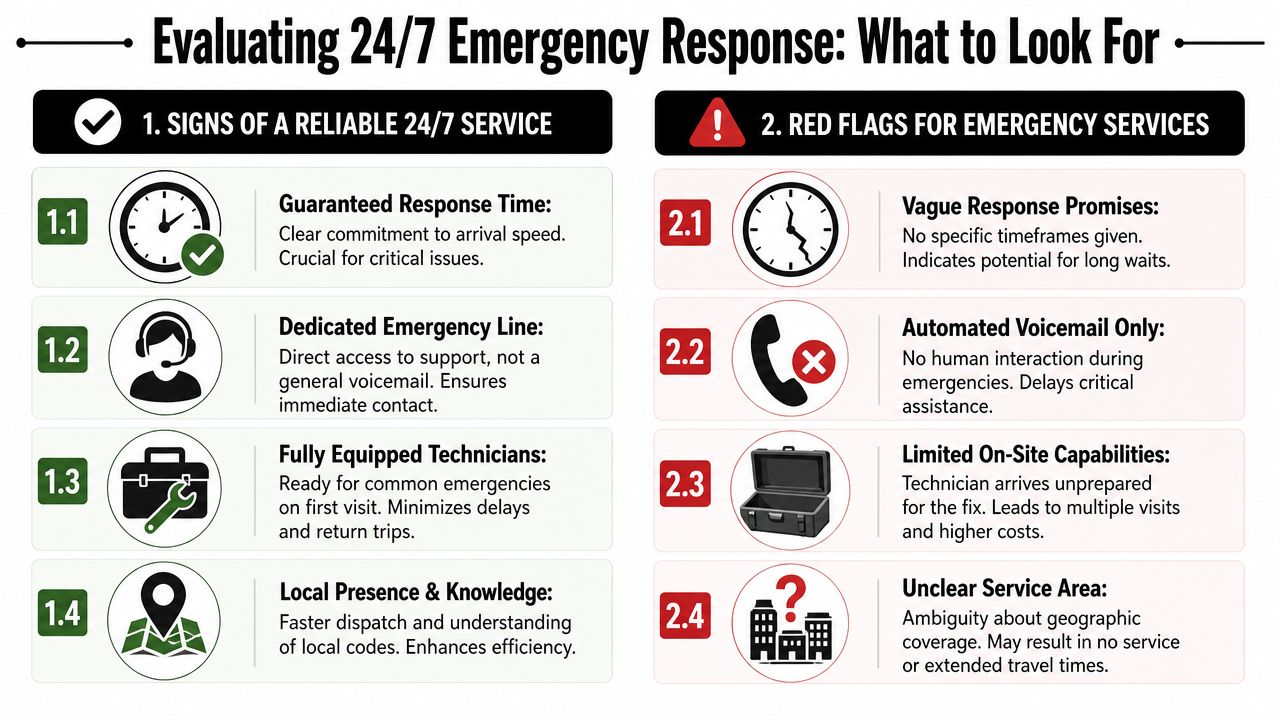
That distinction isn't theoretical. According to BBB directory context for low-voltage and electrical contractors in a major metro, over 60% lacked accreditation or verified licensed-on-call protocols, and 45% of commercial electrical complaints in Atlanta were tied to after-hours service failures or unlicensed responders. Different market, same lesson. “Open 24 hours” on a website doesn't prove licensed emergency coverage.
Here's how the two scenarios usually play out:
| Situation | Weak provider | Real emergency provider |
|---|---|---|
| After-hours call | Voicemail or generic dispatch | Live answer with trade-aware intake |
| First guidance | “Someone will call you back” | Immediate questions about panel status, affected loads, hazards |
| Dispatch confidence | Unclear who is coming | Clear accountability for who responds |
| Outcome | Delay, uncertainty, repeat calls | Faster containment and cleaner handoff to repair |
If your property also deals with storm-related events, this local guide to storm damage repair is worth keeping in your broader emergency file because electrical issues often show up alongside roof, water, and structural problems after severe weather. Good facility response depends on knowing which specialist to call first and which hazards require immediate isolation.
For electrical-specific response planning, this Palm Beach emergency electrician guide gives a practical baseline for what emergency readiness should look like.
Questions that expose weak emergency coverage fast
Don't ask, “Do you offer 24/7 service?” Every contractor knows the right answer to that one. Ask questions that are harder to bluff.
Who answers the phone at night?
Good answer: a trained person who can take real job information and escalate correctly.
Bad answer: a generic service that only forwards messages.Can you explain your emergency dispatch process?
Good answer: they can describe how calls are triaged and what happens next.
Bad answer: they stay vague.What should my staff do before your technician arrives?
Good answer: they give clear, safety-first instructions based on the situation.
Bad answer: they have no field-ready guidance.
If the company can't explain its emergency process in plain English, it probably doesn't have one.
- Do you handle occupied commercial buildings after hours?
Good answer: yes, and they can talk through access, shutdown coordination, and tenant impact.
Bad answer: they mainly “try to fit emergencies in.”
A property manager doesn't need a slogan. You need a response system.
Understanding Commercial Electrician Pricing and Quotes in Palm Beach
Price matters. It just isn't the first thing that matters. A low number with weak scope, no permit clarity, and no accountability is where expensive problems start.
What you are actually paying for
Labor is only one part of a commercial quote, but it helps anchor expectations. In West Palm Beach, the average hourly pay for a commercial electrician was $25.13 as of June 25, 2026, and in the broader U.S., electricians earned an average annual wage of $64,190 in May 2023, according to ZipRecruiter's West Palm Beach commercial electrician pay data.
That wage data is not the same thing as your billable rate. Your invoice also reflects overhead, dispatching, stocked vehicles, supervision, insurance, licensing, permit administration, time spent diagnosing, and the risk the contractor takes when standing behind the work.
A commercial quote may include:
- Labor time: Troubleshooting, installation, testing, coordination, and cleanup.
- Materials: Devices, breakers, conduit, wire, fittings, panels, fixtures, or specialty components.
- Access difficulty: Occupied space work, after-hours scheduling, roof access, lift use, or restricted areas.
- Administrative burden: Permit handling, inspection coordination, and documentation.
What a professional quote should include
A good quote removes confusion before the work begins. It should tell you what is included, what is excluded, and what conditions could change the price.
Look for these elements:
- Defined scope of work: Not “electrical repairs as needed,” but a description of the actual task or investigation.
- Material clarity: Enough detail to understand what level of equipment or replacement is being provided.
- Labor basis: Fixed-price task, time-and-materials, or estimate pending further discovery.
- Permit language: Whether permits are included, excluded, or to be determined after review.
- Payment terms: Clear billing schedule and what triggers additional work authorization.
- Warranty language: Written acknowledgment of what the contractor stands behind.
A vague quote gives the contractor room to improvise. A detailed quote gives both sides a standard to manage the job.
Watch for red flags that usually cost more later:
- Big promises with tiny scope
- No written exclusions
- No permit discussion on permit-likely work
- Pressure to approve immediately
- Line items so vague you can't tell repair from replacement
The best quote isn't the cheapest. It's the one that accurately describes the job you have.
The Hiring Checklist Questions to Ask Before You Commit
Most hiring mistakes happen before the first wrench turns. A short, direct interview will tell you a lot.
Questions about credentials
Ask these before discussing price in detail.
Can you provide your license information and proof of insurance?
A solid contractor sends it without hesitation. A weak one gives excuses, delays, or sends documents that don't match the company name on the proposal.Who pulls the permit if the scope requires one?
The right answer is clear and confident. A bad answer usually tries to make permits sound optional before the contractor has even reviewed the work fully.Have you done this kind of commercial work in occupied spaces?
You want specifics about operational constraints, scheduling, shutdown planning, and inspection handling. Generic “yes, we do everything” answers don't count.
Questions about operations and accountability
These tell you whether the company can support your property after the estimate is accepted.
Who answers your phone after hours?
Good answer: a real person with a defined emergency process.
Red flag: “Leave a message and someone will get back to you.”Will the quote be fixed price or subject to field conditions?
Good answer: they explain what is known, what is unknown, and how changes get approved.
Red flag: they promise certainty on a troubleshooting-heavy job without any limits or process.How do you document changes or hidden conditions?
Good answer: written approval before additional billable work.
Red flag: “We'll sort it out later.”What does job closeout look like?
Good answer: testing, cleanup, permit sign-off where applicable, and communication about what was repaired or replaced.
Red flag: no defined completion process.
Hire the contractor whose answers reduce uncertainty, not the one who talks fastest.
A search for a commercial electrician near me should end with verification, not hope. If the answers sound slippery before the contract is signed, they won't get sharper once your building is down.
Why Palm Beach Businesses Trust Lighthouse Energy Services
A property manager reading this guide usually wants one thing in the end. Not marketing. Not slogans. A contractor that checks every box that matters when the job is critical.
Lighthouse Energy Services fits that standard because the company's operating model lines up with what commercial clients need in Palm Beach County: licensed work, clear communication, emergency availability, local experience, and pricing that doesn't turn into a shell game after the truck arrives.

What this looks like in practice
The company has served Palm Beach County since 2005 and is backed by a team with more than 100 years of combined expertise. That matters because commercial service work depends on judgment as much as labor. The contractor has to recognize patterns, diagnose cleanly, and know when a simple-looking symptom points to a deeper system issue.
Lighthouse Energy Services also offers true 24/7 availability with phones answered by licensed electrical professionals, not just a generic message service. For a business owner or facility manager, that changes the entire first hour of an emergency. The call starts with useful triage instead of dead air.
Other factors stand out too:
- No extra charges for after-hours calls: That removes one of the most common reasons clients hesitate during a real emergency.
- Broad commercial capability: Repairs, upgrades, installations, emergency troubleshooting, and specialized aircraft obstruction lighting.
- Efficiency mindset: The company also installs the Smartcool ECO3 device, which can improve air conditioner efficiency and reduce electricity consumption by up to 25 percent when appropriate.
- Local coverage: Service spans Palm Beach County from Boca Raton to Jupiter.
Why that matters to a property manager
The right contractor doesn't just solve isolated electrical problems. They lower management friction. They show up on time, explain the issue clearly, quote the work transparently, and do the repair or installation in a way that supports long-term reliability.
That matters even more in commercial settings where every bad handoff creates another phone call for the property team. If a vendor is hard to reach, vague about scope, weak on emergency response, or casual about compliance, the burden lands on the owner, manager, or tenant representative.
Lighthouse Energy Services has built trust by doing the opposite. Prompt response. Professional communication. Work rooted in safety and experience. And an understanding that many electrical calls aren't convenience issues. They're business continuity issues.
If you've been searching for a commercial electrician near me in Palm Beach County, that's the benchmark worth using.
If you need a contractor that can handle commercial repairs, emergency response, upgrades, and compliance-sensitive electrical work without games, contact Lighthouse Energy Services. They serve Palm Beach County with licensed expertise, true 24/7 support, transparent pricing, and the kind of workmanship that protects your property for the long haul.